LNC SHOP
- Professional Development for LNCs |
- Legal Nursing Consulting Resources |
- Professional Field Guides |
- Clinical Investigation |
- Private Investigator Training |
- The Chart Files |
- LNC Training |
- LNC Professional Resources |
- Patient Resources |
- Consumer Guides |
- Professional Education for LNCs |
- LNC Tools & Resources |
- Medical Record Review |
- AI & Technology |
- Legal Nurse Consulting |
- Guides |
- Free Resources |
Filters
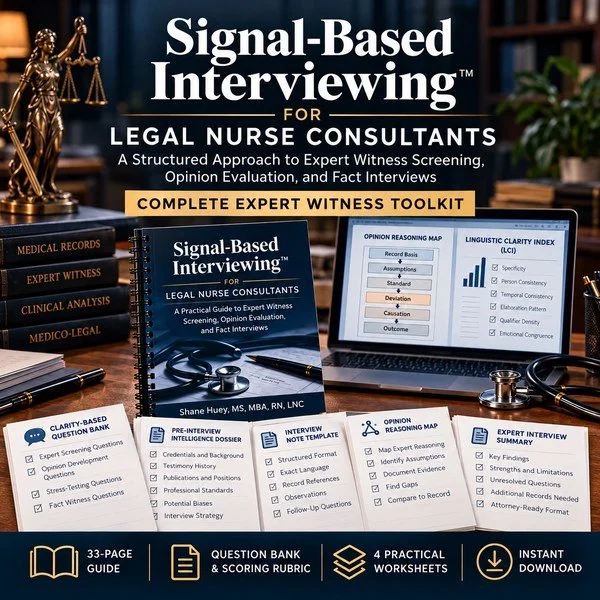
Your Expert's Credentials Are Impressive. But Can Their Opinion Withstand Scrutiny?
You've reviewed the curriculum vitae. Verified the credentials. Examined the publications and testimony history.
The expert appears qualified.
But qualifications are only the beginning.
What happens when the expert's opinion is compared against the actual medical record?
Can the expert identify the documentation supporting each conclusion? Distinguish established facts from assumptions? Explain the clinical reasoning connecting a deviation from the standard of care to the alleged outcome?
And can you identify weaknesses in that reasoning before they become problems during deposition or litigation?
That's the problem Signal-Based Interviewing™ was designed to address.
Introducing Signal-Based Interviewing™ for Legal Nurse Consultants
A structured, evidence-focused approach to interviewing experts and witnesses in medico-legal investigations.
Developed by Shane Huey, MS, MBA, RN, LNC, Signal-Based Interviewing (SBI) provides legal nurse consultants with a repeatable framework for preparing, conducting, documenting, and analyzing investigative interviews.
Rather than relying on general impressions, SBI emphasizes observable language, documented reasoning, clinical records, and independent corroboration.
The methodology addresses three essential areas of legal nurse consulting:
1. Expert Witness Screening
Move beyond credentials and experience to explore how prospective experts approach clinical records, articulate professional standards, and develop opinions.
2. Expert Opinion Development and Evaluation
Examine the factual foundation, assumptions, clinical standards, alleged deviations, causation reasoning, and outcomes supporting an expert's conclusions.
3. Client, Patient, and Fact Witness Interviews
Use structured, non-leading questions to document accounts, identify areas requiring clarification, and compare material statements against the available clinical record.
The result is a more systematic investigative process — one that helps you ask better questions, identify evidentiary gaps, and communicate meaningful findings to the retaining attorney.
Two Complementary Tools. One Structured Method.
The Linguistic Clarity Index (LCI)
Evaluate how an account or opinion is expressed.
The LCI provides a structured observational framework for documenting six dimensions of interview language:
Specificity
Person Consistency
Temporal Consistency
Elaboration Pattern
Qualifier Density
Emotional Congruence
For expert interviews, these dimensions are adapted to examine record anchoring, opinion ownership, chronology, reasoning, certainty calibration, and advocacy.
The LCI helps organize observations and identify areas requiring further questioning.
Important: The LCI is an author-developed observational rubric, not a validated test of deception, credibility, clinical competence, or opinion reliability. Its numerical ratings and categories are provisional organizational tools.
The Opinion Reasoning Map
Evaluate what an expert's opinion actually rests on.
The Opinion Reasoning Map organizes expert analysis around six interconnected elements:
Record Basis → Assumptions → Standard → Deviation → Causation → Outcome
Use this framework to:
Identify unsupported or contradicted assumptions.
Examine whether conclusions are grounded in specific clinical records.
Distinguish professional standards from personal preferences.
Identify missing evidence and unresolved questions.
Examine competing explanations and limitations.
Document findings for attorney review.
The framework is informed by the reliability considerations associated with expert testimony, including Federal Rule of Evidence 702, while recognizing that admissibility decisions belong to the court and legal strategy belongs to the attorney.
The goal isn't to replace professional judgment. It's to make the investigative process more structured, transparent, and documented.
What's Included in the Complete SBI™ Expert Witness Toolkit?
Your digital download includes seven professional resources, plus a brief introductory README.
What You'll Receive
1. SBI™ for Legal Nurse Consultants — Complete Guide A 33-page guide covering the methodology, expert screening, opinion evaluation, fact interviews, documentation, professional boundaries, and a worked clinical example.
2. Clarity-Based Question Bank Structured interview questions for expert screening, retained opinion development, stress-testing, and fact witnesses, with explanations of how the questions are framed.
3. Linguistic Clarity Index Scoring Rubric Behaviorally anchored scoring criteria, expert and fact-witness examples, and printable scoring and profile sheets.
4. Worksheet A — Pre-Interview Intelligence Dossier A six-domain framework for investigating prospective experts, documenting sources, and developing interview questions.
5. Worksheet B — Interview Note Template A structured template for capturing responses, exact language, record references, and observations during interviews.
6. Worksheet C — Opinion Reasoning Map A practical tool for mapping opinion support, documenting assumptions, identifying reasoning gaps, and aligning witness accounts with records.
7. Worksheet D — Expert Interview Summary A structured format for presenting documented findings, unresolved questions, and additional records needed to the retaining attorney.
Bonus: A Read Me First document explains how the resources work together and recommends a workflow for each interview type.
All materials are provided as downloadable PDFs. Worksheets are designed for US Letter printing.
Who Is This Toolkit For?
The SBI™ Expert Witness Toolkit is designed for practicing legal nurse consultants who participate in expert witness screening, clinical case analysis, or investigative interviews.
It is particularly relevant for LNCs who:
Screen or evaluate prospective expert witnesses.
Assist attorneys with expert opinion development.
Review medical malpractice and professional negligence cases.
Interview clients, patients, family members, or fact witnesses.
Identify inconsistencies between statements and medical documentation.
Prepare structured investigative findings for attorney review.
Experience level: Intermediate to advanced.
Familiarity with medical records, professional negligence litigation, and expert witness practice is recommended.
Why Add SBI™ to Your Investigative Workflow?
Replace Impressions With Documented Observations
Move beyond statements such as “The expert seemed confident” or “The witness was vague.”
SBI emphasizes observable statements, supporting quotations, record references, and clearly documented analytical findings.
Identify Reasoning Gaps Before They Become Litigation Problems
A polished explanation can still contain unsupported assumptions, overlooked documentation, or incomplete clinical reasoning.
The Opinion Reasoning Map helps you identify where additional examination is warranted.
Ask Questions That Reveal More
Learn to structure questions that encourage detailed responses without unnecessarily signaling the desired answer.
Connect Witness Accounts to Clinical Evidence
Document what witnesses report, identify where their accounts align or conflict with the medical record, and determine what additional evidence may be needed.
Create a Repeatable Professional Workflow
Use a consistent approach to interview preparation, evidence capture, post-interview analysis, and attorney reporting.
Better questions. Clearer documentation. More disciplined clinical investigation.
Developed for the Realities of Medico-Legal Practice
Signal-Based Interviewing™ was developed by Shane Huey, MS, MBA, RN, LNC, a forensic nurse consultant, legal nurse consultant, and applied forensic linguist.
The methodology combines structured interviewing, clinical record analysis, linguistic observation, and documented evaluation of expert reasoning.
Unlike general interview guides, this edition focuses specifically on the challenges legal nurse consultants encounter when evaluating expert opinions and gathering factual information in healthcare litigation.
The guide includes a fictional clinical negligence case demonstrating how a qualified expert's initial opinion can contain assumptions that require further record review and clarification.
What's the Difference Between the Guide and the Complete Toolkit?
The guide explains the methodology. The complete toolkit helps you apply it.
The standalone guide provides the conceptual framework, instructions, and worked examples.
The complete bundle adds the question bank, detailed scoring rubric, and four structured worksheets needed to incorporate SBI into an investigative workflow.
If you want to implement SBI in your legal nurse consulting practice, the Complete Expert Witness Toolkit is the recommended option.
Digital Download Details
Format: PDF
Delivery: Digital download
Included: 8 PDF files (7 professional resources + README)
Printing: US Letter worksheets, suitable for black-and-white printing
Physical shipment: None required
Professional Use Notice: These materials are educational resources for qualified professionals. SBI does not determine deception, credibility, clinical competence, expert admissibility, or legal liability. The Linguistic Clarity Index has not undergone formal empirical validation. Users remain responsible for exercising independent professional judgment and working within applicable legal, ethical, and professional requirements.
Go Beyond the Expert's CV.
Develop a more structured approach to interviewing experts, evaluating opinions, and documenting the evidence behind clinical conclusions.
Get the complete Signal-Based Interviewing™ Expert Witness Toolkit and bring a consistent investigative framework to your next expert interview.
Download the Complete SBI™ Toolkit

A WOMAN IS DEAD. FIVE PEOPLE HAVE SOMETHING TO EXPLAIN.
You know how to review a medical record. But can you solve a murder mystery?
Blackwood Manor. Halloween morning. 2:17 a.m.
Eighty-four-year-old Eleanor Blackwood is discovered unresponsive in Room 12 of the historic nursing facility that was once her family home.
Her physician certifies a natural death.
No medical examiner is called. No autopsy is performed. Three days later, Eleanor is cremated.
Case closed?
Not quite.
Eleanor had an appointment with an attorney. She wanted to change something in her personal affairs — and she didn't want her nephew to know.
The nursing documentation describes an ordinary evening.
The medication records raise troubling questions.
The electronic audit trail reveals discrepancies that aren't apparent in the printed chart.
And several people have reasons to explain their actions.
Was Eleanor murdered? Did a medical error contribute to her death? Or was this simply an unfortunate natural death?
That's for you to investigate.
INTRODUCING THE CHART FILES' FIRST ANNUAL HALLOWEEN CLINICAL INVESTIGATION CHALLENGE
THE BLACKWOOD INVESTIGATION
One Death. Conflicting Evidence. What Can You Prove?
This Halloween, The Chart Files invites legal nurse consultants, forensic nurses, and other clinically trained investigators to step into a fictional medical-legal mystery unlike an ordinary case study.
You'll assume the role of a clinical investigator retained by counsel to examine Eleanor Blackwood's suspicious death.
Your assignment is deceptively simple:
Determine what happened, identify who bears responsibility, and establish what the evidence actually proves.
But beware.
Not every discrepancy indicates wrongdoing.
Not every suspicious individual is guilty.
And not everything documented in a medical record necessarily happened as recorded.
WHAT'S INSIDE?
Your purchase includes three professionally designed PDF documents — 45 pages in total:
1. THE BLACKWOOD INVESTIGATION — 30 Pages
A complete fictional medical-legal case featuring:
Five principal persons of interest, each with questions to answer.
Nursing notes, physician orders, and medication administration records.
Hospital discharge documentation and laboratory findings.
Electronic health record audit trails and system-access logs.
Witness statements and risk-management interviews.
Pharmacy records, emergency medical services documentation, and facility policies.
Conflicting timelines, suspicious documentation, and missing evidence.
2. INVESTIGATOR'S CASE NOTEBOOK — 5 Pages
Your personal investigative guide.
Six focused questions challenge you to reconstruct events, evaluate the evidence, identify possible failures, and distinguish established facts from reasonable inferences.
3. SEALED SOLUTION KEY & SCORING GUIDE — 10 Pages
Don't open it until you've completed your investigation!
Discover the underlying case resolution, examine the reconstructed timeline, explore the misleading clues, and compare your conclusions with a detailed evidence-based analysis.
The solution may surprise you.
THINK YOU CAN CRACK THE CASE?
This isn't a multiple-choice quiz.
There are no convenient answers hiding at the bottom of the page.
You'll need to apply your clinical knowledge, examine competing explanations, recognize inconsistencies, and investigate what the record doesn't say.
The challenge isn't simply to identify what looks suspicious. It's to determine what you can prove.
Designed to challenge both new and experienced legal nurse consultants, this investigation offers an entertaining opportunity to exercise the skills that distinguish medical record review from genuine evidence analysis.
Estimated investigation time: 3–5 hours.
No deadlines. No formal competition. Just you, the evidence, and a mystery waiting to be solved.
🕯️ WILL YOU SOLVE THE MYSTERY OF BLACKWOOD MANOR?
The Chart Files — First Annual Halloween Clinical Investigation Challenge
Digital Download: $19.95
Thirty pages of evidence. Five persons of interest. One suspicious death.
You know how to read a medical record.
But do you know how to read between the lines?
ACCEPT THE CHALLENGE.
The Blackwood Investigation is an entirely fictional educational and recreational case. All individuals, facilities, and events are invented. The product is delivered digitally as three PDF files. No physical product will be shipped.
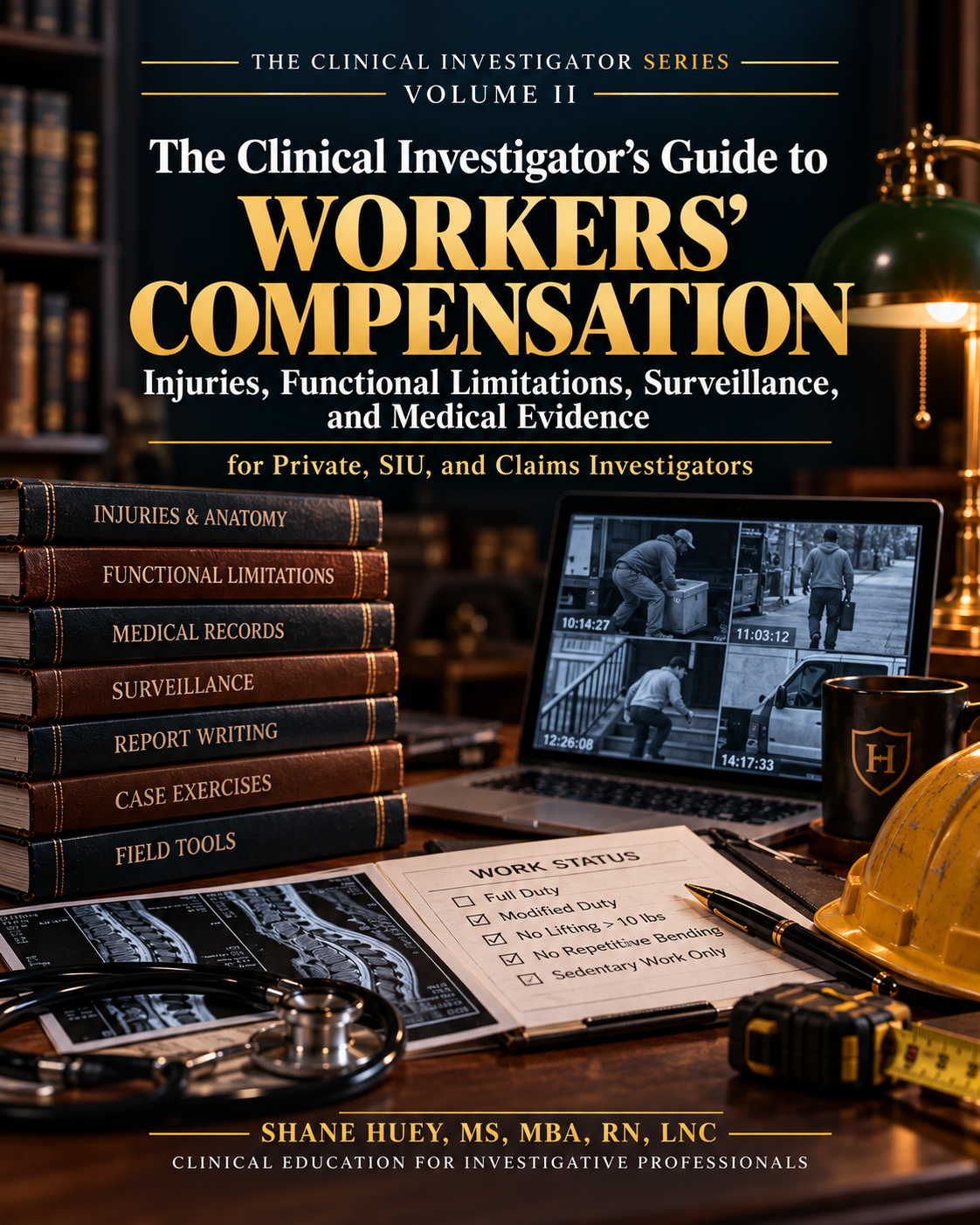
The Clinical Investigator’s Guide to Workers’ Compensation
Injuries, Functional Limitations, Surveillance, and Medical Evidence for Private, SIU, and Claims Investigators
A 100-page professional field guide for investigators who need to understand the medical evidence behind a workers’ compensation claim — and document observations that can actually be used by attorneys, claims professionals, and medical experts.
You’ve been assigned surveillance on an injured worker.
The file says lumbar radiculopathy, 10-pound lifting restriction, no repetitive bending, and modified duty.
What should you actually be looking for?
And, just as importantly, what can you legitimately conclude from what you observe?
The Clinical Investigator’s Guide to Workers’ Compensation bridges the gap between the medical record and the field investigation.
This is not a guide to “catching fakers.”
It is a guide to producing better evidence.
Understand the Injury Before You Investigate the Activity
Workers’ compensation surveillance can generate hours of video and still fail to answer the question that matters.
Why?
Because surveillance without a question produces footage. Surveillance with a question produces evidence.
An investigator who understands the medical context knows that:
Lifting an object does not prove an injury has healed.
Driving does not automatically establish an ability to tolerate prolonged sitting.
Walking without a cane on one occasion does not establish that an assistive device is medically unnecessary.
Performing an activity once does not establish the ability to perform it repeatedly throughout a workday.
This guide teaches you to approach surveillance with a defined clinical question rather than simply waiting for something interesting to happen.
Learn What Matters in the Medical File
A workers’ compensation file can contain diagnoses, restrictions, therapy notes, imaging findings, work-status forms, functional assessments, impairment ratings, and disability determinations.
They do not all mean the same thing.
Learn to distinguish among:
Diagnosis · Symptoms · Restrictions · Function · Work capacity · Recovery · Maximum medical improvement · Impairment · Disability
The guide shows you how to extract the information most relevant to an investigation and translate it into useful investigative questions.
A restriction such as “no lifting over 10 pounds” is not simply a yes-or-no test.
A useful investigation considers:
What object was handled?
How was it handled?
Which extremity was used?
How far was it carried?
How often was the activity repeated?
How reliably can the object's weight be established?
That is the difference between recording activity and developing evidence.
A Practical Guide to Common Workplace Injuries
Dedicated chapters examine injuries investigators commonly encounter, including:
Low back injuries · Cervical spine injuries · Shoulder injuries · Knee injuries · Hip and lower-extremity injuries · Hand, wrist, elbow, and upper-extremity injuries · Head injury and concussion · Repetitive stress and cumulative trauma · Crush injuries, fractures, burns, and serious trauma · Psychological and psychiatric claims
Each injury chapter follows the same practical framework:
Anatomy → Mechanism → Symptoms → Evaluation → Treatment → Restrictions → Functional Effects → Activities to Observe → What the Observation May Establish → What It Cannot Establish → Questions for Expert Review
You don't need to become a clinician.
You need enough clinical understanding to recognize what may matter and what you should not assume.
Turn Surveillance Into Better Evidence
The guide examines how to document functional activity involving:
Lifting and carrying · Walking and gait · Bending and reaching · Driving and sitting · Stairs and climbing · Assistive devices · Repetitive activity · Recreational and employment activity
It also addresses one of the most common weaknesses in investigative reports:
interpretive language disguised as observation.
Instead of:
“Subject demonstrated normal gait.”
Document what actually occurred.
Instead of:
“Subject lifted the object without difficulty.”
Document the object, movement, duration, distance, repetition, pauses, and body mechanics you could actually observe.
Instead of:
“Claimant appeared pain free.”
Describe the observable behavior and leave the medical interpretation to the appropriate expert.
Words such as normal, pain free, full range of motion, strong, disabled, malingering, effortlessly, obviously, and inconsistent with injury can imply conclusions the investigator may not be qualified to make.
This guide teaches you how to replace them with objective, defensible observations.
Apparent Inconsistency Is Not Automatically Fraud
An observation may appear inconsistent with something in the medical record.
That can be important.
But it does not automatically establish fraud, malingering, exaggeration, or absence of injury.
There may be differences in:
Duration · Repetition · Medication · Recovery stage · Environmental conditions · Symptom variability · The precise restriction in effect · What happened before or after the observed activity
The investigator's job is to identify and preserve a potentially relevant inconsistency.
The appropriate expert determines its medical significance.
That distinction makes your investigative work more credible, not less.
Connect the Medical Record to the Surveillance
One of the central methods in the guide is the Medical Record–Surveillance Correlation Matrix.
It organizes:
Medical evidence → Documented limitation → Observed activity → What the observation establishes → What requires expert interpretation
The final column contains questions, not answers.
That structure helps transform surveillance from isolated footage into evidence that can be meaningfully reviewed by attorneys, physicians, nurses, therapists, vocational experts, claims professionals, and other specialists.
Write Reports Experts Can Actually Use
The strongest surveillance report does more than describe where someone went.
It preserves functional evidence.
Learn to document:
Time · Duration · Distance · Frequency · Repetition · Object handled · Body part used · Assistive devices · Pauses · Changes in activity · Environmental context
The objective is not to write the medical expert's conclusion.
It is to give the expert better evidence from which to reach one.
Practice With 10 Case Exercises
The guide includes ten practical exercises involving:
Shoulder restrictions · Lumbar injury and yard work · Knee injury and stairs · Carpal tunnel and tool use · Ankle injury and walking · Concussion and social activity · Cervical injury and driving · Cane use · Repetitive-use restrictions · Lifting restrictions
Each case challenges you to separate:
What you know.
What you observed.
What you can reasonably document.
What still requires expert interpretation.
Includes 8 Professional Field Tools
The guide also includes reusable tools for actual investigative work:
Clinical Surveillance Preparation Sheet
Functional Observation Worksheet
Medical Record–Surveillance Correlation Matrix
Expert Review Referral Sheet
Injury → Function → Observation Matrix
Objective Language Checklist
Words Investigators Should Avoid
Workers’ Compensation Medical Abbreviation Sheet
These turn the guide from something you simply read into a working investigative reference.
Who This Guide Is For
Designed primarily for private investigators conducting workers’ compensation and insurance investigations, with practical value for:
SIU investigators · insurance investigators · claims investigators · fraud investigators · surveillance investigators · litigation investigators · claims professionals · legal investigators · attorneys and paralegals
It is particularly useful for investigators who regularly receive medical records or work-status documentation but have little or no formal clinical training.
Five Distinctions Every Investigator Should Remember
The record is not the event.
Observation is not interpretation.
Diagnosis is not disability.
Activity is not work capacity.
Apparent inconsistency is not fraud.
Those distinctions form the evidence discipline behind the entire guide.
The Clinical Investigator Series · Volume II
100-page digital field guide · PDF format · Immediate access
Pairs with Volume I: Medical Terminology for Private Investigators, which provides the medical vocabulary, anatomy, record terminology, imaging concepts, and clinical foundation behind this guide.
Volume I asks: What does the medical evidence mean?
Volume II asks: What should I look for, how should I document it, and what can I legitimately conclude?
Observe function. Document behavior. Preserve context. Let the appropriate expert interpret the medical significance.
For professional education and investigative reference. This guide does not provide medical or legal advice. Workers’ compensation laws, investigative licensing requirements, surveillance rules, and privacy requirements vary by jurisdiction.
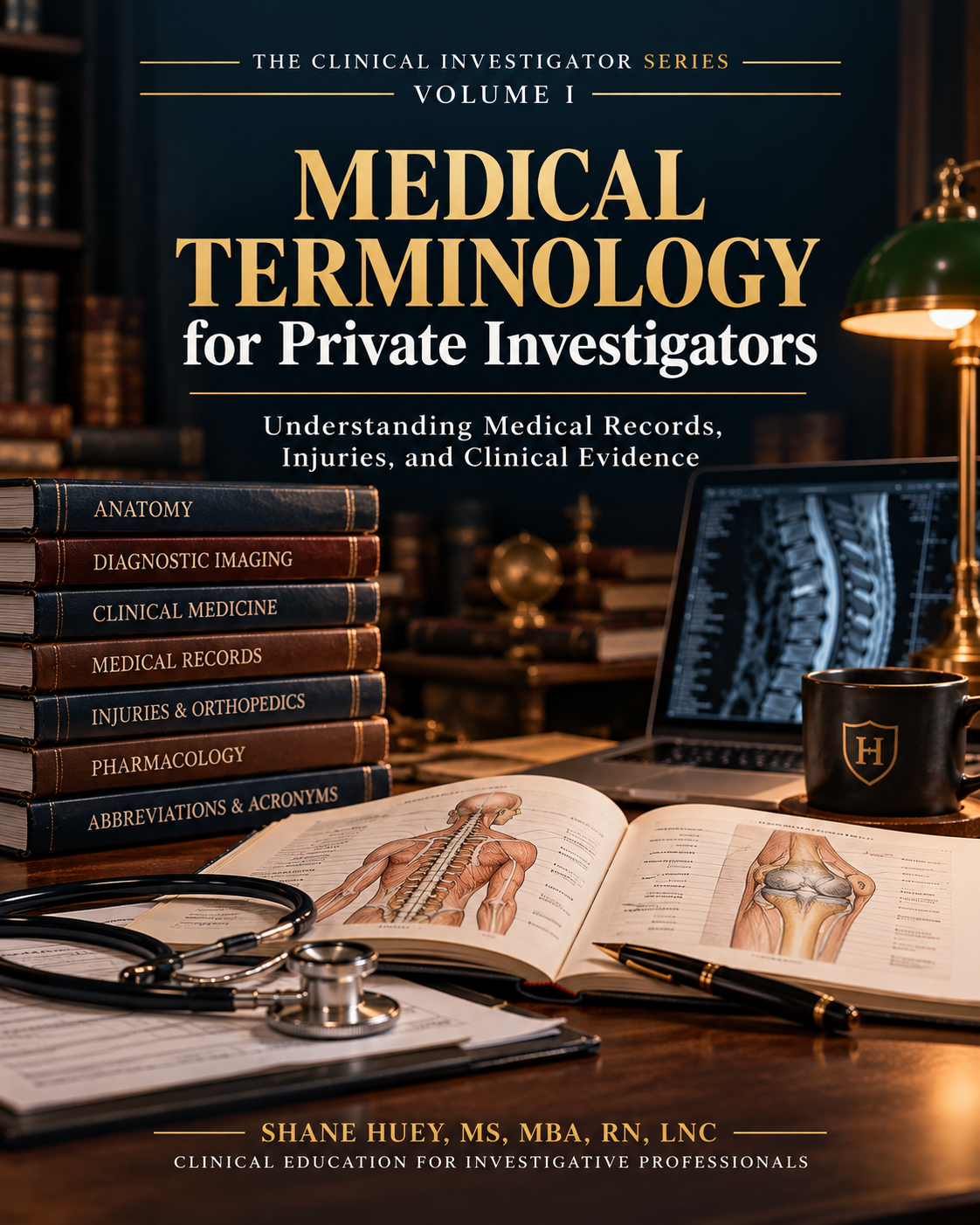
Medical Terminology for Private Investigators
Understanding Medical Records, Injuries, and Clinical Evidence
An 82-page professional field guide designed specifically for private investigators and other investigative professionals who encounter medical records, injuries, diagnoses, and clinical evidence.
You don't need to be a clinician to investigate a case involving medical evidence.
But you do need to understand what you're reading.
What does radiculopathy actually mean? What's the difference between a sprain and a strain? Does a herniated disc necessarily explain someone's symptoms? What does WBAT mean? What is an antalgic gait — and should an investigator actually use that term in a surveillance report?
Traditional medical terminology books are written for people entering healthcare.
This one isn't.
Medical Terminology for Private Investigators was created specifically for investigators who need enough clinical literacy to understand medical evidence, recognize what may matter to an investigation, document observations accurately, and know when interpretation belongs to a qualified medical expert.
Learn the Language Without Going to Medical School
Medical terminology can appear impenetrable until you understand how the language is constructed.
This guide teaches the prefixes, roots, suffixes, anatomical directions, abbreviations, and clinical vocabulary investigators are most likely to encounter — with an emphasis on investigative relevance rather than memorization.
You'll learn terminology associated with:
Spine and back injuries · Shoulder and upper-extremity injuries · Hip, knee, and lower-extremity injuries · Head injury and concussion · Neurological complaints · Cardiovascular and respiratory conditions · Wounds and skin findings · Psychiatric terminology · Diagnostic testing · Treatment and rehabilitation
The goal isn't to turn an investigator into a clinician.
It's to make the investigator medically literate enough to ask better questions and produce better evidence.
Understand the Injuries You Encounter
A medical record may contain terms such as:
Radiculopathy. Paresthesia. Effusion. Impingement. Neuropraxia. Subluxation. Tendinopathy. ORIF. Degenerative disc disease. Range of motion. ADLs.
Knowing the dictionary definition is only the beginning.
The guide helps you understand what these terms generally describe, where they fit anatomically, why they may matter to an investigation — and what you should not assume from seeing them in a medical record.
For example:
An imaging abnormality does not automatically establish the cause of a patient's symptoms.
A diagnosis does not automatically establish a functional limitation.
Observed activity does not automatically establish the absence of pain.
Those distinctions matter when medical evidence enters an investigation.
Learn to Read the Medical Record as Evidence
Medical records aren't written as investigative narratives.
They're assembled from different people, systems, encounters, and points in time.
You'll learn the purpose and significance of common record components, including:
Emergency department records · History and physicals · Progress notes · Consultations · Nursing documentation · Medication records · Laboratory results · Imaging reports · Operative reports · Physical and occupational therapy records · Discharge documentation
The guide also introduces an important investigative distinction:
The medical record tells you what was documented. That is not necessarily the same thing as reconstructing what occurred.
Understanding that difference helps investigators recognize gaps, inconsistencies, chronology issues, later documentation, and evidence that may require additional review.
Imaging Without Playing Radiologist
MRI, CT, X-ray, ultrasound, and electrodiagnostic testing appear constantly in injury-related investigations.
This guide explains what these tests generally evaluate and teaches you to recognize common report terminology such as:
Acute · Chronic · Degenerative · Incidental · Unremarkable · No acute abnormality · Correlate clinically · Equivocal
More importantly, it teaches you what those phrases do not prove.
The investigator's job is to understand the report — not independently diagnose from an image.
Diagnosis Is Not Function
One of the most important sections of the guide examines the relationship among:
Diagnosis → Symptoms → Impairment → Functional Limitation → Disability
These terms are often treated as though they mean the same thing.
They don't.
The distinction becomes especially important in personal injury, disability, insurance, workers' compensation, and surveillance investigations.
An individual may have a documented injury and still perform many activities.
An individual's ability to perform an activity once does not necessarily establish an ability to perform it repeatedly or occupationally.
And observing activity does not authorize an investigator to determine whether an injury has healed.
Observe Function Without Practicing Medicine
This is where medical terminology becomes investigative technique.
Consider the difference:
Weak reporting:
“Subject demonstrated normal right-arm strength.”
Objective reporting:
“Subject carried two grocery bags approximately 60 feet from the vehicle to the residence using the right hand.”
Or:
Weak reporting:
“Subject's knee appeared healed.”
Objective reporting:
“Subject descended four exterior steps without using the handrail.”
The second version preserves evidence.
The first interprets it.
The guide teaches investigators how to recognize that boundary.
Correlation Is Not Contradiction
An observation that appears inconsistent with a medical record, reported symptom, or functional limitation can be important.
It does not automatically prove fraud, malingering, exaggeration, or absence of injury.
Symptoms may vary. Activity may be brief. Medication may affect function. Someone may be capable of performing an activity once but incapable of sustaining it throughout a workday.
The investigator's role is to document the observation accurately enough that the appropriate expert can determine its significance.
That's a much stronger evidentiary product than an investigator trying to make the medical conclusion.
Document for the Expert
A good investigative report should allow another professional to understand what happened without relying on the investigator's interpretation.
The guide teaches you to document details such as:
Time · Duration · Distance · Repetition · Object handled · Body part used · Assistive devices · Pauses and rest · Changes in movement · Environmental context
Your work may ultimately be reviewed by a physician, nurse, physical therapist, occupational therapist, vocational expert, attorney, or other specialist.
The objective is simple:
Give the expert better evidence to work with.
A Medical Vocabulary Built for Investigators
The reference section isn't simply a dictionary.
High-yield medical terms are presented with an investigator in mind, emphasizing not just what a term means, but its investigative relevance and the interpretive mistake to avoid.
That makes the guide useful both as a learning resource and as a desk reference during actual casework.
Who This Guide Is For
Designed primarily for private investigators who encounter medical evidence, with practical value for:
SIU investigators · insurance investigators · claims investigators · fraud investigators · surveillance investigators · litigation investigators · workers' compensation investigators · legal investigators · paralegals and other professionals working with medical records
No prior medical education is required.
The Evidence Discipline Behind the Guide
Throughout the book, the investigator's role remains clear:
Recognize.
Document.
Preserve.
Correlate.
Question.
Refer.
Not diagnose.
Not interpret beyond the evidence.
Not write the expert's conclusion.
The result is a more medically informed investigator without blurring the boundary between investigation and clinical opinion.
The Clinical Investigator Series · Volume I
82-page digital field guide · PDF format · Immediate access
Pairs with Volume II: The Clinical Investigator's Guide to Workers' Compensation for investigators who want to apply this medical foundation to workplace injuries, functional limitations, surveillance, and expert-ready documentation.
Volume I asks: What does the medical evidence mean?
Volume II asks: What should I look for, how should I document it, and what can I legitimately conclude?
Understand the evidence. Document the evidence. Do not exceed what the evidence can prove.
For professional education and investigative reference. This guide does not provide medical or legal advice and does not qualify the reader to diagnose medical conditions or render medical opinions.
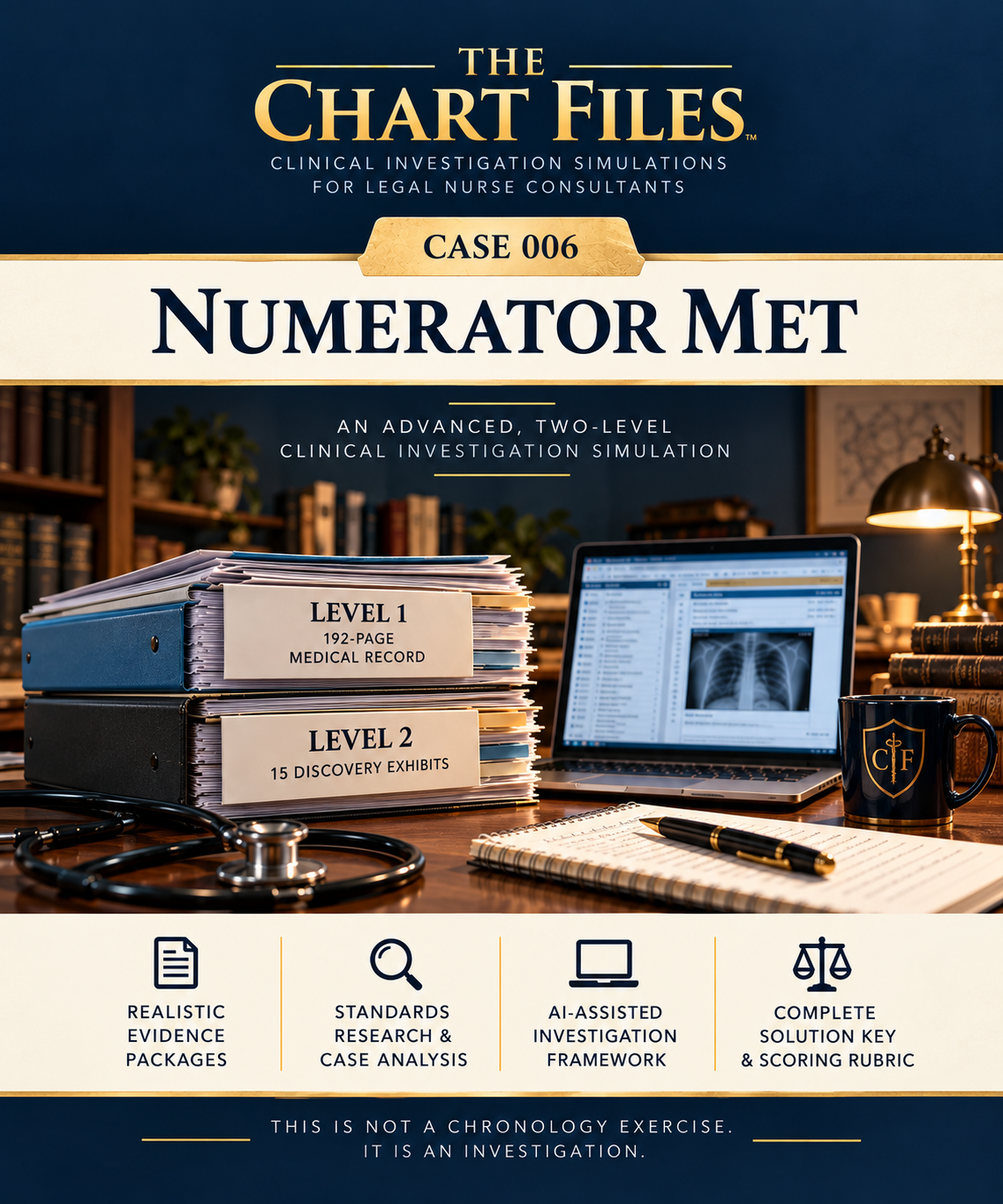
The Chart Files — Case 006: Numerator Met
This isn't a simulated chart review. It's a simulated case investigation.
A 66-year-old woman enters the hospital with pneumonia. Three weeks later, she leaves the healthcare system without her left leg.
The outcome is devastating.
The outcome, however, is not your question.
Your question is the one an attorney must answer before investing a client's money and an expert's reputation:
Does the evidence support going further, against whom, under what standard, and what would be needed to prove it?
Numerator Met is an advanced, two-level clinical investigation designed to move legal nurse consultants and clinical reviewers beyond chronology building and into evidence-based case investigation.
You will encounter duty, standards of care, potential breach, causation, scope and privileging, EHR audit evidence, provider communication, clinical decision support, electronic quality measures, transitions of care, document provenance, competing case theories — and evidence that does not always mean what it first appears to mean.
Some things went wrong.
Some things only look wrong.
And at least one decision that looks wrong in hindsight was reasonable based on the information available at the time.
You cannot solve this case by finding the bad outcome and reasoning backward.
Level 1 — The Merit Review
You begin where an LNC often begins:
An attorney. A potential medical-negligence claim. And a 192-page certified legal medical record.
That's all you get.
There is no answer key telling you where to look. There is no curated list of significant events. And important categories of evidence are not contained in the legal medical record you received.
Your assignment is not to summarize 192 pages.
It is to determine what matters.
You'll identify who owed relevant duties to the patient, research real and applicable authorities, distinguish evidence of the standard of care from the standard itself, identify and rank potential deviations, analyze plausible causal chains, recognize apparent problems that should not support your opinion, and determine what additional evidence should be requested.
Then you'll produce an attorney-facing merit memorandum limited to four pages.
You must decide:
Is there reasonable support for further investigation — and can you defend why?
Then the Case Changes.
Complete and save your Level 1 analysis.
Only then do you open Level 2.
Your requests have produced discovery.
You now receive 15 additional exhibits containing evidence that wasn't available during your initial review:
EHR access and results-inbox audit data. Secure messages. Physician handoffs. Clinical decision-support alert history. Nursing-note metadata. Document version history. The actual Summary of Care transmitted electronically. Direct secure messaging transmission records. Outside medical records. Hospital policies and protocols. Credentialing and privileging documents. Quality-reporting extracts. Deposition testimony.
Now investigate the case again.
Some evidence will confirm what you suspected.
Some will strengthen it.
Some may undermine your original conclusions.
Some may move responsibility from one person or entity to another.
And some questions will remain unresolved.
Just as they do in real cases.
Level 2 — Clinical Case Investigation
Now you're no longer performing a preliminary merit review.
You're reconstructing the evidence.
You'll build a layered evidentiary timeline covering the critical period of the case — not simply a list of medical events, but multiple simultaneous layers:
Clinical event | Documentation | Communication | EHR/system evidence | Standard/duty | Variance | Source | Confidence/provenance
Every material proposition must be traceable to evidence.
And not all evidence is treated equally.
You'll classify information as:
Documented fact.
System-derived fact.
Reported fact.
Inference.
Unresolved contradiction.
That distinction matters.
An EHR may record that a result was acknowledged.
That does not necessarily establish that the clinician read it.
A message may be recorded as read.
That does not establish that it was understood.
A document may exist in the medical record today.
That does not necessarily establish that the same version existed — or was transmitted — at the time of the event.
Numerator Met requires you to keep asking:
What does this evidence actually prove?
Duty. Standard. Breach. Causation. Damages.
Finding something concerning isn't enough.
You must connect the evidence.
Your final case theory is constructed as a defensible chain:
Duty → Applicable Standard → Evidence of What Occurred → Specific Deviation → Foreseeable Consequence → Causal Relationship → Injury and Damages
You'll choose the theory you would be prepared to carry forward and explain why other tempting theories should be set aside.
You'll also classify the important propositions in the case as established, disputed, expert-dependent, unresolved, or requiring additional evidence.
The goal isn't merely to be right.
The goal is to produce reasoning that can survive scrutiny.
The Regulatory and Quality Layer
The title Numerator Met is not incidental.
The case incorporates electronic clinical quality measurement and forces you to confront a distinction increasingly important in modern healthcare litigation and record analysis:
A quality measure can be satisfied while the subsequent clinical care remains very much in question.
You'll encounter apparently compliant quality data and determine what that data establishes — and, more importantly, what it does not establish about the standard of care.
The case also introduces questions involving institutional protocols, practitioner scope and privileging, clinical decision support, transitions of care, and the difference between what an information system records and what can legitimately be inferred about human action.
AI-Assisted. Human Investigated.
AI use is permitted.
Blind reliance on it is not.
Use AI to help extract, organize, sort, and convert evidence if you choose. But you remain responsible for verifying the source, checking every material assertion, validating time conversions, researching standards, assigning provenance, and making the investigative judgments.
AI does not decide whether a variance occurred.
You do.
The exercise is deliberately designed to expose one of the greatest risks of AI-assisted medical-record review:
A beautifully organized inference is still an inference.
And There Is a Ground Truth.
After completing both levels, unseal the Solution Key.
This isn't a few pages of answers.
The key walks through what actually happened, the applicable authorities and their limitations, the duty map, evidentiary traps, red herrings, timeline reconstruction, model merit analysis, case theory, quality-measure issues, and the evidence that remains genuinely unresolved.
A detailed 100-point scoring rubric evaluates both stages of the investigation, including your standards research, breach analysis, causation reasoning, timeline accuracy, provenance discipline, case theory, fact classification — and whether you were willing to revise your original conclusions when better evidence became available.
Because that, too, is part of investigation.
Difficulty: Advanced
Estimated investigation time: 8–12 hours
Case setting: Fictional U.S. medical-negligence matter
Your case includes:
Investigator Briefing
192-page Level 1 certified medical record
Level 2 discovery package with 15 additional exhibits
Layered evidentiary timeline assignment
AI-assisted investigation framework
Case-theory and fact-classification exercises
Sealed Solution Key
100-point scoring rubric
The simulated action is venued in Florida and incorporates selected Florida authorities, but the investigative methods and evidence-analysis skills taught throughout the case are broadly applicable to legal nurse consulting and clinical case investigation.
The record is evidence about the event. It is not the event.
This is not a chronology exercise. It is an investigation.
Every patient, provider, facility, and event in this simulation is fictional. Created for professional education and investigative training; not legal or medical advice.
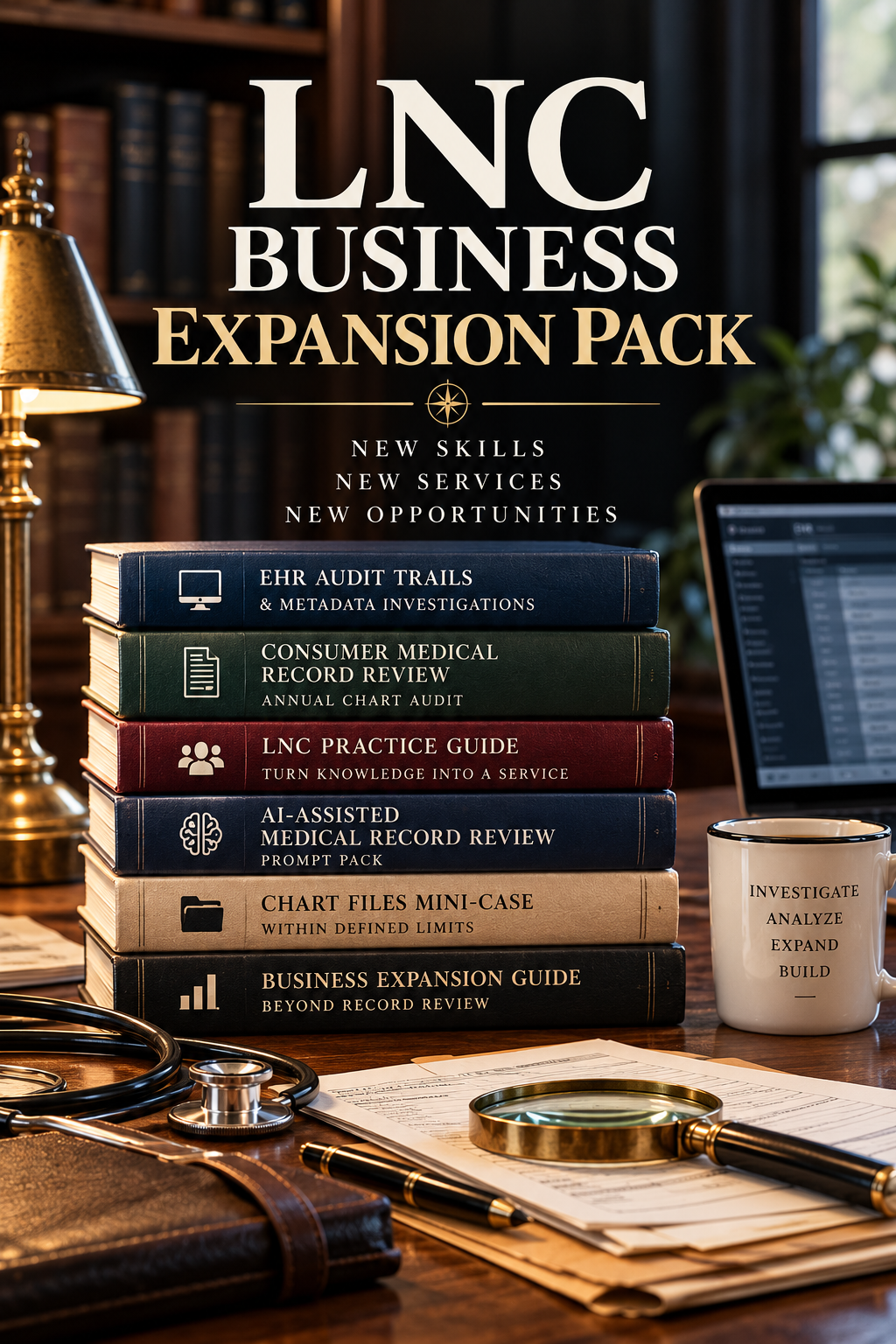
LNC Business Expansion Pack
Don't Just Wait for Attorney Cases. Build Your Practice.
Most Legal Nurse Consultants are introduced to the same core services: medical-record review, chronologies, case summaries, and litigation support.
Those services matter. But they don't have to define your entire business.
And if you're a new LNC, there's an immediate problem with building a practice around them alone:
You can't review an attorney's case until an attorney sends you one.
The LNC Business Expansion Pack was created to help Legal Nurse Consultants develop additional skills, services, and potential revenue streams while continuing to build their traditional attorney-facing practice.
Learn how to investigate electronic health records beyond the printed chart. Explore consumer-facing medical-record services. Develop an annual chart-audit offering. Incorporate AI into record review responsibly. And begin thinking about your nursing and medical-record expertise not simply as one service, but as the foundation for multiple business lines.
What's Included
EHR Audit Trails, Metadata & Digital Medical Record Investigations
Professional Training + Practice Toolkit
Go beyond the PDF medical record and learn to investigate the electronic systems behind it.
This approximately 128-page training and practice system includes the Professional Field Manual, Nine-Step EHR Investigation Workflow, six applied case laboratories, reusable EHR Investigation Chart File, worksheets, request templates, and The Chart Files: Case 003 — The Clean Copy, an advanced audit-trail and EHR revision investigation.
Develop a specialized service capability involving audit trails, metadata, version history, documentation timing, access information, provenance, electronic evidence, and EHR investigation.
The Personal Medical Record Audit — Annual Chart Check
A complete 143-page consumer medical-record auditing system with seven reusable worksheets and 32 ready-to-use letters, messages, and scripts.
Use it to understand how a structured annual medical-record review works and as the foundation for developing consumer-facing services that help individuals examine their records for inaccurate, outdated, duplicated, missing, or questionable information.
Consumer Medical Record Review & Annual Audit — LNC Practice Guide
Expansion Pack Exclusive
The consumer guide teaches patients how to examine their records.
This companion guide teaches the LNC how to turn that knowledge into a service.
Learn how consumer medical-record review and annual chart audits can fit into an independent LNC practice, including service structure, intake, workflow, deliverables, professional boundaries, recurring annual reviews, referral considerations, and practical approaches to packaging the service.
This resource is available exclusively as part of the LNC Business Expansion Pack.
AI-Assisted Medical Record Review Prompt Pack
Includes 16 LNC-specific AI prompts across six categories, verification protocols, a de-identification checklist, an AI Use Verification Log, and an evidentiary framework for using AI as an organizational and analytical assistant without outsourcing professional judgment.
Use AI to help organize, extract, compare, flag, draft, and build chronologies — while keeping the LNC responsible for verification and conclusions.
Chart Files Mini-Case: Within Defined Limits
Put the concepts into practice with a focused EHR investigation involving charting by exception, conflicting assessments, documentation timing, provenance, and audit-trail reasoning.
Rather than simply asking what the chart says, investigate how the documentation got there and what it actually proves.
Beyond Record Review — The LNC Business Expansion Guide
Expansion Pack Exclusive
The roadmap that ties the entire system together.
Explore additional services and specialized capabilities that can be developed from your existing nursing and medical-record expertise, including:
EHR audit-trail and metadata investigation • electronic medical-record investigation • consumer medical-record review • annual personal chart audits • medical-record discrepancy review • record-request strategy • AI-assisted record analysis • documentation provenance and information-availability analysis
For each area, examine what the service is, who might need it, what skills are required, what the LNC can deliver, professional boundaries to consider, and practical ways to begin incorporating it into an independent practice.
Build While You Wait
A new LNC doesn't have to spend the first year simply waiting for an attorney to send a case.
You can use that time to develop specialized capabilities.
You can build consumer-facing services.
You can learn EHR investigation.
You can create repeatable workflows.
You can practice on realistic evidence.
And you can continue marketing to attorneys while developing other reasons for clients to hire you.
For established LNCs, the question is different:
What else could your practice become?
The LNC Business Expansion Pack is designed to help you answer it.
One package. Multiple capabilities. More than one path to building an LNC practice.
Don't just wait for cases. Build capabilities. Build services. Build your practice.
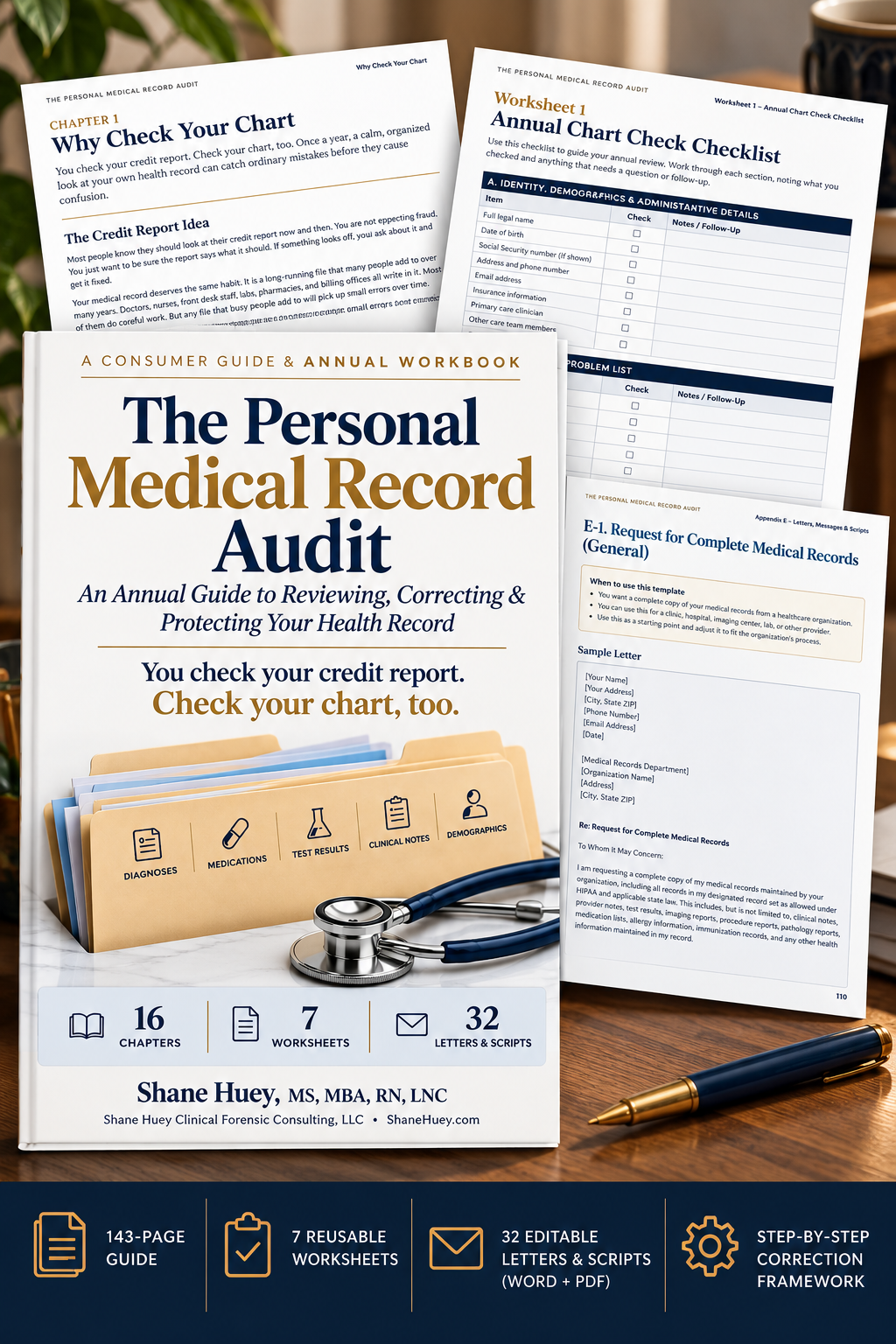
The Personal Medical Record Audit
You check your credit report. Check your chart, too.
Your medical record follows you for life.
It can influence the care you receive, the medications and allergies clinicians see, how your health history is understood, and—in some circumstances—information used in insurance and claims decisions.
But when was the last time you actually checked it?
The Personal Medical Record Audit is a 143-page consumer guide and annual workbook that shows you, step by step, how to review your own medical records for inaccurate, outdated, missing, duplicated, or potentially wrong-patient information—and what to do when you find something that doesn't look right.
No medical background required. No healthcare IT knowledge required. Everything is explained in plain English.
Learn What Your Medical Record Actually Says About You
Your patient portal is useful—but it isn't necessarily your complete medical record.
This guide shows you where your health information can live, how it moves between healthcare organizations, and how to systematically review the information that matters most.
You'll learn how to check:
diagnoses and your problem list;
medications, allergies, and immunizations;
laboratory and imaging results;
procedures and surgeries;
clinical notes and medical history;
demographics, insurance, and administrative information;
information that may be outdated, duplicated, or copied forward;
entries that may belong to another patient; and
records held outside the portal, including health information exchanges, registries, and certain insurance-related databases.
You'll also learn how to read a clinical note—including the difference between what you reported, what a clinician observed, and the clinician's professional assessment—so you can distinguish a genuine factual discrepancy from something that simply looks unfamiliar.
Find Something Wrong? You'll Know What to Do Next.
Finding a questionable entry is only the beginning.
The guide walks you through an Eight-Step Correction Framework for documenting the issue, finding its source, requesting the appropriate records, contacting the right organization, requesting an amendment when appropriate, tracking the response, and verifying what ultimately changed.
It also explains your medical-record rights in understandable language, including HIPAA access and amendment rights, information blocking, designated record sets, health information exchanges, CommonWell, Carequality, TEFCA, registries, MIB and prescription-history reports.
And because correcting information at one healthcare organization doesn't necessarily correct copies that have already traveled elsewhere, you'll learn how to follow the information downstream.
More Than a Guide—It's an Annual System
The goal isn't to make you obsess over your medical record.
It's to make checking it routine.
The Annual Chart Check gives you a repeatable process you can perform once a year, much like reviewing your credit report.
The package includes 7 reusable worksheets to help you inventory your records, document questionable entries, track requests and amendments, follow up, and create an annual audit summary.
And when it's time to actually contact someone, you won't have to wonder what to say.
Includes 32 Ready-to-Use Letters, Messages & Scripts
You'll receive practical templates for situations including:
requesting your complete medical record • requesting a missing record • questioning an unfamiliar diagnosis • updating medication information • requesting an amendment • responding to a denied amendment • asking that corrected information be sent downstream • reporting possible wrong-patient information • following up on unanswered requests • and more.
The templates are also provided in a separate editable Word document, so you can customize them without copying and reformatting text from the guide.
Created by Someone Who Knows the Medical Record From Both Sides of the Screen
Shane Huey, MS, MBA, RN, LNC has been a Registered Nurse for 14 years and has spent more than 11 years building, maintaining, and working with electronic health record systems.
His work sits at the intersection of clinical care, healthcare IT, electronic documentation, and regulatory requirements.
As a Legal Nurse Consultant and Clinical Investigator, he also examines medical records critically—tracing where information came from, comparing conflicting documentation, identifying what may be missing, distinguishing repeated information from independent evidence, and determining what the record actually supports.
The Personal Medical Record Audit brings that experience to consumers in plain English.
What You Receive
The Personal Medical Record Audit — PDF
143-page consumer guide and annual workbook
16 chapters
7 reusable worksheets
Plain-language HIPAA and patient-rights reference
Medical terminology and abbreviation references
Healthcare and regulatory resource directory
32 letters, portal messages, and phone scripts
Editable Letters, Messages & Scripts — Word
All 32 templates in an editable format for easy customization.
$39
Your medical record tells your health story.
Make sure it's telling the right one.
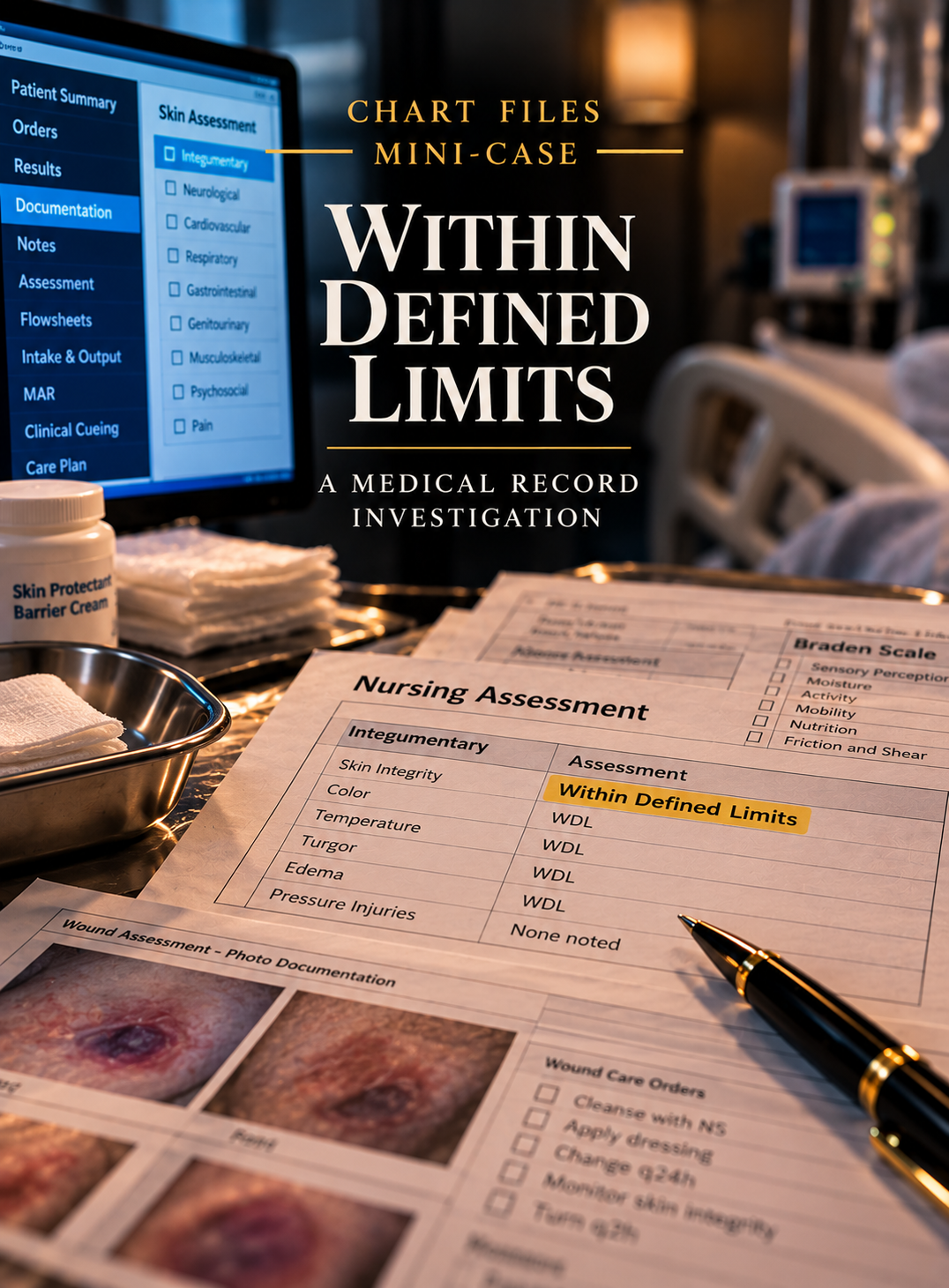
Chart Files Mini-Case: Within Defined Limits
What does “Within Defined Limits” actually establish?
An elderly patient is hospitalized after a prolonged period on the floor and later develops a significant sacral pressure injury. The medical record contains an apparently reassuring finding: the patient's integumentary assessment was documented Within Defined Limits (WDL).
That entry seems important.
But before relying on it, an investigator needs to ask a different question:
How did that documentation get there?
Within Defined Limits is a 20–30 minute Chart Files Mini-Case designed for legal nurse consultants and medical record reviewers who want to look beyond the rendered chart and investigate the EHR processes that created it.
You'll examine conflicting skin assessments, charting by exception, documentation timing, and the evidentiary significance of EHR workflow. The case challenges you to determine how much weight should be given to an apparently specific clinical entry when the mechanism behind that entry tells a more complicated story.
This isn't simply a pressure-injury case.
It's an investigation into what an EHR entry actually proves — and what it doesn't.
One question. One answer you can defend.
Skills practiced: EHR documentation, charting by exception, conflicting clinical findings, present-on-admission analysis, audit-trail reasoning, documentation provenance, and evidence-based conclusions.
Estimated completion time: 20–30 minutes.
Format: Digital PDF mini-case with case materials and sealed analysis.
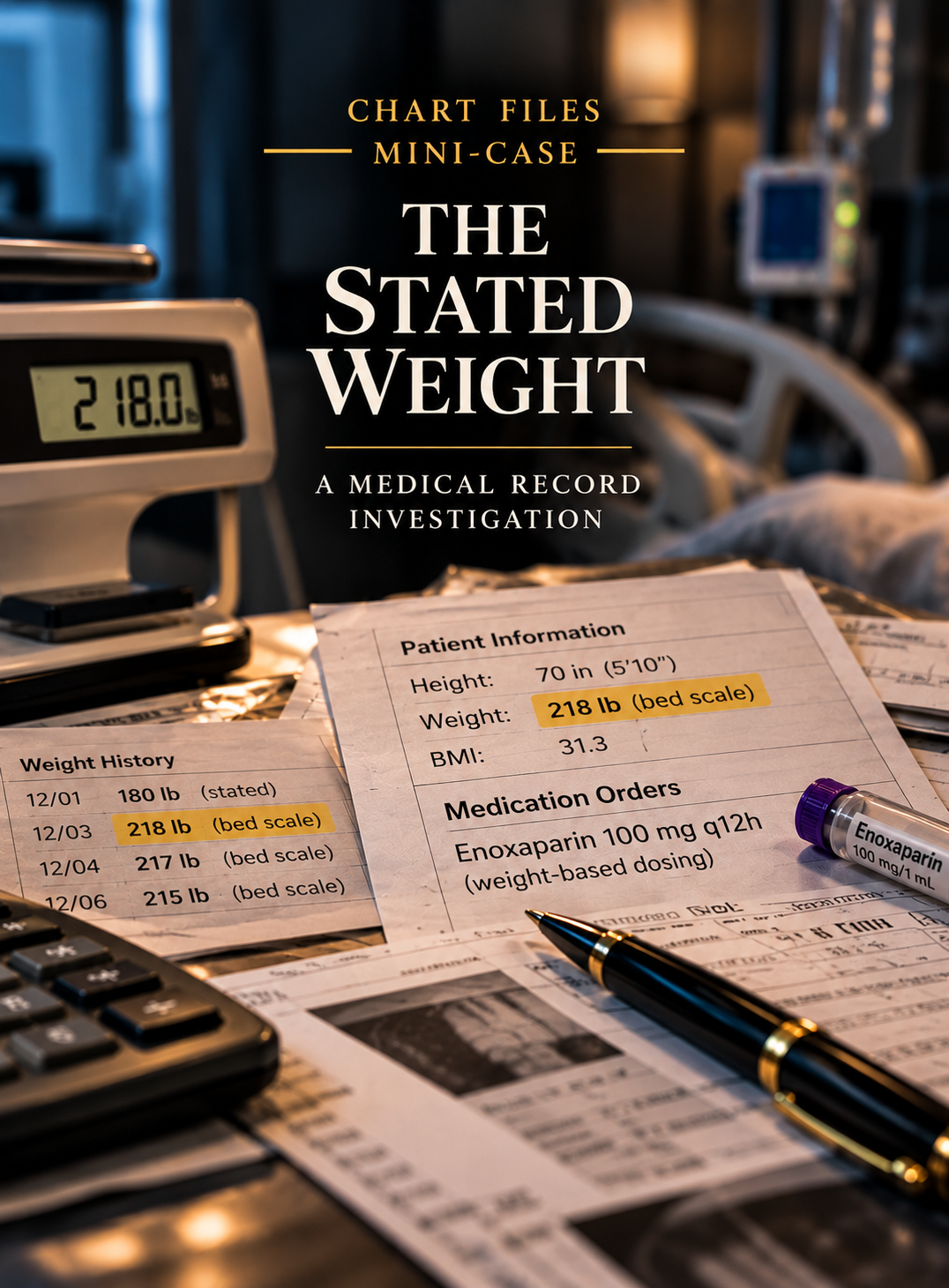
Chart Files Mini-Case: The Stated Weight
Every number in a medical record has a first source. Find it before you trust what was calculated from it.
A hospitalized patient receives weight-based anticoagulation and later develops a significant bleeding complication. The case theory seems straightforward: an incorrect patient weight resulted in an excessive medication dose.
The numbers appear to support it.
But do they?
The Stated Weight is a 20–30 minute Chart Files Mini-Case designed for legal nurse consultants and medical record reviewers who want to practice investigating the record rather than simply accepting its contents at face value.
You'll examine conflicting patient weights, medication dosing, EHR data provenance, and the difference between stated and measured information. Your task is to trace a seemingly simple clinical value back to its source and determine whether the proposed explanation actually survives the evidence.
This isn't an exercise in finding facts that support the theory you've been given. It's an exercise in testing the theory itself.
One question. One answer you can defend.
Skills practiced: medical record investigation, data provenance, weight-based medication dosing, stated vs. measured values, chronology, competing hypotheses, and evidence-based conclusions.
Estimated completion time: 20–30 minutes.
Format: Digital PDF mini-case with case materials and sealed analysis.
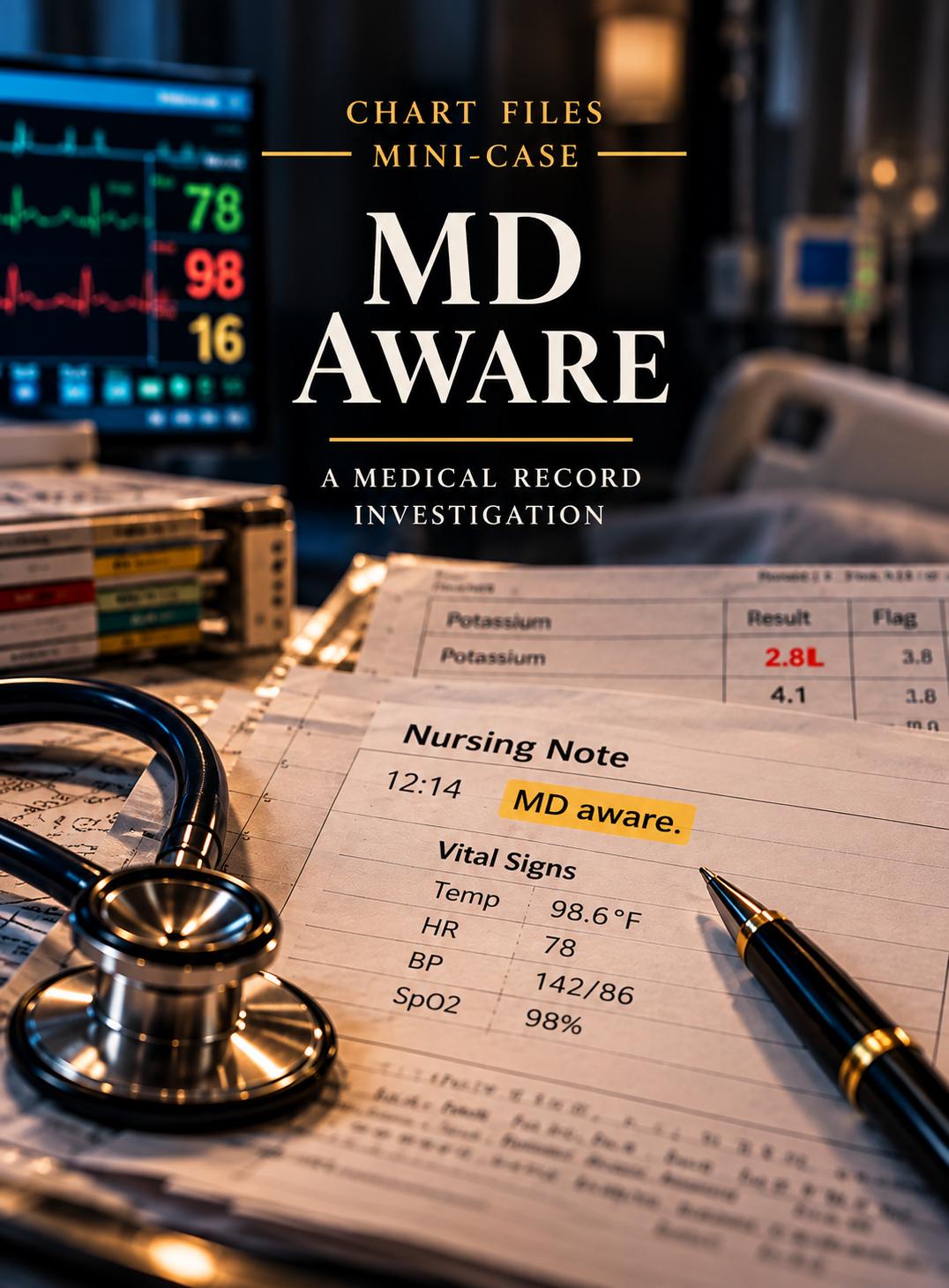
Chart Files Mini-Case: MD Aware
Can two words in a nursing note prove that a physician was notified?
A hospitalized patient has a critical potassium result. The nursing documentation says “MD aware.” The attending physician later says no one called him.
The answer appears simple — until you examine the timestamps, laboratory results, telephone orders, and attribution behind the documentation.
MD Aware is a short, case-based medical record investigation designed for legal nurse consultants and other clinical reviewers who want to sharpen their evidentiary reasoning.
You'll investigate a realistic medical record and work through questions involving critical-value communication, nursing documentation, physician attribution, telephone orders, and the danger of treating two separate laboratory results as though they were one event.
Your task is deliberately narrow:
One question. One answer you can defend.
The case is designed to strengthen your ability to separate documented fact from inference, hypothesis, and what the available record simply cannot establish.
Skills practiced: medical record investigation, critical laboratory values, documentation attribution, temporal reasoning, telephone orders, and evidence-based conclusions.
Estimated completion time: 20–30 minutes.
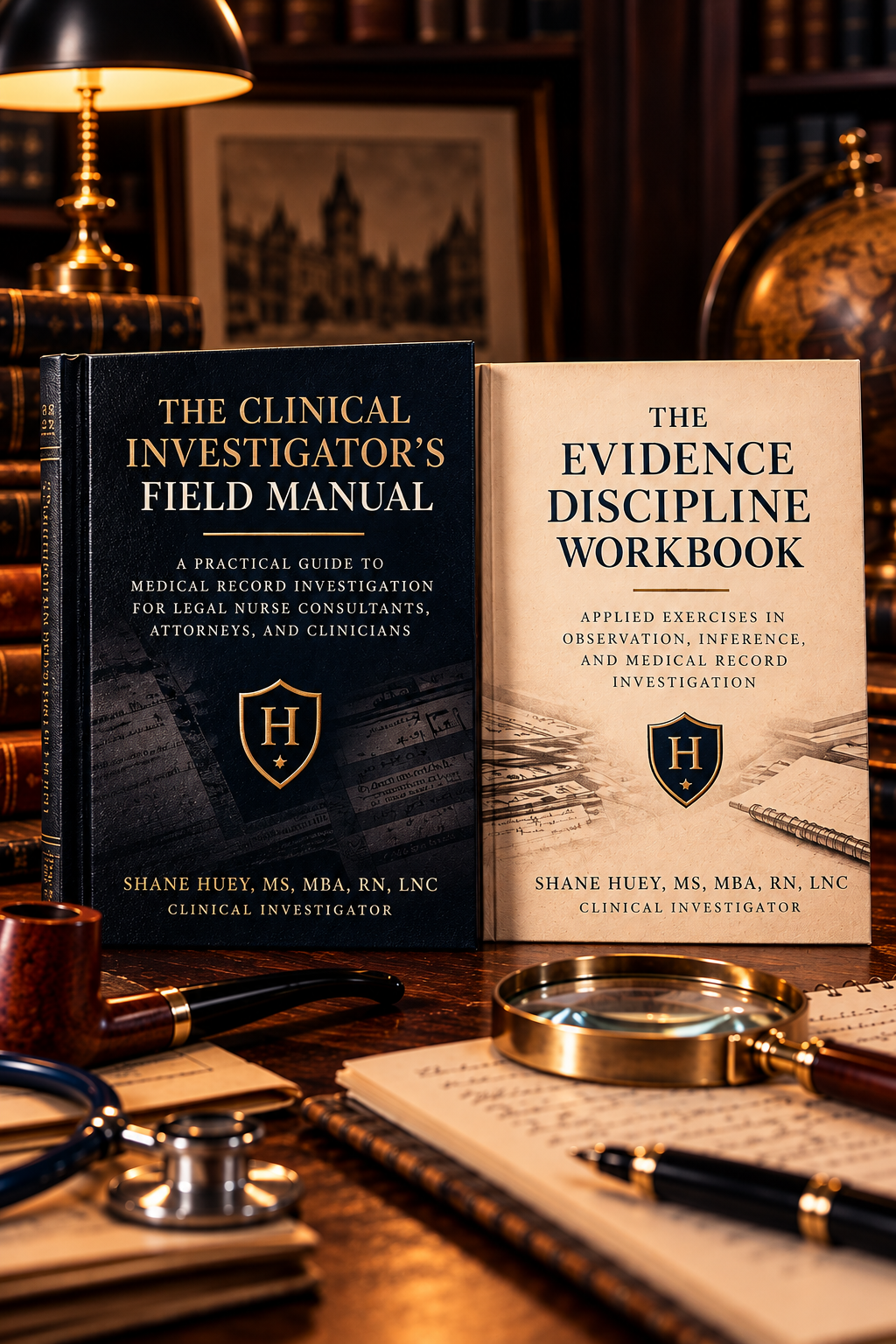
The Evidence Discipline Collection
The Clinical Investigator’s Field Manual + The Evidence Discipline Workbook
Medical-record review is not simply finding information in a chart. It is determining what the record actually establishes, what can reasonably be inferred from it, what remains only a hypothesis, and what the available evidence does not permit you to conclude.
The Evidence Discipline Collection is a two-part professional training system designed for legal nurse consultants, clinical investigators, nurses, advanced practice clinicians, attorneys, and other professionals who analyze medical records in clinical, legal, and investigative settings.
Rather than teaching you simply what to look for, this collection focuses on how to think about what you find.
At its foundation is The Clinical Investigator’s Field Manual, a practical framework for disciplined medical-record investigation. It develops the reasoning skills necessary to move beyond passive chart review and approach the record as evidence — examining chronology, provenance, inconsistencies, missing information, documentation patterns, EHR behavior, competing explanations, and the limits of what the available record can support.
The Field Manual emphasizes a critical distinction that is easily lost during complex case review:
Observation is not inference. Inference is not hypothesis. Hypothesis is not conclusion.
Knowing where one ends and the next begins can profoundly affect the accuracy and defensibility of an analysis.
The companion Evidence Discipline Workbook turns those principles into deliberate practice. Through structured exercises and record-review problems, you will practice separating documented facts from interpretation, identifying unsupported assumptions, generating competing hypotheses, recognizing evidentiary gaps, testing conclusions, and communicating findings with appropriate precision.
Together, the two resources create a learn-and-apply system:
Learn the investigative method in the Field Manual. Practice the method in the Workbook. Carry the discipline into your own cases.
This collection is particularly useful for professionals who work with records involving questions of standard of care, chronology, causation, documentation discrepancies, medication administration, clinical decision-making, EHR workflows, metadata and audit trails, or other situations in which what appears in the chart may not tell the entire story.
The goal is not to teach reviewers to reach more dramatic conclusions.
It is to teach them to reach better-supported ones.
Because a strong clinical investigator must be able to tell counsel not only:
Here is what I found.
But also:
Here is what the record establishes.
Here is what it suggests.
Here is what it does not establish.
Here is what remains unknown.
And here is what I would investigate next.
Included in the Collection
The Clinical Investigator’s Field Manual
A practical reference for approaching medical records as investigative evidence, with an emphasis on observation, inference, hypothesis formation, verification, documentary inconsistencies, evidentiary limits, and disciplined clinical reasoning.
The Evidence Discipline Workbook
A companion practice resource designed to move those concepts off the page and into actual reasoning through structured exercises that challenge you to observe carefully, question assumptions, distinguish fact from interpretation, and defend only what the available evidence supports.
Who It’s For
Legal nurse consultants • Registered nurses • Nurse practitioners and physician assistants • Physicians • Attorneys • Medical-record reviewers • Clinical and forensic investigators
Two resources. One investigative discipline.
Don’t just review the record. Learn to interrogate it.
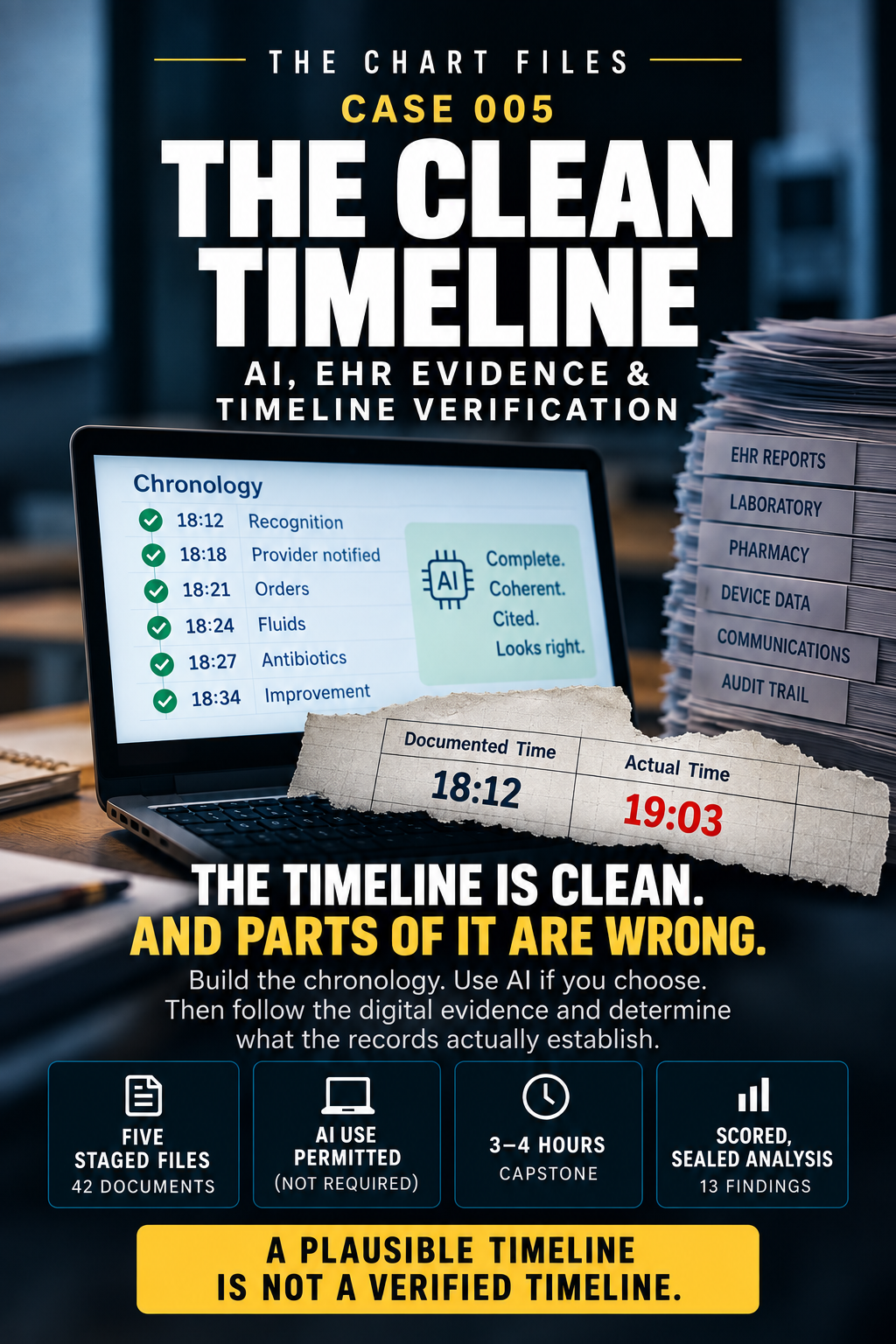
The Chart Files: Case 005 — The Clean Timeline
Capstone Medical-Record Investigation: AI, EHR Evidence & Timeline Verification
The timeline is clean.
Recognition at 18:12. Provider notified at 18:18. Orders at 18:21. Fluids at 18:24. Antibiotics at 18:27. Improvement at 18:34.
It is coherent. It is supported by citations. An AI chronology tool reaches essentially the same conclusion.
And parts of it are wrong.
Not because the AI hallucinated.
Not because it failed to read the chart.
Because the medical record it was given could not tell the whole story.
Welcome to Case 005 — The Clean Timeline, the capstone investigation in The Chart Files.
This time, you're encouraged to bring AI with you.
Then you're going to investigate whether you can trust what it tells you.
Your Assignment
You have been retained by defense counsel in Pruitt v. Marsh Harbor General Hospital.
A 67-year-old postoperative patient develops an anastomotic leak, septic shock, acute kidney injury, and a prolonged hospitalization. Counsel needs a defensible chronology of the deterioration and response.
You receive the hospital's 46-page certified medical-record production.
Your first task sounds straightforward:
Reconstruct what happened.
You may use an AI system of your choice to help extract events, identify inconsistencies, classify timestamps, and build the chronology. In fact, AI use is permitted and encouraged.
And AI may do an impressive job.
But there is a problem hiding in plain sight.
The certified production consists of printed EHR reports. It does not include audit trails, device data, alert history, dispensing-cabinet records, infusion-pump data, communication logs, or other system metadata. And its flowsheet and MAR reports display documented performed time.
So before you trust your timeline, you'll have to answer a harder question:
What does the evidence actually establish?
Build the Timeline. Then Try to Break It.
This is not a case where you receive every document at once.
You work the investigation in stages.
First, you'll analyze the conventional medical record and build your chronology. You'll commit to your findings before seeing what comes next.
Then counsel obtains the underlying digital evidence.
Audit data. Device records. Alert history. Laboratory metadata. Pharmacy records. Barcode scans. Infusion-pump data. Communication logs. Access records.
Now you have a new assignment:
Audit your own timeline.
Which events survive?
Which need to be qualified?
Which happened at a different time than the conventional chart suggests?
And which “facts” were never facts at all?
Stage II explicitly asks you to compare your initial chronology against system data and determine “what survives.”
One Patient. Multiple Systems. Multiple Kinds of Time.
Modern medical records don't contain one clock.
They contain many.
An event may have a performed time, entry time, signed time, collection time, result time, order time, service time, device time, alert time, administration time, or access time.
Those distinctions can completely change a chronology.
In The Clean Timeline, you'll encounter documentation showing one sequence of events while underlying electronic systems preserve another.
You'll have to determine:
When did the patient's condition actually deteriorate?
When was it recognized?
When was the provider actually contacted?
When were orders placed?
When did fluids actually begin?
When did the antibiotic reach the patient?
When were laboratory results available — and when did a clinician actually see them?
And perhaps most importantly:
Which of those questions can the evidence answer at all?
AI Isn't the Villain in This Case.
That's what makes Case 005 different.
AI may catch something you miss.
It can cross-reference dozens of pages rapidly. It can identify conflicting medication doses, suspicious sequences, duplicated language, and inconsistencies buried across a large medical record.
In development testing, AI identified several meaningful discrepancies in the Stage I record—including one that a tired human reviewer could easily overlook.
But it still constructed key intervals around the documented chronology because the evidence necessary to disprove those times wasn't yet available to it.
That distinction is the heart of the case.
AI can extract what a record says.
The investigator still has to determine what the evidence proves.
Then You Get Someone Else's AI Work Product.
Just when you think you've reconstructed the case, counsel sends you one more document.
A litigation-support vendor previously processed the certified record through an AI chronology system.
The result looks excellent.
It's polished.
It's cited.
It's been reviewed by a paralegal.
It identifies genuine discrepancies.
And it reaches conclusions counsel would very much like to believe.
Your assignment:
Audit it.
You'll evaluate the vendor's chronology statement by statement and identify problems such as:
documented time treated as event time;
patient report treated as established fact;
order time treated as administration;
result time treated as clinician awareness;
copied-forward text treated as a current finding;
correct citation paired with an unsupported conclusion;
events improperly merged or attributed;
and conclusions resting on unreliable premises.
This isn't an exercise in finding silly AI hallucinations.
The difficult errors are the ones that sound reasonable, cite the correct record, and still aren't supported by the evidence.
Six Questions. Every Event.
Throughout the investigation, you'll apply the Case 005 framework:
1. What happened?
The clinical event, as best the evidence establishes it.
2. What was documented?
The words and values appearing in the record.
3. When was it documented?
The entry time—not necessarily the time printed beside it.
4. What does the digital evidence establish?
Devices, alerts, scans, logs, access and other system evidence.
5. What did AI infer?
What your tool—or someone else's—concluded from the evidence.
6. What survives?
Only what you can verify against the source evidence.
That last question is the one that matters.
This Is More Than Timeline Building.
Case 005 combines the skills developed throughout The Chart Files into a single investigation:
clinical medical-record review + chronology reconstruction + EHR audit evidence + metadata + device data + medication evidence + source provenance + AI-assisted analysis + human verification.
You'll have to distinguish Fact, Inference, Hypothesis, and Unknown throughout the investigation—and recognize when a perfectly plausible conclusion exceeds what the available evidence can actually establish.
You are not being asked to determine standard of care, causation, or intent.
You're being asked to do something more fundamental:
Establish the factual record on which those opinions may eventually depend.
What's Included
The complete Case 005 investigation contains five staged files and 42 documents, including a 46-page certified clinical record; investigator workbook; audit trails and EHR metadata; device and sepsis-alert data; laboratory timing and access evidence; pharmacy, dispensing-cabinet, barcode and infusion-pump records; communication and system-access logs; a prior reviewer's AI-generated chronology; three investigative checkpoints; a 90-second attorney-facing Final Challenge; and a scored, sealed Investigator's Analysis containing the verified timeline, 13 scored findings, vendor audit key, model response, records to request, and Chart Files Principles.
Difficulty: Capstone — the hardest file in the series
Estimated Investigation Time: 3–4 hours
Recommended: Complete Cases 003 and 004 first
AI: Permitted and encouraged, but not required
The Real Test
The danger isn't that AI will produce an obviously bad chronology.
The danger is that it will produce a very good one.
Fast. Organized. Cited. Persuasive.
And just wrong enough to matter.
Your job as the investigator isn't to reject AI.
It's to know when to use it, when to question it, how to verify it, and where its conclusions must stop.
Because in a medical-record investigation:
A plausible timeline is not a verified timeline.
AI can accelerate the investigation.
It cannot assume responsibility for it.
Build the timeline. Audit the AI. Follow the digital evidence. Determine what survives.
The Chart Files: Case 005 — The Clean Timeline
Capstone Medical-Record Investigation | Five Staged Files | Digital Download | $69.95
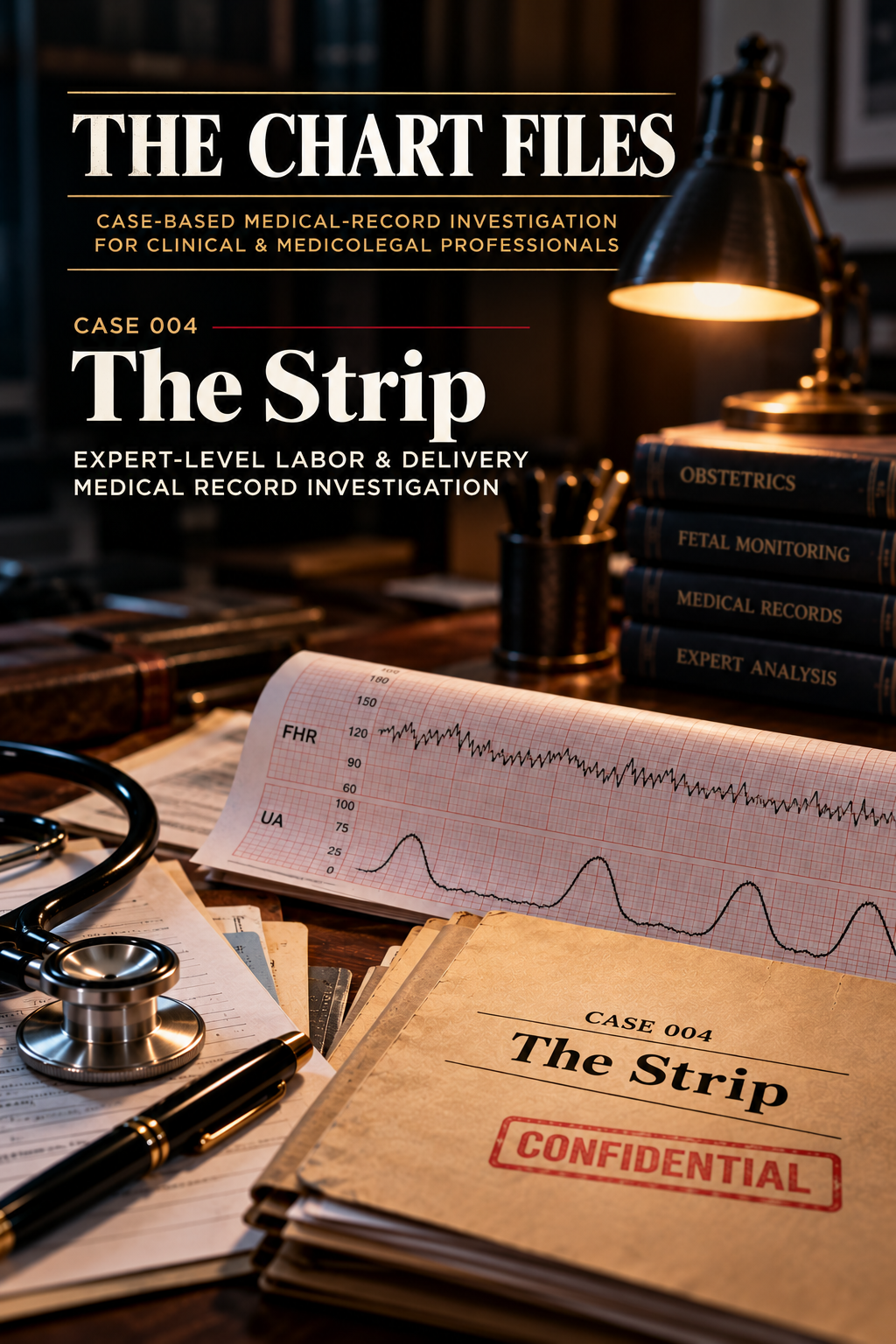
The Chart Files: Case 004 — The Strip
Expert-Level Labor & Delivery Medical Record Investigation
The baby is healthy. The mother is not.
An emergency cesarean results in a bladder injury. The patient maintains that the surgery was unnecessary. A board-certified obstetrician has reviewed the record and agrees — and plaintiff's counsel has retained you to help support the case.
The expert's preliminary opinion appears compelling.
The certified medical record appears to support it.
Until you start investigating the record itself.
Because buried across fetal monitoring data, nursing documentation, medication records, device logs, communication records, and EHR evidence is a problem counsel doesn't yet know exists:
Some of the factual premises supporting your own expert's opinion may not survive scrutiny.
And she's headed toward deposition.
Your Assignment
In Case 004 — The Strip, you are the consulting Legal Nurse Consultant in Dunbar v. Tidewater Regional Medical Center.
Counsel provides you with the hospital's certified medical-record production, the plaintiff's preliminary expert opinion, fetal monitoring records, and a focused assignment:
Determine whether the record actually supports the factual premises underlying the expert's opinions — and identify what additional evidence should be obtained before she testifies.
You are not being asked to decide whether the cesarean was necessary or whether the standard of care was breached.
Your job is harder in a different way.
You must determine what the records actually establish.
This Is Not a Case Study. It's an Investigation.
You will not receive every relevant document at once.
You begin with the evidence available to the litigation team and work the case as an investigator would.
Build the chronology. Identify inconsistencies. Separate documented fact from inference. Decide what the existing production can — and cannot — establish.
Then commit to your findings.
Only after doing so will you receive additional evidence.
New records may confirm your conclusions.
They may change them.
Or they may reveal that something you initially accepted as fact was never established at all.
Across three investigative stages, you'll repeatedly reassess the case as new evidence becomes available — exactly when changing your mind is more important than defending your first theory.
One Patient. Multiple Electronic Records. Multiple Clocks.
The clinical story does not exist in a single chart.
To reconstruct the critical period, you'll have to compare evidence generated by different systems with different purposes, timestamps, and evidentiary limitations.
You'll investigate:
fetal monitoring strips and NICHD terminology;
EHR flowsheet and medication documentation;
late entries and contemporaneous electronic evidence;
infusion-pump event data;
device-clock offsets and timestamp reconciliation;
physician-notification and communication records;
fetal-monitor annotations;
operative documentation;
hospital policies;
the completeness of a certified medical-record production;
and the factual assumptions underlying a retained expert's opinion.
Some sources will agree.
Others won't.
Your task is not merely to spot the discrepancy.
You have to determine which source can establish which fact — and why.
Can You Reconstruct What Actually Happened?
A chart might say a medication was discontinued at one time.
A device may tell a different story.
A nursing narrative may describe an event hours later.
A contemporaneous annotation may place it somewhere else.
And a physician's operative report may characterize the tracing differently from the archived fetal-monitor data.
Which timestamp matters?
Which record was created contemporaneously?
Which was entered later?
Does a device clock match the hospital's clock?
Can an apparent discrepancy be reconciled?
Does the evidence establish that documentation is wrong — or merely that additional investigation is required?
Those distinctions matter.
Finding a discrepancy is easy. Knowing what you're entitled to conclude from it is the real work.
The Certified Record May Not Be the Entire Record
You'll also confront a problem increasingly important in modern medical-record investigation:
What exactly did the hospital produce?
The certified chart may not contain every electronically maintained source relevant to the case.
You'll have to recognize evidence that may exist outside the conventional legal medical record, determine what additional records should be requested, and understand why “not included in the certified chart” does not necessarily mean “does not exist.”
The case forces you to think beyond the PDF.
Then Your Own Expert Becomes Part of the Investigation
The plaintiff's expert has already formed preliminary opinions.
Your job is not to validate them.
Your job is to test their factual foundation against the evidence.
What happens if the expert relied upon documentation that later evidence contradicts?
Which opinions remain supported?
Which require reconsideration?
What new questions should be taken back to the nursing or obstetrical experts?
And most importantly:
What does counsel need to know before the opposing side discovers it first?
This is where medical-record review becomes investigation.
What You'll Practice
The Strip is designed to challenge your ability to reconstruct chronology, evaluate source provenance, reconcile timestamps, distinguish clinical events from documentation events, identify missing evidence, test competing explanations, communicate evidentiary limitations, and recognize when a conclusion exceeds what the record can support.
You won't earn points for accusing someone of wrongdoing.
You won't earn points for deciding whether the surgery was necessary.
You'll earn them by knowing what the evidence establishes, what it suggests, what remains unknown — and what should happen next.
What's Included
55-page digital investigation file, including:
Investigator Workbook
Case Briefing and Assignment
Plaintiff's Preliminary Expert Opinion
Documents 01–20
Fetal Monitoring Strips
EHR and Clinical Documentation
Infusion-Pump Data
Communication Evidence
Policies and Supplemental Records
Three Staged Investigative Checkpoints
Final Attorney-Facing Challenge
Scored, Sealed Investigator's Analysis
NICHD Fetal Heart-Rate Reference
Difficulty: Expert — One of the most challenging Chart Files to date
Estimated Investigation Time: 2–3 hours
Prerequisite: Working knowledge of NICHD fetal heart-rate definitions; a one-page reference is included.
The Real Test
Anyone can review a medical record looking for evidence that supports the client's theory.
A clinical investigator has to be willing to discover that the theory is wrong.
The strongest LNC isn't the one who finds what counsel hoped was there.
It's the one who finds what is actually there, understands what it means, recognizes what it doesn't establish, and tells counsel before the other side does.
Work the file. Follow the evidence. Defend your conclusion.
The Chart Files: Case 004 — The Strip
Expert-Level Case Simulation | Digital PDF Download | $49.95
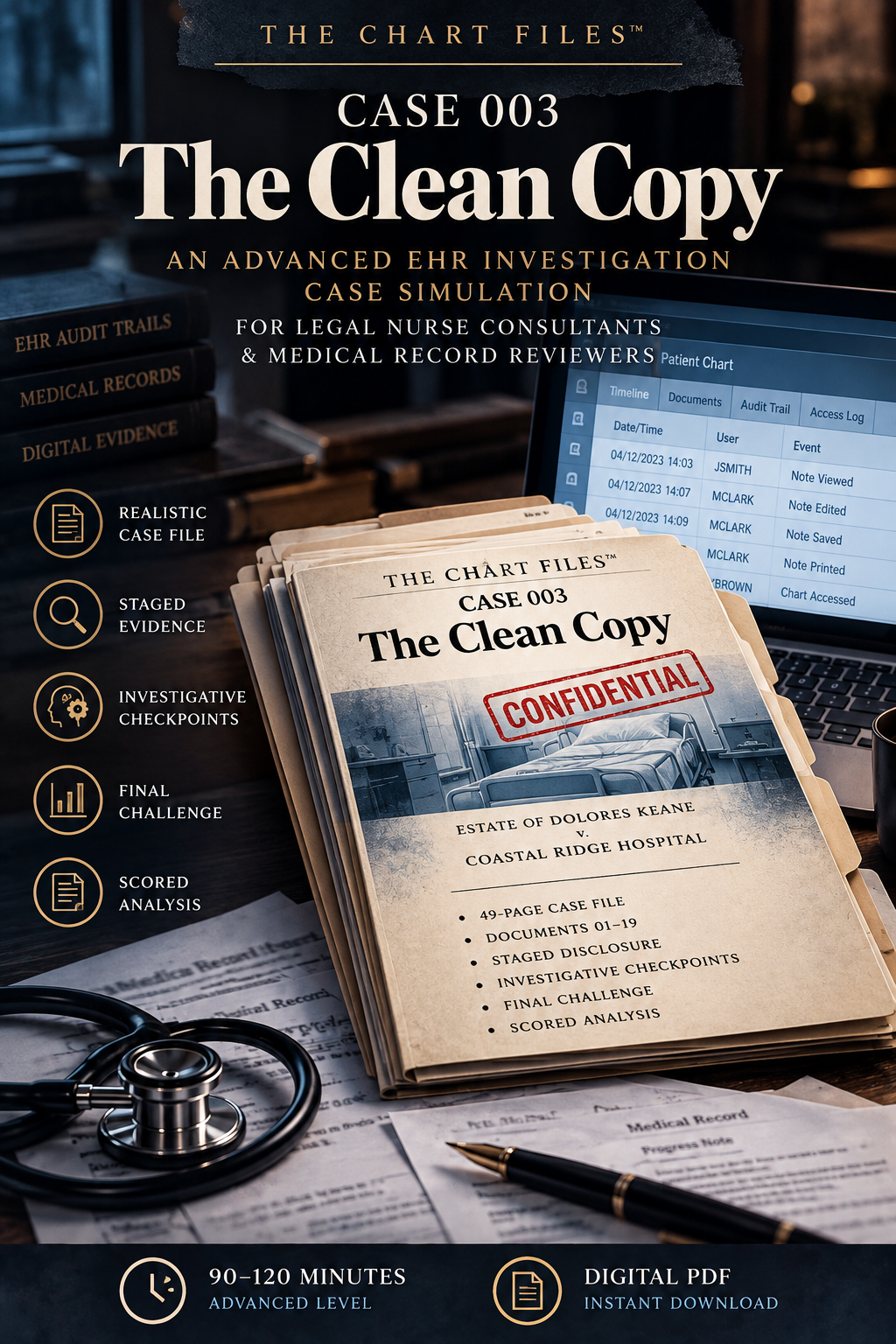
The Chart Files: Case 003 — The Clean Copy
An Advanced EHR Investigation Case Simulation for Legal Nurse Consultants & Medical Record Reviewers
Two versions of the same physician note exist.
One was downloaded from the patient portal. The other appears later in the hospital’s certified production.
They are not the same.
The later version contains clinically significant language that does not appear in the earlier copy.
Your job is to determine what happened — and, just as importantly, what the evidence actually allows you to say about it.
This Is Not a Case Study. It’s a Case File.
The Clean Copy puts you in the role of the consulting Legal Nurse Consultant retained to investigate a disputed electronic medical record.
You’ll work the matter much as evidence can emerge in an actual case: in stages.
You begin with the engagement materials and two conflicting versions of the record. Additional EHR evidence is then introduced as the investigation develops — including audit information, access data, hospital explanations, policies, scanning records, and other evidence that may confirm, complicate, or undermine your working theory.
At each stage, you must decide what is documented fact, inference, hypothesis, or still unknown before moving forward.
The Investigation
In Estate of Dolores Keane v. Coastal Ridge Hospital, plaintiff’s counsel has discovered a discrepancy between a physician note previously obtained through the patient portal and the version later included in the hospital’s certified medical-record production.
Counsel wants answers.
Was the record changed? When? By whom? What does the audit evidence actually establish? Does the hospital’s disclosure accounting answer the question counsel thinks it does? And can the newly appearing clinical information be independently corroborated?
You are not being asked to prove misconduct or assume the attorney’s theory is correct. You are being asked to investigate the electronic record and determine what the available evidence supports — and what it does not.
You’ll Work With
The 49-page case file includes the case workbook, Exhibits A–B, Documents 01–19, staged evidence releases, investigative checkpoints, a final challenge, and sealed/scored analysis. The case is rated Advanced and is designed for approximately 90–120 minutes of focused investigative work.
Along the way, you'll confront issues involving EHR version history and revisions, access logs versus HIPAA accounting of disclosures, certified medical-record productions, print templates, portal release and download activity, corroboration, and the relationship between written policy and actual system timestamps.
Can You Defend Your Conclusion?
Finding a difference between two records is easy.
Determining when the change occurred, what the system evidence establishes, whether the added information can be independently supported, and how far your conclusion can legitimately go is considerably harder.
That's the point of The Chart Files.
These cases are designed to develop the investigative side of medical-record review — observation, reconstruction, evidence classification, competing hypotheses, corroboration, and disciplined conclusions.
Don't just read about medical-record investigation. Work the case.
CASE FILE 003: THE CLEAN COPY
Difficulty: Advanced
Estimated investigation time: 90–120 minutes
Format: Digital PDF Download
Case: Estate of Dolores Keane v. Coastal Ridge Hospital
Primary Focus: EHR Revision & Audit-Trail Investigation
$39.95
Case 003 is also included in the complete EHR Audit Trails, Metadata & Digital Medical Record Investigations — Professional Training + Practice Toolkit.

EHR Audit Trails, Metadata & Digital Medical Record Investigations
Professional Training + Practice Toolkit for Legal Nurse Consultants
The medical record you receive is not always the whole story.
A printed chart or PDF is a rendering of information stored across an electronic health record. Behind it may be audit events, revision histories, access logs, metadata, portal activity, system timestamps, interface data, print settings, and other electronic evidence capable of answering questions the ordinary medical record cannot.
But knowing that data exists is not enough.
You need to know what to look for, what to request, who may hold it, how to interpret what comes back — and what the evidence does and does not allow you to conclude.
EHR Audit Trails, Metadata & Digital Medical Record Investigations is a professional training and practice toolkit designed for legal nurse consultants who want to add EHR documentation, audit-trail, and metadata investigation to their record-review skill set.
This is not simply a book about EHRs.
It is a complete system for learning the methodology, practicing it on realistic evidence, testing yourself against a complex case, and carrying the same workflow into your own consulting matters.
What You'll Learn
By the end of the program, you should be able to distinguish among an EHR audit trail, user access log, metadata, version history, and HIPAA accounting of disclosures — and explain those differences clearly to counsel.
You'll learn how to turn a vague concern such as “something about this chart doesn't add up” into a focused investigative question; identify the electronic evidence that may answer it; develop targeted requests; evaluate what is produced; recognize ordinary EHR behavior before treating it as significant; reconstruct an integrated timeline; and communicate your findings without overstating what the evidence proves.
The guiding principle throughout the program is simple:
An audit event, timestamp, or version difference is a reason to ask a specific question. It is not, by itself, evidence of wrongdoing.
The Complete Training + Practice System
01 | The Professional Field Manual
A comprehensive guide to the foundations and practical methodology of EHR investigation for the LNC.
You'll learn how electronic records are created, revised, timestamped, stored, accessed, and rendered — and why two versions of the “same” record may not actually contain the same information. The program addresses major EHR platforms conceptually while teaching a vendor-independent investigative approach.
The Field Manual includes the complete Nine-Step EHR Investigation Workflow, common EHR issues, request strategies, response evaluation, timeline reconstruction, request templates, worksheets, attorney communication, case scoping, and professional-practice considerations.
02 | Six Applied Case Laboratories
Reading about EHR evidence isn't the same as analyzing it.
Six case laboratories put the methodology to work using realistic record excerpts and audit evidence:
The Late Note
The Carried-Forward Exam
The Wrong Chart
The Cabinet and the MAR
The Corrected Summary
Two Clocks
Each laboratory requires you to work through the evidence yourself before reviewing the complete analysis.
03 | The Chart Files: Case 003 — The Clean Copy
Your advanced capstone investigation.
You are retained by plaintiff's counsel in a fictional wrongful-death matter involving two different versions of the same physician note.
Was the record changed?
When?
By whom?
And, most importantly, what does the evidence actually establish?
You'll work through a realistic 49-page case file containing a client engagement, portal record, certified medical-record production, revision history, access data, portal activity, print-template information, hospital policy, staged supplemental disclosures, and other evidence.
You don't receive everything at once.
New evidence is disclosed in stages, requiring you to commit to your analysis at checkpoints before seeing what comes next. At the conclusion, you'll answer counsel's Final Challenge before opening the sealed Investigator's Analysis and scoring your work.
Difficulty: Advanced
Estimated completion time: 90–120 minutes
Documents: Exhibits A–B + Documents 01–19
Includes: Scored, sealed Investigator's Analysis
04 | The EHR Investigation Chart File
Take the methodology into your own practice.
This separate working case packet organizes an EHR matter from initial intake through the attorney-facing findings summary using the same nine-step workflow taught throughout the program:
DEFINE → MAP → INVENTORY → REQUEST → TRACK → COMPARE → RECONSTRUCT → CORROBORATE → REPORT
The Chart File includes tools for case intake, electronic-record source mapping, production inventory, evidence targeting, audit and metadata request development, request-route tracking, custodian communications, audit-trail analysis, version comparison, timeline reconstruction, corroboration, and reporting.
Licensed individual purchasers may reuse the Chart File, worksheets, and templates in their own client matters.
More Than “Request the Audit Trail”
One of the most common problems in electronic-record investigation is imprecise terminology.
An audit trail is not the same thing as a user access log.
Neither is synonymous with metadata or version history.
And a HIPAA accounting of disclosures is not an internal EHR access log.
The program teaches you to distinguish these sources, understand what each may establish, identify the appropriate custodian, and formulate more precise requests rather than simply asking for “the audit trail.”
You'll also learn to consider evidence that may reside outside the primary EHR — including portals, laboratory systems, PACS, pharmacy and medication-dispensing systems, monitoring devices, HIEs, contracted physician systems, scanning systems, and communications platforms. The accompanying Chart File gives you a structured way to map those potential sources in an actual matter.
Built for the Legal Nurse Consultant
This program sits at the intersection of clinical record review and health-information-technology literacy.
It is not a digital-forensics certification and does not teach the LNC to make legal conclusions, determine intent, or replace the attorney, digital forensic examiner, or standard-of-care expert.
Instead, it teaches a specialized and highly practical consulting skill:
Understanding how electronic clinical documentation is created, changed, timestamped, retained, accessed, and produced well enough to ask better questions — and help counsel understand the answers.
What's Included
Professional Training + Field Manual — 63 pages
Foundations, Nine-Step Workflow, worksheets, request templates, professional practice guidance, six case laboratories, glossary, quick-reference material, and federal access-law appendix.
The EHR Investigation Chart File — 16 pages
A reusable working case packet for EHR documentation, audit-trail, and metadata matters.
The Chart Files: Case 003 — The Clean Copy — 49 pages
An advanced staged case simulation with exhibits, medical records, audit evidence, checkpoints, Final Challenge, and scored Investigator's Analysis.
Approximately 128 pages of professional training, applied investigation, and reusable practice tools.
Individual Professional License Included
Your individual license permits you to use the program yourself and to reuse the EHR Investigation Chart File, worksheets, and templates in your own independent consulting practice and client matters.
Program materials may not be redistributed, shared, resold, posted online, or used to teach others under the individual license. Practice, multi-LNC, and educator licensing are available separately.
Learn the Method. Work the Evidence. Use It in Practice.
Electronic medical records contain far more than what appears on the printed page.
The question is whether you know what else may exist — and what to do with it.
EHR Audit Trails, Metadata & Digital Medical Record Investigations gives you the methodology, practice cases, investigative tools, and advanced capstone to begin developing that skill as part of your LNC practice.
Learn. Practice. Prove. Apply.
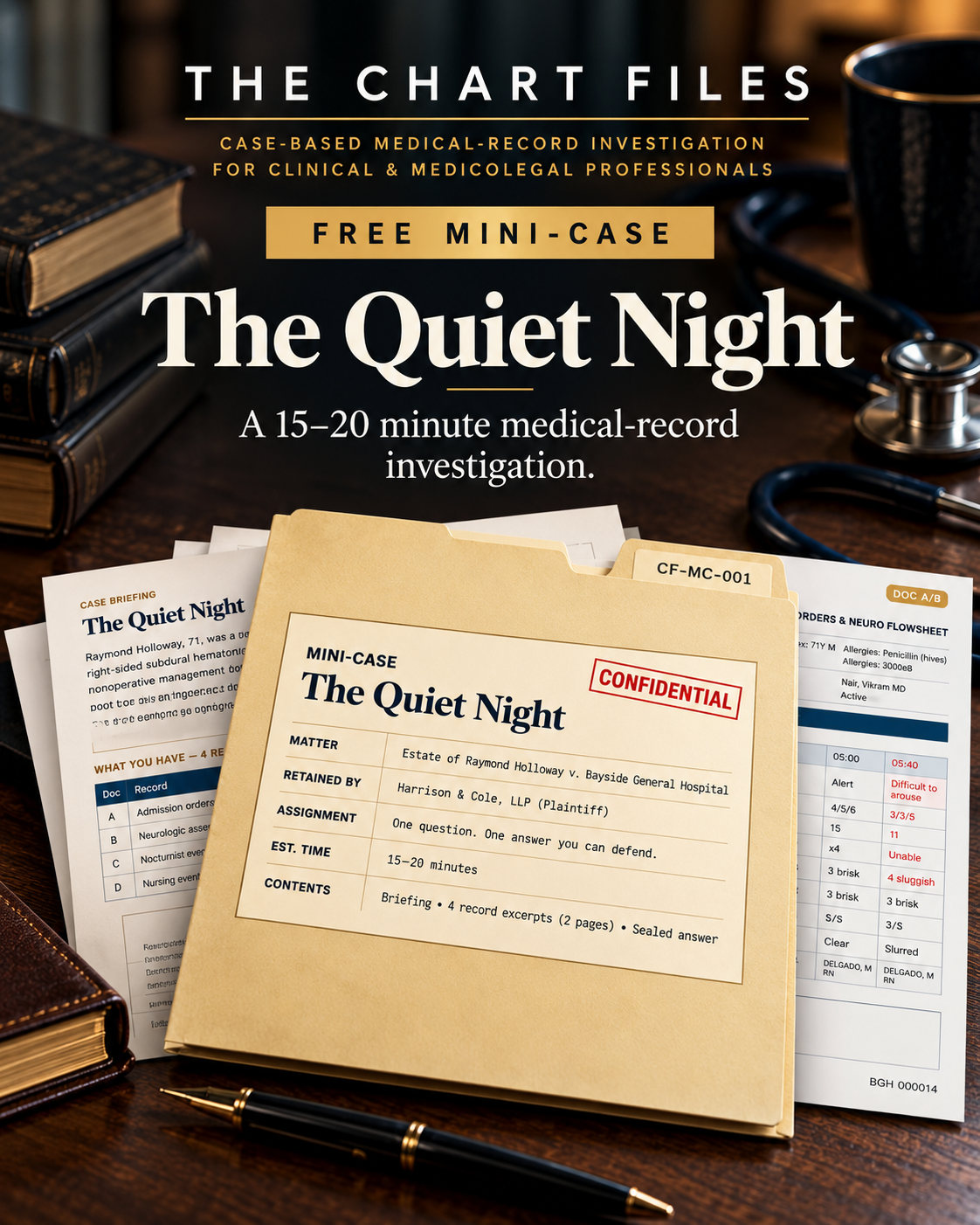
The Quiet Night — A Free Chart Files Mini-Case
A medical record can look complete, consistent, and convincing — until you start asking the right questions.
In The Quiet Night, a 71-year-old patient with a subdural hematoma deteriorates overnight. His flowsheet appears reassuring: hourly neurologic assessments, consistently normal, right up until the moment his condition dramatically changes.
But is that what actually happened?
You’ll receive a realistic case briefing and four medical-record excerpts and be asked to answer the same deceptively simple question posed to the consultant: Were the hourly neurologic checks done as ordered?
Work the evidence yourself. Compare records. Examine timestamps. Separate documented fact from inference, hypothesis, and the unknown. Then commit to an answer before breaking the seal on the case analysis.
Inside the sealed section, you'll discover additional evidence that changes how the record must be interpreted — and see how an investigator can identify a serious documentation problem without claiming more than the evidence actually proves.
Designed to take approximately 15–20 minutes, The Quiet Night is a compact introduction to The Chart Files — realistic medical-record investigations designed to sharpen observation, chronology, corroboration, evidence discipline, and clinical reasoning.
Built for legal nurse consultants, RNs, NPs, PAs, physicians, attorneys, and medical-record reviewers.
If you enjoy The Quiet Night, the full Chart Files take the investigation much deeper — with larger Bates-labeled record productions, EHR audit evidence, staged disclosures, investigative checkpoints, final challenges, and detailed analysis.
The record is not the event. It is evidence of the event.
The Chart Files: Case 002 — The Diagnosis That Grew
A Full Investigative Medical-Record Case Simulation for Legal Nurse Consultants
The diagnosis appears throughout the chart. But how did the chart come to know it?
Natalie Mercer is a 30-year-old elementary-school teacher whose medical record contains what appears to be a well-established history of bipolar II disorder.
An independent psychiatric examiner describes that history as “well-documented,” dating to at least May 2024 and independently documented by multiple providers.
Your job is not to accept that conclusion.
It isn't to reject it, either.
Your job is to investigate the record.
The Diagnosis That Grew places you inside a realistic legal-medical case involving fourteen months of primary care, urgent care, behavioral health, emergency, inpatient psychiatric, pharmacy, and EHR evidence.
You'll receive the case the way an LNC might actually receive it: an engagement letter, an expert opinion to test, a certified Bates-labeled medical-record production, and an investigative assignment.
Then the case evolves.
Additional records arrive.
Pharmacy evidence changes what you know.
Outside psychiatric records complicate the story.
EHR audit data reveals where apparently independent documentation actually came from.
At each stage, you'll have to decide what the evidence establishes — before seeing what comes next.
This is a case simulation, not a case study.
You won't simply read about diagnostic provenance.
You'll investigate it yourself.
Across an 81-page case file containing 35 realistic record documents, you'll reconstruct how a psychiatric diagnosis moved through the medical record — from observations and differential diagnosis to provisional diagnosis, problem list, past medical history, subsequent encounters, hospitalization, and ultimately a forensic psychiatric opinion.
The central question is deliberately narrower than:
Does Natalie Mercer have bipolar II disorder?
Nothing in the file permits you to make that diagnosis.
Instead, you'll investigate:
How did the record come to know that she did — and how certain was the evidence at each point?
What you'll work with
The simulation includes a realistic mixture of:
Primary-care records
Patient portal messages
Urgent-care documentation
Psychiatric evaluations and follow-up notes
Collateral history
Emergency-department records
Inpatient behavioral-health documentation
Medication histories
Laboratory and toxicology findings
Prescription-dispensing data
Outside psychiatric records
Problem-list history
EHR note-source and audit data
An independent forensic psychiatric evaluation
Some evidence supports the prevailing interpretation.
Some complicates it.
Some appears to corroborate earlier documentation — until you investigate where it came from.
And some evidence can tempt you toward a competing explanation that the record doesn't actually prove either.
Skills you'll practice
Case 002 is designed to develop practical clinical-forensic record-review skills, including diagnostic provenance, differential versus established diagnosis, problem-list propagation, copy-forward recognition, EHR text-source analysis, medication and exposure chronology, collateral-history evaluation, competing explanations, and the distinction between repetition and independent corroboration.
You'll also continue using the Chart Files investigative framework:
DOCUMENTED FACT — What the available evidence directly establishes.
INFERENCE — A conclusion reasonably drawn from one or more observations.
HYPOTHESIS — A proposed explanation requiring additional evidence.
UNKNOWN — Something the available record does not permit you to determine.
The challenge is not merely finding information.
It's knowing what you are entitled to conclude from it.
Work the case before you see the answer
The file is intentionally staged.
You'll encounter STOP pages and three investigative checkpoints requiring you to commit to your findings before opening subsequent disclosures.
New evidence may strengthen your analysis.
It may force you to revise it.
Or it may reveal that what looked like new corroboration was simply an old conclusion appearing in a new place.
At the end, you'll face a Final Challenge before opening the sealed Investigator's Analysis and scoring your work against a 22-point assessment.
What's included
One downloadable 81-page PDF case file, including:
Case briefing and engagement materials • Expert psychiatric opinion • 35 realistic medical-record documents • Bates-labeled record production • Staged supplemental disclosures • Outside psychiatric records • PDMP evidence • EHR audit evidence • Three investigative checkpoints • Final Challenge • Sealed Investigator's Analysis • 22-point self-assessment
Difficulty: Moderate
Estimated working time: 60–90 minutes
Format: Digital PDF download
Designed for: Legal Nurse Consultants, nurse reviewers, forensic nurses, and other professionals who want to sharpen medical-record investigative skills
The lesson beneath the case
A diagnosis appearing repeatedly in a medical record can look increasingly authoritative.
But repetition is not necessarily corroboration.
A differential can become a provisional diagnosis. A provisional diagnosis can enter a problem list. A problem-list entry can populate subsequent histories. Those histories can then be cited as evidence that multiple clinicians independently documented the condition.
Or they may not.
Your job is to find out.
Because the most consequential statement in a medical record may not be false.
It may simply be more certain on page 500 than the underlying evidence ever justified on page 50.
The Chart Files — Real records. Deeper thinking.
Don't just read the record. Investigate it.
All persons, facilities, and events in this simulation are fictional. Created for professional training and educational purposes. Licensed for individual training use only. This simulation does not provide legal or medical advice.
Think you know how to read a medical record? Prove it.
The Chart Files is a series of realistic, case-based medical-record investigations created specifically for Legal Nurse Consultants.
If you've ever worked through Hunt A Killer, Unsolved Case Files, Deadbolt Mystery Society, or another investigative mystery experience, you'll recognize the basic idea:
You're given the evidence. You work the case. You decide what the evidence supports.
The Chart Files brings that concept into the world of Legal Nurse Consulting — without turning medical-record review into a game.
Instead of fictional police reports and crime-scene clues, you'll work with the evidence LNCs actually encounter: medication administration records, physician orders, nursing documentation, flowsheets, audit trails, laboratory results, device data, and more.
There are no hidden ciphers. No contrived riddles. No cheesy “gotcha” clues.
The medical record is the puzzle.
The documents, patients, clinicians, and facilities are fictional, but the problems you'll encounter are rooted in the realities of healthcare, EHR documentation, medical-legal investigation, and the kinds of evidentiary questions that arise in actual case review.
For experienced LNCs, The Chart Files is an opportunity to put your investigative skills to the test.
For new and aspiring LNCs, it's something even harder to find:
A case to work before someone pays you to work theirs.
CASE 001: THE 14:06 ADMINISTRATION
A 67-year-old postoperative patient experiences a serious opioid-related respiratory event.
The Medication Administration Record shows hydromorphone 0.5 mg IV administered at 14:06.
There's a problem.
The physician order appears to have been entered at 14:19.
Plaintiff counsel wants answers:
Was hydromorphone administered before it was ordered?
Did that medication contribute to the patient's subsequent respiratory deterioration?
At first glance, the medical record appears to tell a straightforward story.
Don't be so sure.
YOUR ASSIGNMENT
You've been retained to conduct a preliminary medical-record review.
You'll receive a 37-page investigative case file containing an Investigator Workbook, 17 realistic medical-record documents, staged supplemental evidence, and a sealed Investigator's Analysis.
But you don't get everything at once.
The investigation unfolds in stages. You'll review the evidence available to you, reconstruct what happened, answer specific investigative questions, and commit to your conclusions before opening the next disclosure.
New evidence may confirm what you thought.
It may require you to revise your conclusions.
Or it may reveal that something you thought you knew was never actually established at all.
HOW THE INVESTIGATION WORKS
Stage 1 — Accept the Assignment
Receive the engagement letter from plaintiff counsel and determine exactly what you've been asked to investigate.
Stage 2 — Review the Initial Production
Work through the certified medical record as originally produced, including anesthesia documentation, postoperative orders, nursing flowsheets, the MAR, order history, nursing notes, Rapid Response documentation, laboratory results, imaging, physician documentation, and discharge records.
Stage 3 — Checkpoint One
Reconstruct the timeline. Identify the important evidence. Commit to your preliminary findings.
Stage 4 — Supplemental Disclosure
Counsel obtains additional electronic evidence. Review the newly produced EHR audit data and determine whether it changes the meaning of anything you've already seen.
Stage 5 — Checkpoint Two
Interrogate your original conclusions. Defend them, modify them, or abandon them based on the evidence now available.
Stage 6 — Biomedical Evidence
A final source of clinical data becomes available.
Stage 7 — The Final Challenge
Counsel calls.
You have 60 seconds to explain what the evidence actually supports.
Stage 8 — Break the Seal
Only after completing the investigation do you open the Investigator's Analysis and compare your reasoning with the case analysis.
THIS ISN'T A “SPOT THE ERROR” WORKSHEET.
The central discipline of The Chart Files is learning to separate four very different things:
DOCUMENTED FACT
What does the available evidence directly establish?
INFERENCE
What can reasonably be concluded from one or more observations?
HYPOTHESIS
What explanation fits the evidence but still requires additional evidence?
UNKNOWN
What does the available record simply not permit you to determine?
Because a plausible explanation is not necessarily an established fact.
And something appearing in the medical record doesn't necessarily mean what you initially think it means.
Your job isn't to construct the most persuasive story. Your job is to determine what the evidence permits you to say.
SKILLS YOU'LL PUT TO WORK
Case 001 challenges you to apply and sharpen skills including:
Timeline reconstruction
Medication-administration analysis
EHR documentation and audit trails
Source provenance
Observation versus inference
Negative evidence
Competing hypotheses
Recognition of missing information
Corroboration and contradiction
Revision of conclusions as new evidence emerges
And throughout the investigation, you'll confront a deceptively simple question:
What does a timestamp actually prove?
FOR EXPERIENCED LNCs
You review medical records professionally.
But how often do you get to test your own investigative process when nothing is riding on the outcome?
Case 001 gives you that opportunity.
Can you distinguish the record from the event the record supposedly represents?
Can you recognize when multiple documents aren't actually independent corroboration?
Can you identify assumptions hiding inside apparently factual conclusions?
Can you resist premature closure when the evidence seems obvious?
And, perhaps most importantly:
Can you change your mind when the evidence changes?
Put your process under pressure and find out.
FOR NEW AND ASPIRING LNCs
One of the great problems facing a new Legal Nurse Consultant is simple:
How do you become good at reviewing cases before you have cases to review?
Courses can teach concepts. Books can explain methodology. Sample reports can show you the finished product.
But eventually, you have to sit down with a medical record and do the work yourself.
The Chart Files gives you that opportunity in a controlled environment.
No client is waiting.
No attorney is depending on your answer.
No real patient's case is at stake.
You can investigate, make mistakes, reconsider your assumptions, and compare your reasoning with the Investigator's Analysis afterward.
A case to work before someone pays you to work theirs.
CASE FILE SPECIFICATIONS
Case: 001 — The 14:06 Administration
Matter: Eleanor Price v. North River Medical Center
Difficulty: Intermediate–Advanced
Estimated Investigation Time: 60–90 minutes
Case File: 37 pages
Evidence: 17 medical-record documents
Format: Digital PDF
Includes: Investigator Workbook + Sealed Investigator's Analysis
Designed For: Legal Nurse Consultants and medical-record reviewers
All patients, clinicians, facilities, and events portrayed in the simulation are fictional.
THIS IS CASE 001.
The 14:06 Administration is the first investigation in The Chart Files.
Future cases will bring new medical records, new clinical scenarios, new documentation problems, and new evidentiary challenges — each designed to develop the investigative reasoning behind sophisticated medical-record review.
Not simply:
What does the chart say?
But:
What does the evidence establish?
What am I inferring?
What else could explain it?
What should be present if my hypothesis is correct?
What's missing?
That's the difference between simply reading the medical record and investigating it.
Don't just read the record. Investigate it.
Open Case 001.
The record is waiting.
Digital download. Instant access.
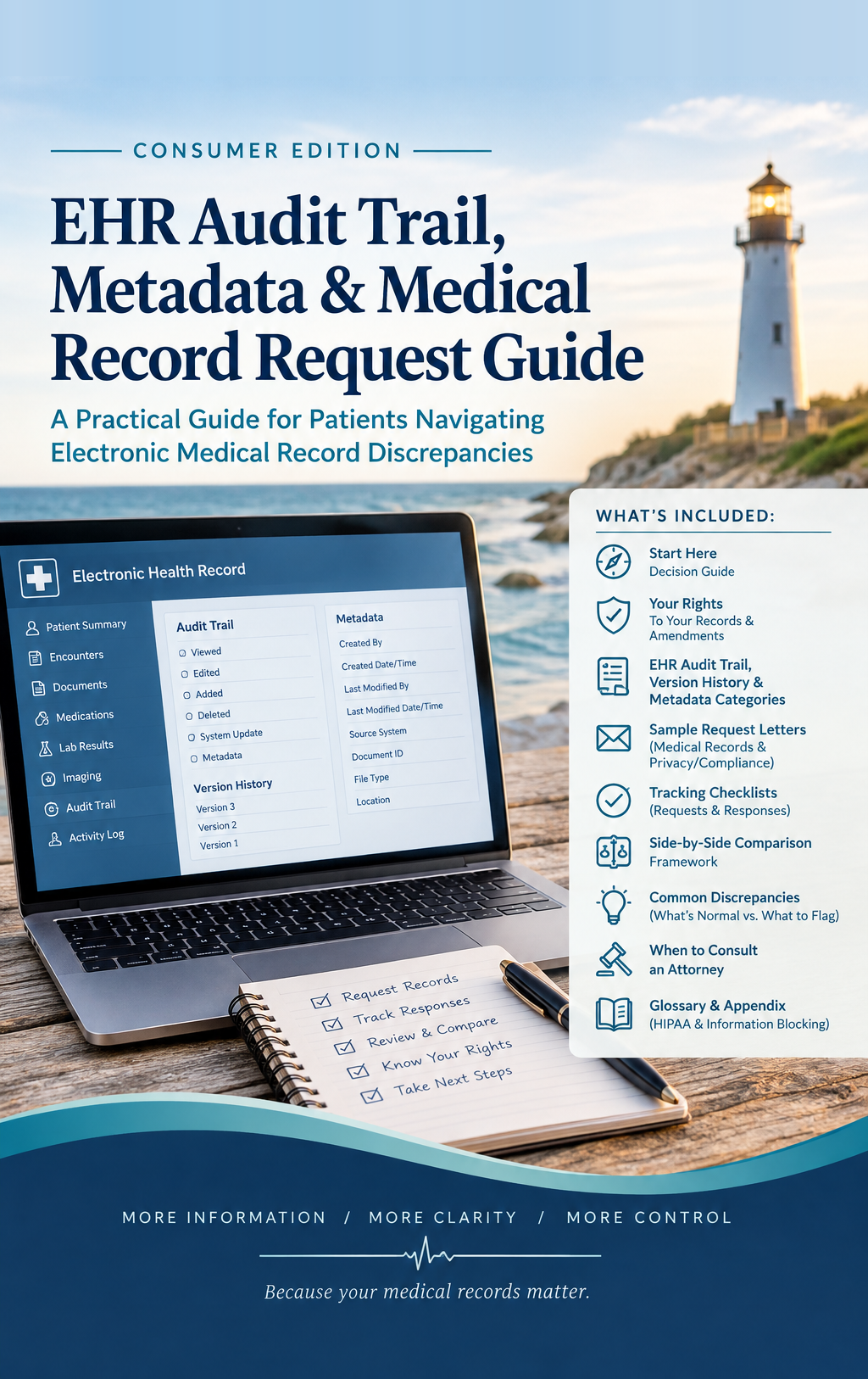
A Practical Guide for Patients Navigating Electronic Medical Record Discrepancies
Description:
Getting a copy of your medical record is only half the story. Behind every chart is a digital paper trail — an audit log, a version history, system metadata — that shows when an entry was really created, whether it was edited later, and by whom. Most patients don't know this information exists, let alone how to ask for it.
This 35-page guide gives you the same framework a legal nurse consultant uses to start this kind of work, organized into a clear, step-by-step process you can follow on your own — before deciding whether you need anything more.
What's included:
A "start here" decision guide to point you to exactly what you need
Plain-language explanation of your federal rights to your records, amendments, and access
A complete list of the EHR audit trail, version history, and metadata categories worth requesting
Ready-to-adapt sample request letters for Medical Records and Privacy/Compliance offices
Request and response tracking checklists
A side-by-side comparison framework for evaluating what you receive
A guide to common, non-malicious causes of documentation discrepancies — so you know what's actually worth flagging
Guidance on when it's time to consult an attorney
Glossary and a plain-language HIPAA/information blocking reference appendix
Format: Delivered as both a Word document and a PDF, so you can fill in the worksheets directly or simply read and print. Licensed for personal use by a single purchaser. Includes limited follow-up email support to help you apply the guide.
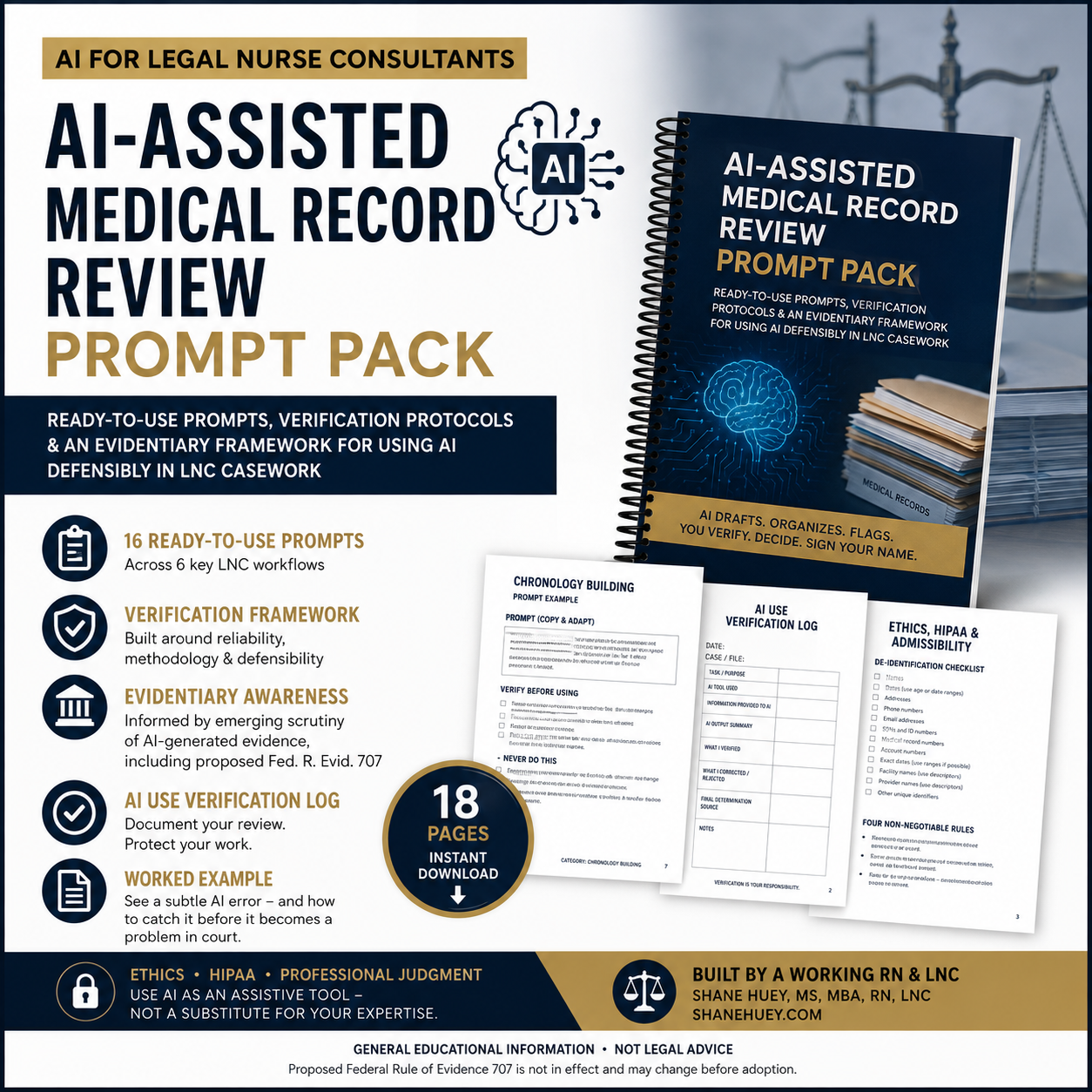
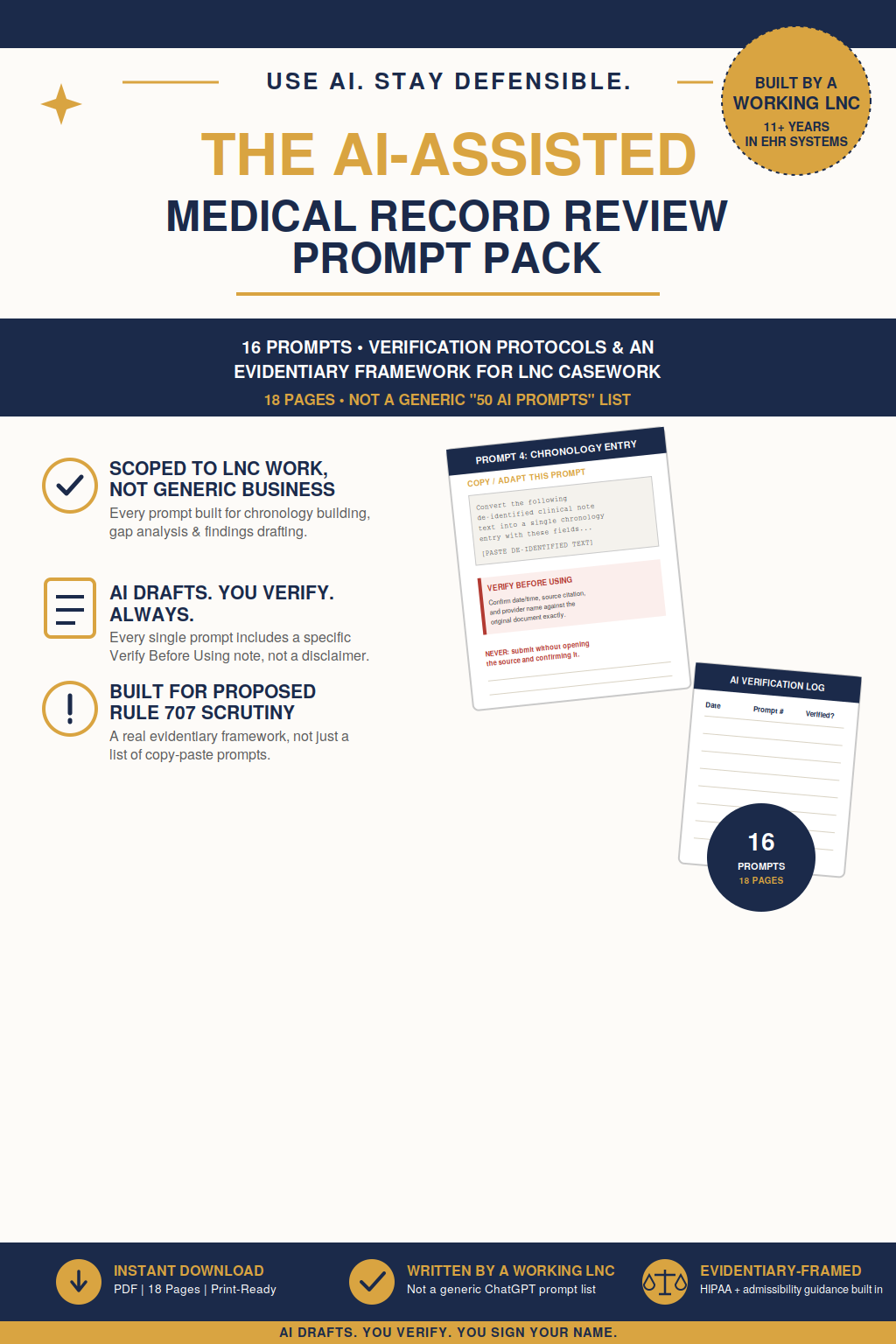
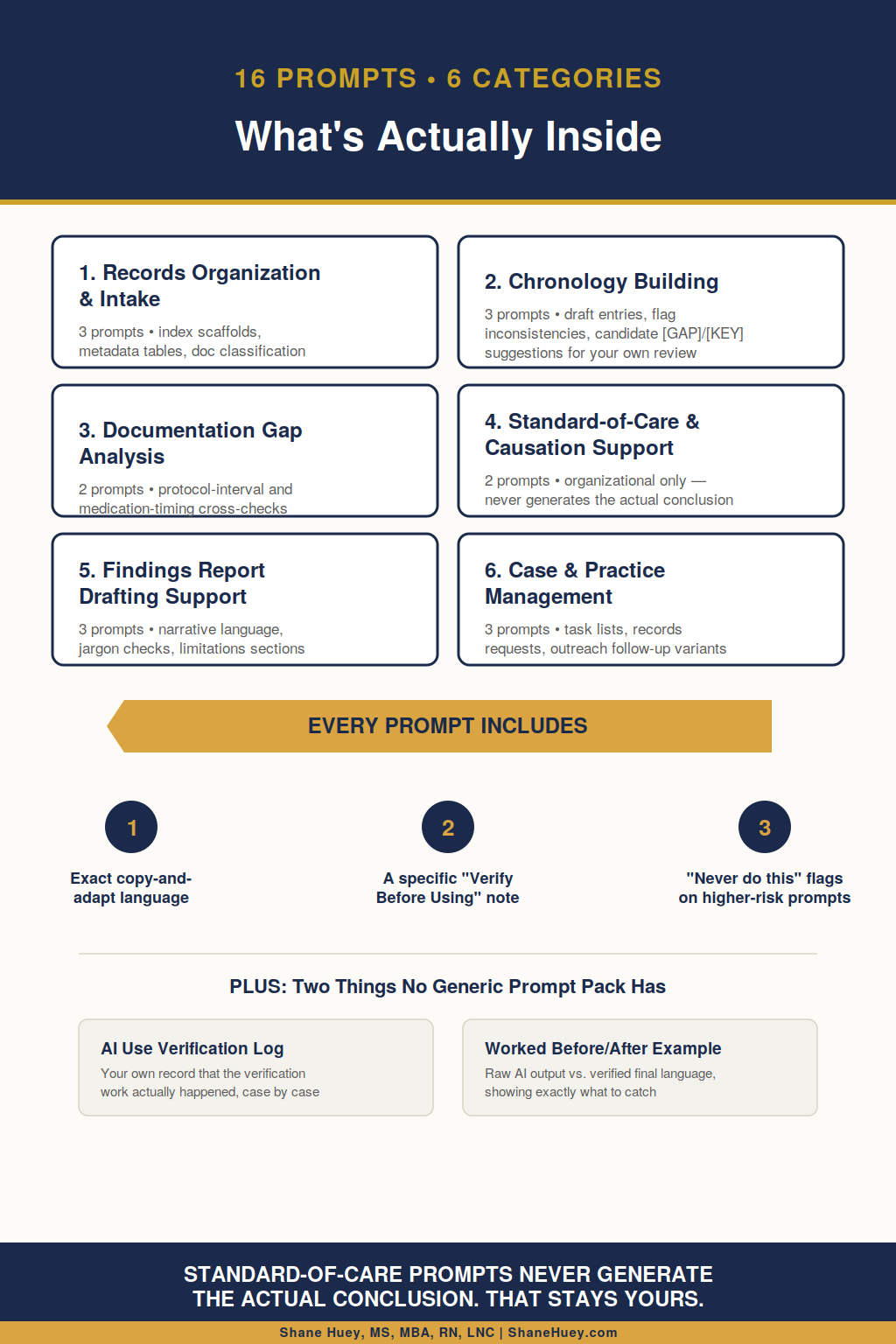
THE AI-ASSISTED MEDICAL RECORD REVIEW PROMPT PACK
Ready-to-Use Prompts, Verification Protocols & an Evidentiary Framework for Using AI Defensibly in LNC Casework
Most AI prompt packs are generic — the same 50 prompts sold to marketers, students, and small business owners with a new cover slapped on. This one isn't. Every prompt in this pack is scoped specifically to legal nurse consulting work, built around a real evidentiary framework, and written by a working legal and forensic nurse consultant — not adapted from a general-purpose template.
This guide exists because of something most LNCs using AI right now haven't thought through. A proposed new Federal Rule of Evidence — Rule 707 — would specifically require AI-generated evidence offered without an expert witness to meet the same reliability standards as expert testimony. It isn't in effect yet, and won't be before December 1, 2027 at the earliest — but the federal judiciary is actively working through exactly the questions this guide is built around: reliability, methodology, and verification for AI-generated evidence. Whether or not this specific rule is ultimately adopted, that scrutiny isn't going away. This pack teaches you to use AI genuinely well, inside a framework that stays defensible either way.
WHAT'S INSIDE (18 PAGES):
Why This Guide Exists
The real evidentiary context behind why AI discipline matters now — including a real federal case, decided under existing evidentiary standards (not the proposed Rule 707), that shows exactly the kind of scrutiny this new rule would formalize into a specific, named requirement.
Ethics, HIPAA & Admissibility — Read This Before Prompt 1
A genuine de-identification checklist, four non-negotiable rules governing every prompt in this pack, and the same Daubert-standard framework I hold every input to in my own practice — not a boilerplate disclaimer.
16 Ready-to-Use Prompts Across 6 Categories:
Records Organization & Intake
Chronology Building
Documentation Gap Analysis
Standard-of-Care & Causation Support (organizational support only — never asks AI to generate the actual clinical or legal conclusion)
Findings Report Drafting Support
Case & Practice Management
Every single prompt includes:
The exact copy-and-adapt language
A "Verify Before Using" note specific to that prompt's actual risk points — not a generic warning
"Never do this" callouts on the higher-risk prompts
Plus:
An AI Use Verification Log — your own record that the verification work actually happened
A worked before/after example showing the exact kind of subtle, confident AI error that gets expert reports excluded from court
WHY THIS IS DIFFERENT
This isn't a course teaching you to let AI think for you. Every prompt is built around one rule: AI drafts, organizes, and flags. You verify, decide, and sign your name. The standard-of-care prompts in particular are scoped so AI can never generate the actual clinical determination — that stays yours, always, by design.
WHAT YOU GET
The complete 18-page guide as an instant-download PDF
16 fully-developed prompts, ready to copy and adapt
Print-ready formatting
LICENSE
For personal, non-commercial use. Please don't share or redistribute — if a colleague wants a copy, send them to the listing.
A NOTE ON SCOPE
This guide offers general educational information about using AI tools in LNC work. It is not legal advice and does not constitute a HIPAA compliance determination. Verify current requirements in your own jurisdiction.
WRITTEN BY
Shane Huey, MS, MBA, RN, LNC — ShaneHuey.com
Instant digital download. No physical item will be shipped.
The Toolkit and the Method Behind It
Nine case-ready document templates, plus the interview methodology to back up what's in them.
Most of the work of being an LNC happens before anyone sees your report: organizing the record, building the chronology, deciding what's missing, and figuring out what the client actually experienced versus what ended up in the chart.
This bundle covers both halves of that work — the documents you build the case on, and a structured way to conduct the interviews that go into it.
What's Included
The LNC Case Toolkit — nine templates built for case work, not generic project management: Initial Case Assessment Checklist, Medical Record Chronology Template, Missing Documentation Checklist, Standard of Care Review Worksheet, Medical Record Request Checklist, Case Viability Decision Form, Client/Patient Interview Sheet, EHR Metadata Request Guide, and a Witness Statement Reliability Scoring Guide.
Signal-Based Interviewing — the ebook, the Linguistic Clarity Index scoring rubric, a question bank, and an interview note-taking template. A method for reading what a client's or patient's language actually reveals, not just what they say, built from forensic linguistics and investigative interviewing rather than sales-training theory.
Together: a documented process from intake through interview through case chronology, in your own name, ready to use on your next file.
Why Both
The Case Toolkit gives you structure. Signal-Based Interviewing gives you a defensible way to conduct and document the interview itself — the part of the process that's usually the least standardized, and the part that's hardest to explain to an attorney after the fact if your notes are thin.
Used together, every document in the toolkit and every score in the LCI comes back to the same thing: what's actually documented, not what you remember or assumed.
What You're Actually Getting
9 case document templates (docx + PDF), yours to use and rebrand across your own practice
A full ebook on Signal-Based Interviewing, written for legal and clinical intake
The complete LCI scoring rubric and a print-ready scoring sheet
A question bank organized by interview purpose
An interview note-taking template for use in the room
Lifetime updates on both products
No subscription. No recurring fee. Use it on your first case this week.
About Shane Huey, MS, MBA, RN, LNC
Forensic nurse consultant and legal nurse consultant with 11+ years in healthcare IT and EHR systems, trained in forensic linguistics, investigative interviewing, and statement analysis. Signal-Based Interviewing and the LNC Case Toolkit are both built from that background — not adapted from generic business templates.
FAQ
Do I need both products, or can I buy them separately? Both are available on their own. The bundle is priced lower than buying them individually — see pricing below.
Are the templates locked to a specific case type? No. They're built for general medical record review and case work and can be adapted to your specialty.
Can I put my own branding on the templates? Yes. They're yours to use and rebrand for your own practice. Resale or redistribution isn't included in the license.
Is Signal-Based Interviewing a certification? No. It's a method and a set of working tools, not a credentialed course.
Build the file. Read the interview. Document both.
Your Client Already Rehearsed the Story. Here's How to Hear Past It.
A forensic linguistic method for legal client intake and patient history-taking — built by a forensic nurse consultant, not a sales trainer.
The Problem
By the time a client sits down with you, they've already told the story more than once — to a spouse, a claims adjuster, an ER nurse, a friend. Not because they're being dishonest. Because that's what people do with a hard experience: they compress it, smooth it out, and settle on a version that's easy to repeat.
The same thing happens across the exam table. A patient describing a symptom reaches for the words they think you want to hear, not necessarily the words that describe what's actually happening.
Standard intake questions can't tell the difference between a lived account and a rehearsed one — because they're not designed to. Signal-Based Interviewing is.
The Method
Signal-Based Interviewing (SBI™) is a structured, forensic-linguistics-based interview method that evaluates what a client's or patient's language reveals — not just what they say. It draws on the same discipline used in investigative interviewing and forensic statement analysis, adapted specifically for legal intake and clinical/forensic history-taking.
At the center of it is the Linguistic Clarity Index (LCI) — a six-dimension, behaviorally anchored scoring instrument you can use to document, score, and defend your read on any interview, using the person's own language as the evidence.
This isn't lie detection, and it isn't a diagnostic tool. It's a disciplined way of listening that turns an ordinary interview into a documented, defensible record.
What's Inside
A complete, ready-to-use system — not just theory.
📘 Signal-Based Interviewing (the ebook) The full method: why standard intake interviews fail, what SBI is, the complete Linguistic Clarity Index with real anchor examples, how to design questions that produce language worth scoring, and a full worked interview — from first question to a scored, documented Clarity Profile.
📋 LCI Scoring Rubric The complete behaviorally anchored scoring guide for all six LCI dimensions, the four Clarity Profile tiers, and a print-ready scoring & profile sheet for every interview you conduct.
❓ Question Bank Dozens of open, non-telegraphed questions organized by purpose — incident narrative, medical history, functional impact, and consistency checks — each paired with the direct question it replaces and a note on why the reframing works. Plus a ready-to-deploy six-question sequence.
📝 Interview Note-Taking Template A structured capture sheet for use during the interview — pre-interview checklist, six question-capture blocks, a real-time observation log, and an immediate post-interview recall protocol.
📖 Quick-Start Guide How the four pieces fit together, in the order you'll actually use them.
Why This, Why Now
Most interviewers — legal and clinical alike — are still evaluating the performance in the room: confidence, delivery, how convincing someone sounds. You'll be reading the language underneath it.
That's a different skill, and it's one your file, your chart, or your record can actually show your work on. Every score in the LCI is grounded in the client's or patient's own words — not your gut feel, not a hunch. That's what makes it something you can stand behind later, whether "later" is a deposition, a peer review, or your own case notes six months from now.
About Shane Huey, MS, MBA, RN, LNC
Shane Huey is a forensic nurse consultant and legal nurse consultant with 11+ years in healthcare IT and EHR systems, combined with training in forensic linguistics, investigative interviewing, and statement analysis. Signal-Based Interviewing is his own applied-forensic-linguistics methodology, developed first for employment interviewing and adapted here specifically for the interviews that define legal and clinical practice.
FAQ
Is this a substitute for medical records, documentary evidence, or corroborating witnesses? No. SBI produces one additional, structured, documented data point. It strengthens your file — it doesn't replace the rest of it.
Do I need special software or recording equipment? No. The method works from your own notes or a standard Zoom/Teams transcript. The note-taking template is built for either.
Is this only for personal injury intake? No — the question bank and worked examples cover both legal client intake and patient/forensic history-taking, and the six-question framework adapts to most one-on-one interview contexts.
Can I use this with my team? Yes. Each document is yours to use across your own practice.
Start reading people, not performances.
How to Become an LNC
A Realistic Roadmap for Nurses Considering Legal Nurse Consulting
Free — 46 pages of real answers, not recruitment copy.
Most information about becoming an LNC comes from people selling a certification program — which means it's optimistic by design. This guide isn't. It's written by a working legal and forensic nurse consultant who's built the business from the ground up, covering what the field actually requires: the clinical foundation, the legal fluency, how training and certification really work, and — most importantly — the relationship-driven business reality that determines whether a new LNC's practice survives its first two years.
Inside the guide:
What an LNC actually does, day to day — beyond "reads medical records for lawyers"
The clinical experience you need before you're ready, and why
Understanding the legal side without needing a law degree
Training and certification paths, including a full breakdown of CLS by BARBRI and why joining AALNC early is worth it
The honest truth about how slow the first year really is, and why that's normal
Choosing your path: part-time freelance, full-time solo, subcontracting, or W-2
Specializing vs. staying a generalist — and branching into forensics
The tools and systems every new LNC needs from day one
Common mistakes that have nothing to do with clinical skill
Realistic income expectations, by employment model
No sign-up funnel tricks, no inflated income promises — just the roadmap a new LNC actually needs, from someone who's walked it.
Download now for free.
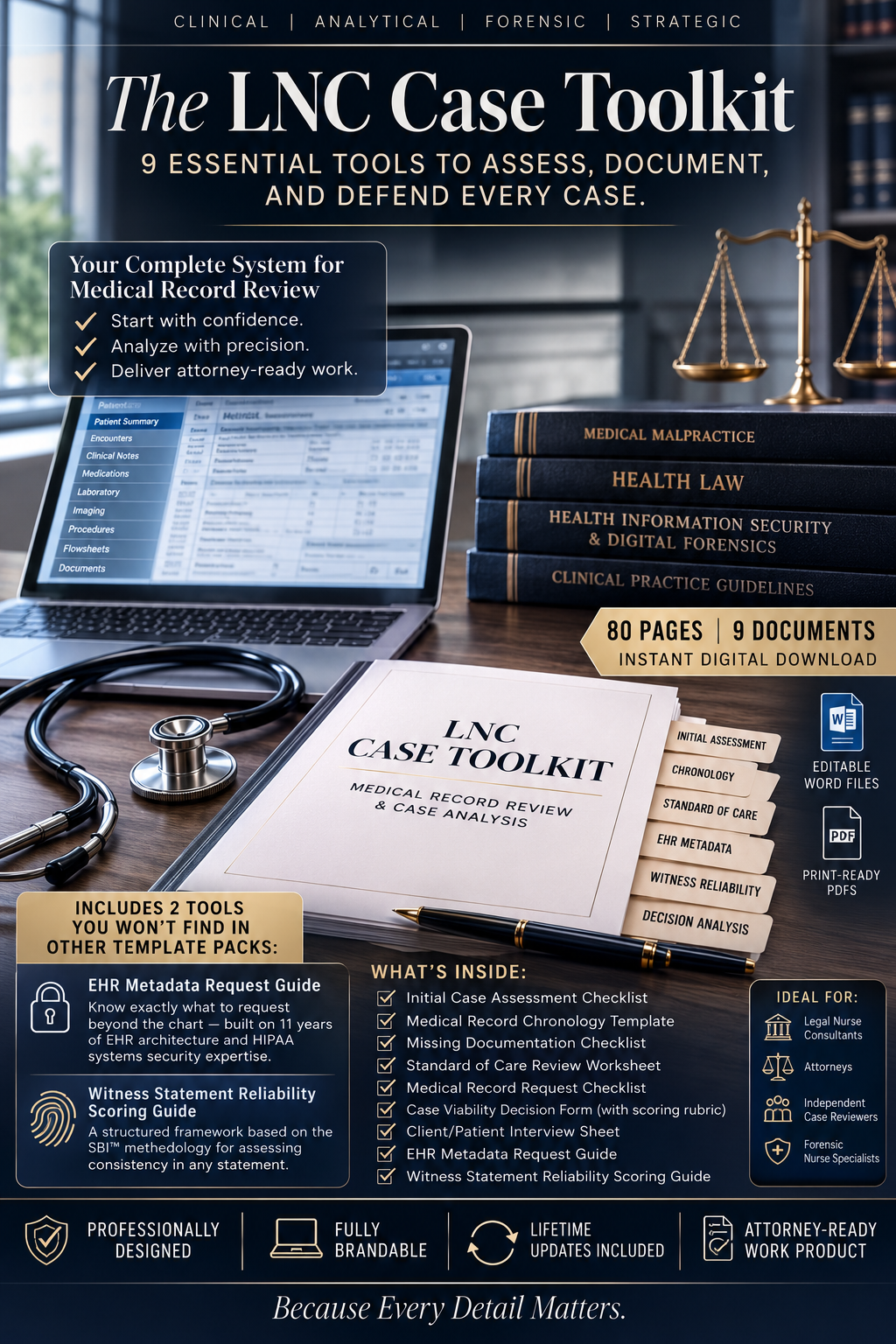
The LNC Case Toolkit
9 essential tools to assess, document, and defend every case
The LNC Case Toolkit gives you a complete, professionally designed system for reviewing and organizing a case from first referral to final decision — created by a legal and forensic nurse consultant who doesn't just know how to read the medical record, but has actually built and maintained the electronic health record for numerous large healthcare organizations over an 11-year career, backed by a master's degree in Information Security with a focus on HIPAA-regulated systems and digital forensics.
That distinction matters most in two tools you won't find in other LNC template packs:
The EHR Metadata Request Guide — built on 11 years of hands-on EHR architecture and HIPAA systems security work, not a surface-level checklist. Know exactly what to request beyond the flattened chart, why it matters, and how to get records custodians to actually produce it.
The Witness Statement Reliability Scoring Guide — adapted from the SBI™ (Signal-Based Interviewing) methodology, a proprietary forensic interviewing framework, and applied here to depositions, staff witnesses, family accounts, and client interviews.
80 pages. 9 documents. One complete system.
What's inside:
Initial Case Assessment Checklist
Medical Record Chronology Template
Missing Documentation Checklist
Standard of Care Review Worksheet
Medical Record Request Checklist
Case Viability Decision Form (with scoring rubric)
Client/Patient Interview Sheet
EHR Metadata Request Guide — know exactly what to request beyond the chart itself
Witness Statement Reliability Scoring Guide — a structured framework for assessing consistency in any statement, built on the SBI™ methodology
Every document comes as an editable Word file and a print-ready PDF, fully brandable for your own practice. Lifetime updates included — as the toolkit improves, so does yours.
No results found
No results match your search. Try removing a few filters.