 Image 1 of 1
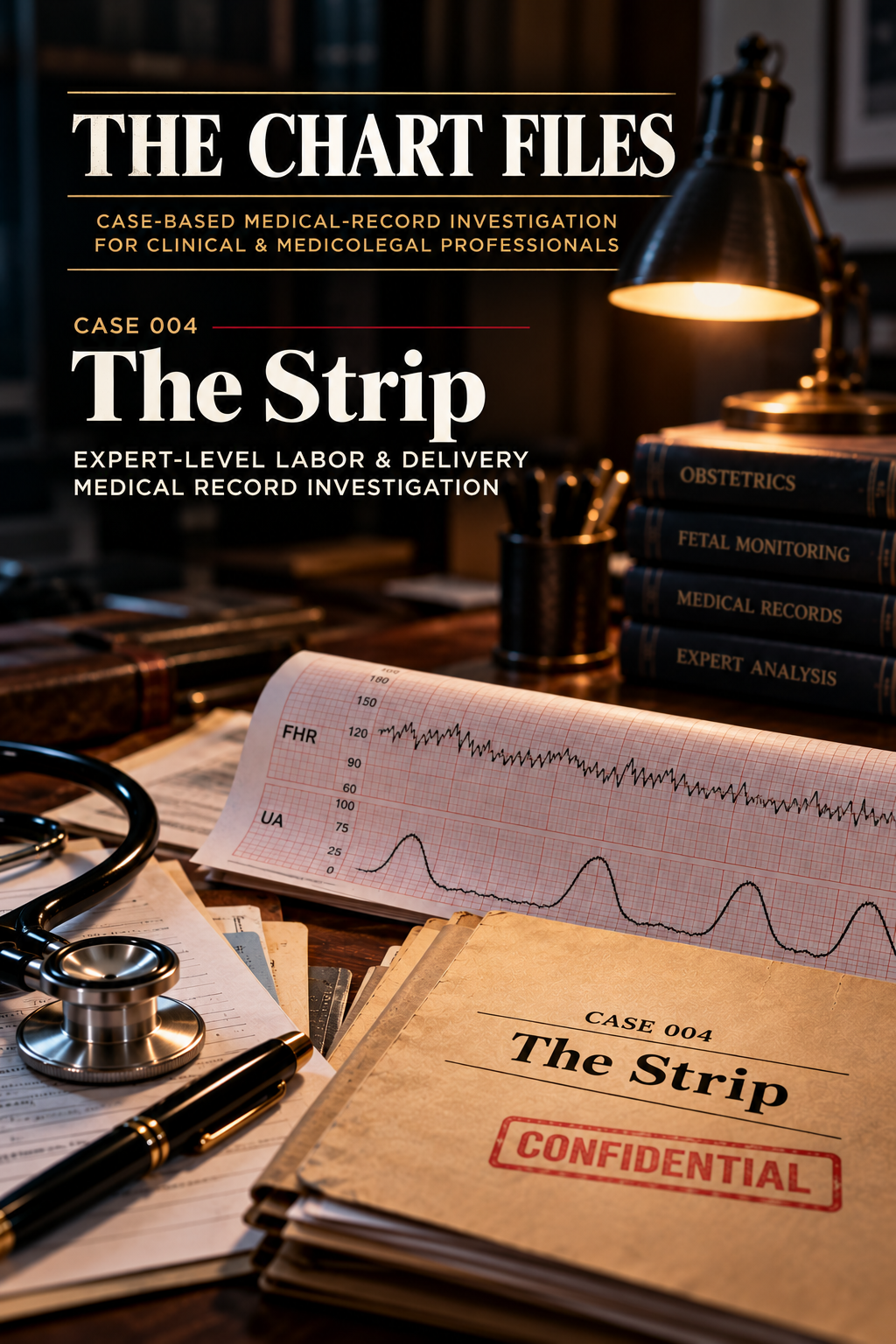
The Chart Files: Case 004 — The Strip
The Chart Files: Case 004 — The Strip
Expert-Level Labor & Delivery Medical Record Investigation
The baby is healthy. The mother is not.
An emergency cesarean results in a bladder injury. The patient maintains that the surgery was unnecessary. A board-certified obstetrician has reviewed the record and agrees — and plaintiff's counsel has retained you to help support the case.
The expert's preliminary opinion appears compelling.
The certified medical record appears to support it.
Until you start investigating the record itself.
Because buried across fetal monitoring data, nursing documentation, medication records, device logs, communication records, and EHR evidence is a problem counsel doesn't yet know exists:
Some of the factual premises supporting your own expert's opinion may not survive scrutiny.
And she's headed toward deposition.
Your Assignment
In Case 004 — The Strip, you are the consulting Legal Nurse Consultant in Dunbar v. Tidewater Regional Medical Center.
Counsel provides you with the hospital's certified medical-record production, the plaintiff's preliminary expert opinion, fetal monitoring records, and a focused assignment:
Determine whether the record actually supports the factual premises underlying the expert's opinions — and identify what additional evidence should be obtained before she testifies.
You are not being asked to decide whether the cesarean was necessary or whether the standard of care was breached.
Your job is harder in a different way.
You must determine what the records actually establish.
This Is Not a Case Study. It's an Investigation.
You will not receive every relevant document at once.
You begin with the evidence available to the litigation team and work the case as an investigator would.
Build the chronology. Identify inconsistencies. Separate documented fact from inference. Decide what the existing production can — and cannot — establish.
Then commit to your findings.
Only after doing so will you receive additional evidence.
New records may confirm your conclusions.
They may change them.
Or they may reveal that something you initially accepted as fact was never established at all.
Across three investigative stages, you'll repeatedly reassess the case as new evidence becomes available — exactly when changing your mind is more important than defending your first theory.
One Patient. Multiple Electronic Records. Multiple Clocks.
The clinical story does not exist in a single chart.
To reconstruct the critical period, you'll have to compare evidence generated by different systems with different purposes, timestamps, and evidentiary limitations.
You'll investigate:
fetal monitoring strips and NICHD terminology;
EHR flowsheet and medication documentation;
late entries and contemporaneous electronic evidence;
infusion-pump event data;
device-clock offsets and timestamp reconciliation;
physician-notification and communication records;
fetal-monitor annotations;
operative documentation;
hospital policies;
the completeness of a certified medical-record production;
and the factual assumptions underlying a retained expert's opinion.
Some sources will agree.
Others won't.
Your task is not merely to spot the discrepancy.
You have to determine which source can establish which fact — and why.
Can You Reconstruct What Actually Happened?
A chart might say a medication was discontinued at one time.
A device may tell a different story.
A nursing narrative may describe an event hours later.
A contemporaneous annotation may place it somewhere else.
And a physician's operative report may characterize the tracing differently from the archived fetal-monitor data.
Which timestamp matters?
Which record was created contemporaneously?
Which was entered later?
Does a device clock match the hospital's clock?
Can an apparent discrepancy be reconciled?
Does the evidence establish that documentation is wrong — or merely that additional investigation is required?
Those distinctions matter.
Finding a discrepancy is easy. Knowing what you're entitled to conclude from it is the real work.
The Certified Record May Not Be the Entire Record
You'll also confront a problem increasingly important in modern medical-record investigation:
What exactly did the hospital produce?
The certified chart may not contain every electronically maintained source relevant to the case.
You'll have to recognize evidence that may exist outside the conventional legal medical record, determine what additional records should be requested, and understand why “not included in the certified chart” does not necessarily mean “does not exist.”
The case forces you to think beyond the PDF.
Then Your Own Expert Becomes Part of the Investigation
The plaintiff's expert has already formed preliminary opinions.
Your job is not to validate them.
Your job is to test their factual foundation against the evidence.
What happens if the expert relied upon documentation that later evidence contradicts?
Which opinions remain supported?
Which require reconsideration?
What new questions should be taken back to the nursing or obstetrical experts?
And most importantly:
What does counsel need to know before the opposing side discovers it first?
This is where medical-record review becomes investigation.
What You'll Practice
The Strip is designed to challenge your ability to reconstruct chronology, evaluate source provenance, reconcile timestamps, distinguish clinical events from documentation events, identify missing evidence, test competing explanations, communicate evidentiary limitations, and recognize when a conclusion exceeds what the record can support.
You won't earn points for accusing someone of wrongdoing.
You won't earn points for deciding whether the surgery was necessary.
You'll earn them by knowing what the evidence establishes, what it suggests, what remains unknown — and what should happen next.
What's Included
55-page digital investigation file, including:
Investigator Workbook
Case Briefing and Assignment
Plaintiff's Preliminary Expert Opinion
Documents 01–20
Fetal Monitoring Strips
EHR and Clinical Documentation
Infusion-Pump Data
Communication Evidence
Policies and Supplemental Records
Three Staged Investigative Checkpoints
Final Attorney-Facing Challenge
Scored, Sealed Investigator's Analysis
NICHD Fetal Heart-Rate Reference
Difficulty: Expert — One of the most challenging Chart Files to date
Estimated Investigation Time: 2–3 hours
Prerequisite: Working knowledge of NICHD fetal heart-rate definitions; a one-page reference is included.
The Real Test
Anyone can review a medical record looking for evidence that supports the client's theory.
A clinical investigator has to be willing to discover that the theory is wrong.
The strongest LNC isn't the one who finds what counsel hoped was there.
It's the one who finds what is actually there, understands what it means, recognizes what it doesn't establish, and tells counsel before the other side does.
Work the file. Follow the evidence. Defend your conclusion.
The Chart Files: Case 004 — The Strip
Expert-Level Case Simulation | Digital PDF Download | $49.95
The Chart Files: Case 004 — The Strip
Expert-Level Labor & Delivery Medical Record Investigation
The baby is healthy. The mother is not.
An emergency cesarean results in a bladder injury. The patient maintains that the surgery was unnecessary. A board-certified obstetrician has reviewed the record and agrees — and plaintiff's counsel has retained you to help support the case.
The expert's preliminary opinion appears compelling.
The certified medical record appears to support it.
Until you start investigating the record itself.
Because buried across fetal monitoring data, nursing documentation, medication records, device logs, communication records, and EHR evidence is a problem counsel doesn't yet know exists:
Some of the factual premises supporting your own expert's opinion may not survive scrutiny.
And she's headed toward deposition.
Your Assignment
In Case 004 — The Strip, you are the consulting Legal Nurse Consultant in Dunbar v. Tidewater Regional Medical Center.
Counsel provides you with the hospital's certified medical-record production, the plaintiff's preliminary expert opinion, fetal monitoring records, and a focused assignment:
Determine whether the record actually supports the factual premises underlying the expert's opinions — and identify what additional evidence should be obtained before she testifies.
You are not being asked to decide whether the cesarean was necessary or whether the standard of care was breached.
Your job is harder in a different way.
You must determine what the records actually establish.
This Is Not a Case Study. It's an Investigation.
You will not receive every relevant document at once.
You begin with the evidence available to the litigation team and work the case as an investigator would.
Build the chronology. Identify inconsistencies. Separate documented fact from inference. Decide what the existing production can — and cannot — establish.
Then commit to your findings.
Only after doing so will you receive additional evidence.
New records may confirm your conclusions.
They may change them.
Or they may reveal that something you initially accepted as fact was never established at all.
Across three investigative stages, you'll repeatedly reassess the case as new evidence becomes available — exactly when changing your mind is more important than defending your first theory.
One Patient. Multiple Electronic Records. Multiple Clocks.
The clinical story does not exist in a single chart.
To reconstruct the critical period, you'll have to compare evidence generated by different systems with different purposes, timestamps, and evidentiary limitations.
You'll investigate:
fetal monitoring strips and NICHD terminology;
EHR flowsheet and medication documentation;
late entries and contemporaneous electronic evidence;
infusion-pump event data;
device-clock offsets and timestamp reconciliation;
physician-notification and communication records;
fetal-monitor annotations;
operative documentation;
hospital policies;
the completeness of a certified medical-record production;
and the factual assumptions underlying a retained expert's opinion.
Some sources will agree.
Others won't.
Your task is not merely to spot the discrepancy.
You have to determine which source can establish which fact — and why.
Can You Reconstruct What Actually Happened?
A chart might say a medication was discontinued at one time.
A device may tell a different story.
A nursing narrative may describe an event hours later.
A contemporaneous annotation may place it somewhere else.
And a physician's operative report may characterize the tracing differently from the archived fetal-monitor data.
Which timestamp matters?
Which record was created contemporaneously?
Which was entered later?
Does a device clock match the hospital's clock?
Can an apparent discrepancy be reconciled?
Does the evidence establish that documentation is wrong — or merely that additional investigation is required?
Those distinctions matter.
Finding a discrepancy is easy. Knowing what you're entitled to conclude from it is the real work.
The Certified Record May Not Be the Entire Record
You'll also confront a problem increasingly important in modern medical-record investigation:
What exactly did the hospital produce?
The certified chart may not contain every electronically maintained source relevant to the case.
You'll have to recognize evidence that may exist outside the conventional legal medical record, determine what additional records should be requested, and understand why “not included in the certified chart” does not necessarily mean “does not exist.”
The case forces you to think beyond the PDF.
Then Your Own Expert Becomes Part of the Investigation
The plaintiff's expert has already formed preliminary opinions.
Your job is not to validate them.
Your job is to test their factual foundation against the evidence.
What happens if the expert relied upon documentation that later evidence contradicts?
Which opinions remain supported?
Which require reconsideration?
What new questions should be taken back to the nursing or obstetrical experts?
And most importantly:
What does counsel need to know before the opposing side discovers it first?
This is where medical-record review becomes investigation.
What You'll Practice
The Strip is designed to challenge your ability to reconstruct chronology, evaluate source provenance, reconcile timestamps, distinguish clinical events from documentation events, identify missing evidence, test competing explanations, communicate evidentiary limitations, and recognize when a conclusion exceeds what the record can support.
You won't earn points for accusing someone of wrongdoing.
You won't earn points for deciding whether the surgery was necessary.
You'll earn them by knowing what the evidence establishes, what it suggests, what remains unknown — and what should happen next.
What's Included
55-page digital investigation file, including:
Investigator Workbook
Case Briefing and Assignment
Plaintiff's Preliminary Expert Opinion
Documents 01–20
Fetal Monitoring Strips
EHR and Clinical Documentation
Infusion-Pump Data
Communication Evidence
Policies and Supplemental Records
Three Staged Investigative Checkpoints
Final Attorney-Facing Challenge
Scored, Sealed Investigator's Analysis
NICHD Fetal Heart-Rate Reference
Difficulty: Expert — One of the most challenging Chart Files to date
Estimated Investigation Time: 2–3 hours
Prerequisite: Working knowledge of NICHD fetal heart-rate definitions; a one-page reference is included.
The Real Test
Anyone can review a medical record looking for evidence that supports the client's theory.
A clinical investigator has to be willing to discover that the theory is wrong.
The strongest LNC isn't the one who finds what counsel hoped was there.
It's the one who finds what is actually there, understands what it means, recognizes what it doesn't establish, and tells counsel before the other side does.
Work the file. Follow the evidence. Defend your conclusion.
The Chart Files: Case 004 — The Strip
Expert-Level Case Simulation | Digital PDF Download | $49.95