Your medical record follows you for life.
It can influence the care you receive, the medications and allergies clinicians see, how your health history is understood, and—in some circumstances—information used in insurance and claims decisions.
But when was the last time you actually checked it?
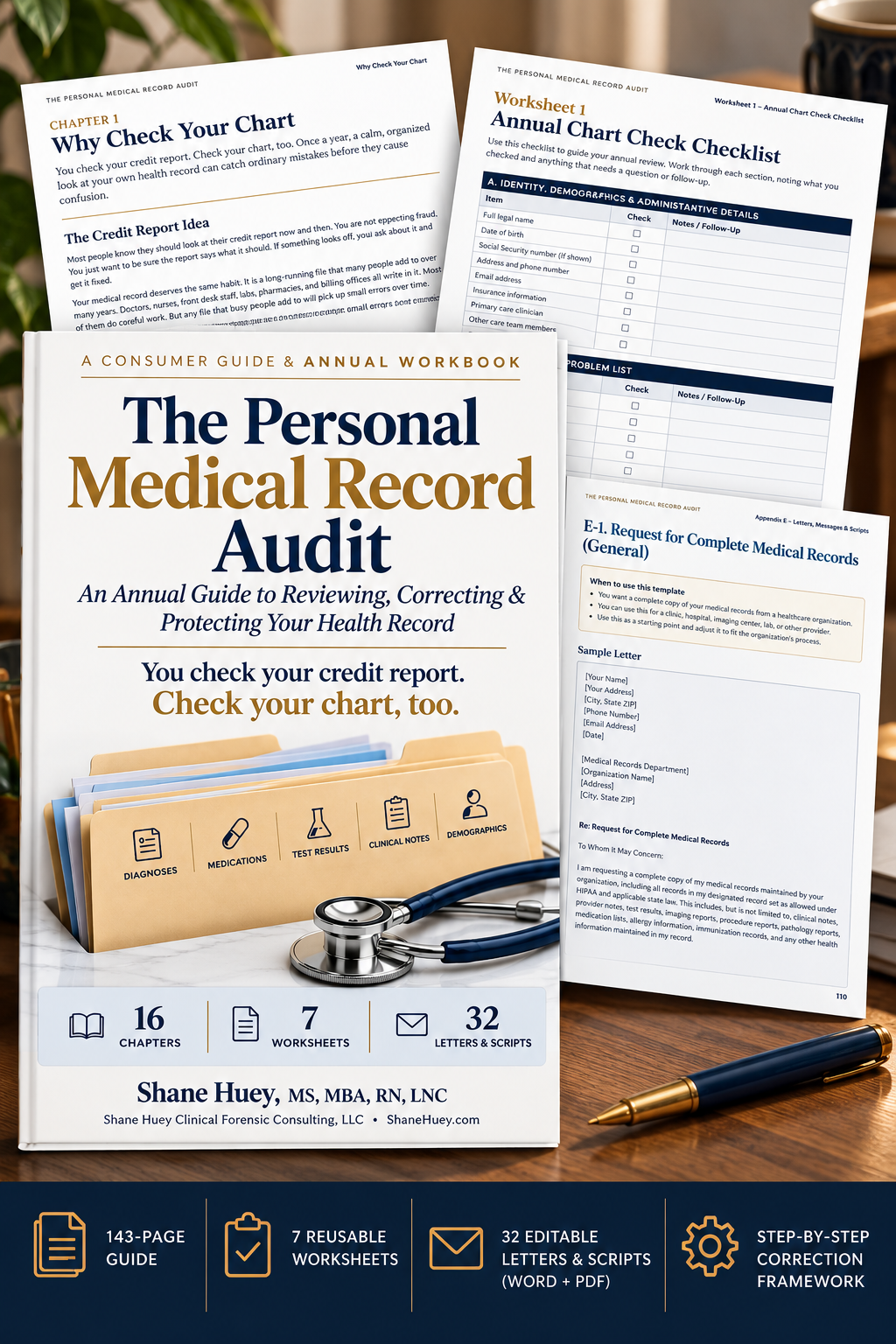
The Personal Medical Record Audit is a 143-page consumer guide and annual workbook that shows you, step by step, how to review your own medical records for inaccurate, outdated, missing, duplicated, or potentially wrong-patient information—and what to do when you find something that doesn't look right.
No medical background required. No healthcare IT knowledge required. Everything is explained in plain English.
Your patient portal is useful—but it isn't necessarily your complete medical record.
This guide shows you where your health information can live, how it moves between healthcare organizations, and how to systematically review the information that matters most.
You'll learn how to check:
diagnoses and your problem list;
medications, allergies, and immunizations;
laboratory and imaging results;
procedures and surgeries;
clinical notes and medical history;
demographics, insurance, and administrative information;
information that may be outdated, duplicated, or copied forward;
entries that may belong to another patient; and
records held outside the portal, including health information exchanges, registries, and certain insurance-related databases.
You'll also learn how to read a clinical note—including the difference between what you reported, what a clinician observed, and the clinician's professional assessment—so you can distinguish a genuine factual discrepancy from something that simply looks unfamiliar.
Finding a questionable entry is only the beginning.
The guide walks you through an Eight-Step Correction Framework for documenting the issue, finding its source, requesting the appropriate records, contacting the right organization, requesting an amendment when appropriate, tracking the response, and verifying what ultimately changed.
It also explains your medical-record rights in understandable language, including HIPAA access and amendment rights, information blocking, designated record sets, health information exchanges, CommonWell, Carequality, TEFCA, registries, MIB and prescription-history reports.
And because correcting information at one healthcare organization doesn't necessarily correct copies that have already traveled elsewhere, you'll learn how to follow the information downstream.
The goal isn't to make you obsess over your medical record.
It's to make checking it routine.
The Annual Chart Check gives you a repeatable process you can perform once a year, much like reviewing your credit report.
The package includes 7 reusable worksheets to help you inventory your records, document questionable entries, track requests and amendments, follow up, and create an annual audit summary.
And when it's time to actually contact someone, you won't have to wonder what to say.
You'll receive practical templates for situations including:
requesting your complete medical record • requesting a missing record • questioning an unfamiliar diagnosis • updating medication information • requesting an amendment • responding to a denied amendment • asking that corrected information be sent downstream • reporting possible wrong-patient information • following up on unanswered requests • and more.
The templates are also provided in a separate editable Word document, so you can customize them without copying and reformatting text from the guide.
Shane Huey, MS, MBA, RN, LNC has been a Registered Nurse for 14 years and has spent more than 11 years building, maintaining, and working with electronic health record systems.
His work sits at the intersection of clinical care, healthcare IT, electronic documentation, and regulatory requirements.
As a Legal Nurse Consultant and Clinical Investigator, he also examines medical records critically—tracing where information came from, comparing conflicting documentation, identifying what may be missing, distinguishing repeated information from independent evidence, and determining what the record actually supports.
The Personal Medical Record Audit brings that experience to consumers in plain English.
The Personal Medical Record Audit — PDF
143-page consumer guide and annual workbook
16 chapters
7 reusable worksheets
Plain-language HIPAA and patient-rights reference
Medical terminology and abbreviation references
Healthcare and regulatory resource directory
32 letters, portal messages, and phone scripts
Editable Letters, Messages & Scripts — Word
All 32 templates in an editable format for easy customization.
Your medical record tells your health story.
Make sure it's telling the right one.
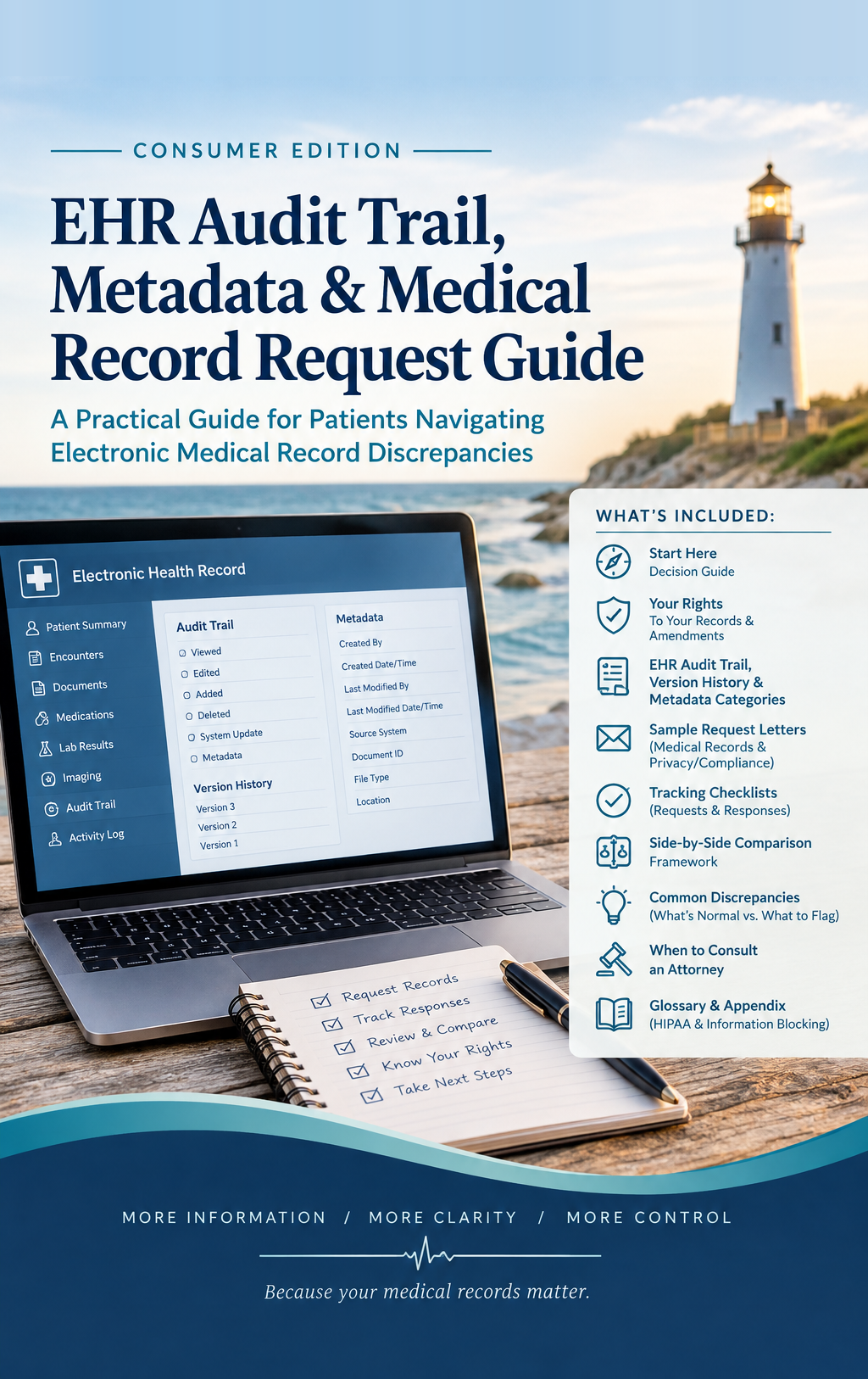
A Practical Guide for Patients Navigating Electronic Medical Record Discrepancies
Description:
Getting a copy of your medical record is only half the story. Behind every chart is a digital paper trail — an audit log, a version history, system metadata — that shows when an entry was really created, whether it was edited later, and by whom. Most patients don't know this information exists, let alone how to ask for it.
This 35-page guide gives you the same framework a legal nurse consultant uses to start this kind of work, organized into a clear, step-by-step process you can follow on your own — before deciding whether you need anything more.
What's included:
A "start here" decision guide to point you to exactly what you need
Plain-language explanation of your federal rights to your records, amendments, and access
A complete list of the EHR audit trail, version history, and metadata categories worth requesting
Ready-to-adapt sample request letters for Medical Records and Privacy/Compliance offices
Request and response tracking checklists
A side-by-side comparison framework for evaluating what you receive
A guide to common, non-malicious causes of documentation discrepancies — so you know what's actually worth flagging
Guidance on when it's time to consult an attorney
Glossary and a plain-language HIPAA/information blocking reference appendix
Format: Delivered as both a Word document and a PDF, so you can fill in the worksheets directly or simply read and print. Licensed for personal use by a single purchaser. Includes limited follow-up email support to help you apply the guide.
No results match your search. Try removing a few filters.