 Image 1 of 1
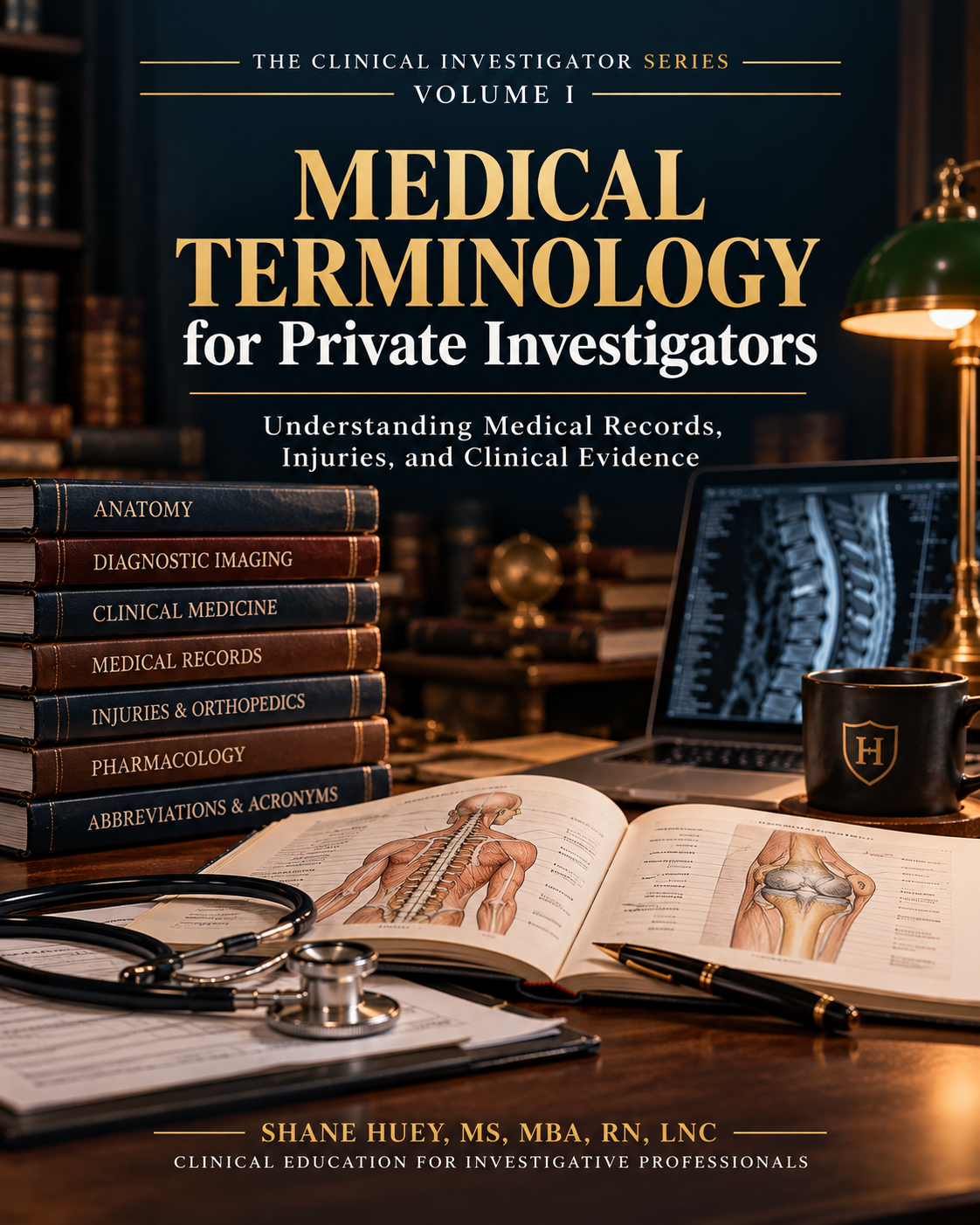
Medical Terminology for Private Investigators
Medical Terminology for Private Investigators
Understanding Medical Records, Injuries, and Clinical Evidence
An 82-page professional field guide designed specifically for private investigators and other investigative professionals who encounter medical records, injuries, diagnoses, and clinical evidence.
You don't need to be a clinician to investigate a case involving medical evidence.
But you do need to understand what you're reading.
What does radiculopathy actually mean? What's the difference between a sprain and a strain? Does a herniated disc necessarily explain someone's symptoms? What does WBAT mean? What is an antalgic gait — and should an investigator actually use that term in a surveillance report?
Traditional medical terminology books are written for people entering healthcare.
This one isn't.
Medical Terminology for Private Investigators was created specifically for investigators who need enough clinical literacy to understand medical evidence, recognize what may matter to an investigation, document observations accurately, and know when interpretation belongs to a qualified medical expert.
Learn the Language Without Going to Medical School
Medical terminology can appear impenetrable until you understand how the language is constructed.
This guide teaches the prefixes, roots, suffixes, anatomical directions, abbreviations, and clinical vocabulary investigators are most likely to encounter — with an emphasis on investigative relevance rather than memorization.
You'll learn terminology associated with:
Spine and back injuries · Shoulder and upper-extremity injuries · Hip, knee, and lower-extremity injuries · Head injury and concussion · Neurological complaints · Cardiovascular and respiratory conditions · Wounds and skin findings · Psychiatric terminology · Diagnostic testing · Treatment and rehabilitation
The goal isn't to turn an investigator into a clinician.
It's to make the investigator medically literate enough to ask better questions and produce better evidence.
Understand the Injuries You Encounter
A medical record may contain terms such as:
Radiculopathy. Paresthesia. Effusion. Impingement. Neuropraxia. Subluxation. Tendinopathy. ORIF. Degenerative disc disease. Range of motion. ADLs.
Knowing the dictionary definition is only the beginning.
The guide helps you understand what these terms generally describe, where they fit anatomically, why they may matter to an investigation — and what you should not assume from seeing them in a medical record.
For example:
An imaging abnormality does not automatically establish the cause of a patient's symptoms.
A diagnosis does not automatically establish a functional limitation.
Observed activity does not automatically establish the absence of pain.
Those distinctions matter when medical evidence enters an investigation.
Learn to Read the Medical Record as Evidence
Medical records aren't written as investigative narratives.
They're assembled from different people, systems, encounters, and points in time.
You'll learn the purpose and significance of common record components, including:
Emergency department records · History and physicals · Progress notes · Consultations · Nursing documentation · Medication records · Laboratory results · Imaging reports · Operative reports · Physical and occupational therapy records · Discharge documentation
The guide also introduces an important investigative distinction:
The medical record tells you what was documented. That is not necessarily the same thing as reconstructing what occurred.
Understanding that difference helps investigators recognize gaps, inconsistencies, chronology issues, later documentation, and evidence that may require additional review.
Imaging Without Playing Radiologist
MRI, CT, X-ray, ultrasound, and electrodiagnostic testing appear constantly in injury-related investigations.
This guide explains what these tests generally evaluate and teaches you to recognize common report terminology such as:
Acute · Chronic · Degenerative · Incidental · Unremarkable · No acute abnormality · Correlate clinically · Equivocal
More importantly, it teaches you what those phrases do not prove.
The investigator's job is to understand the report — not independently diagnose from an image.
Diagnosis Is Not Function
One of the most important sections of the guide examines the relationship among:
Diagnosis → Symptoms → Impairment → Functional Limitation → Disability
These terms are often treated as though they mean the same thing.
They don't.
The distinction becomes especially important in personal injury, disability, insurance, workers' compensation, and surveillance investigations.
An individual may have a documented injury and still perform many activities.
An individual's ability to perform an activity once does not necessarily establish an ability to perform it repeatedly or occupationally.
And observing activity does not authorize an investigator to determine whether an injury has healed.
Observe Function Without Practicing Medicine
This is where medical terminology becomes investigative technique.
Consider the difference:
Weak reporting:
“Subject demonstrated normal right-arm strength.”
Objective reporting:
“Subject carried two grocery bags approximately 60 feet from the vehicle to the residence using the right hand.”
Or:
Weak reporting:
“Subject's knee appeared healed.”
Objective reporting:
“Subject descended four exterior steps without using the handrail.”
The second version preserves evidence.
The first interprets it.
The guide teaches investigators how to recognize that boundary.
Correlation Is Not Contradiction
An observation that appears inconsistent with a medical record, reported symptom, or functional limitation can be important.
It does not automatically prove fraud, malingering, exaggeration, or absence of injury.
Symptoms may vary. Activity may be brief. Medication may affect function. Someone may be capable of performing an activity once but incapable of sustaining it throughout a workday.
The investigator's role is to document the observation accurately enough that the appropriate expert can determine its significance.
That's a much stronger evidentiary product than an investigator trying to make the medical conclusion.
Document for the Expert
A good investigative report should allow another professional to understand what happened without relying on the investigator's interpretation.
The guide teaches you to document details such as:
Time · Duration · Distance · Repetition · Object handled · Body part used · Assistive devices · Pauses and rest · Changes in movement · Environmental context
Your work may ultimately be reviewed by a physician, nurse, physical therapist, occupational therapist, vocational expert, attorney, or other specialist.
The objective is simple:
Give the expert better evidence to work with.
A Medical Vocabulary Built for Investigators
The reference section isn't simply a dictionary.
High-yield medical terms are presented with an investigator in mind, emphasizing not just what a term means, but its investigative relevance and the interpretive mistake to avoid.
That makes the guide useful both as a learning resource and as a desk reference during actual casework.
Who This Guide Is For
Designed primarily for private investigators who encounter medical evidence, with practical value for:
SIU investigators · insurance investigators · claims investigators · fraud investigators · surveillance investigators · litigation investigators · workers' compensation investigators · legal investigators · paralegals and other professionals working with medical records
No prior medical education is required.
The Evidence Discipline Behind the Guide
Throughout the book, the investigator's role remains clear:
Recognize.
Document.
Preserve.
Correlate.
Question.
Refer.
Not diagnose.
Not interpret beyond the evidence.
Not write the expert's conclusion.
The result is a more medically informed investigator without blurring the boundary between investigation and clinical opinion.
The Clinical Investigator Series · Volume I
82-page digital field guide · PDF format · Immediate access
Pairs with Volume II: The Clinical Investigator's Guide to Workers' Compensation for investigators who want to apply this medical foundation to workplace injuries, functional limitations, surveillance, and expert-ready documentation.
Volume I asks: What does the medical evidence mean?
Volume II asks: What should I look for, how should I document it, and what can I legitimately conclude?
Understand the evidence. Document the evidence. Do not exceed what the evidence can prove.
For professional education and investigative reference. This guide does not provide medical or legal advice and does not qualify the reader to diagnose medical conditions or render medical opinions.
Medical Terminology for Private Investigators
Understanding Medical Records, Injuries, and Clinical Evidence
An 82-page professional field guide designed specifically for private investigators and other investigative professionals who encounter medical records, injuries, diagnoses, and clinical evidence.
You don't need to be a clinician to investigate a case involving medical evidence.
But you do need to understand what you're reading.
What does radiculopathy actually mean? What's the difference between a sprain and a strain? Does a herniated disc necessarily explain someone's symptoms? What does WBAT mean? What is an antalgic gait — and should an investigator actually use that term in a surveillance report?
Traditional medical terminology books are written for people entering healthcare.
This one isn't.
Medical Terminology for Private Investigators was created specifically for investigators who need enough clinical literacy to understand medical evidence, recognize what may matter to an investigation, document observations accurately, and know when interpretation belongs to a qualified medical expert.
Learn the Language Without Going to Medical School
Medical terminology can appear impenetrable until you understand how the language is constructed.
This guide teaches the prefixes, roots, suffixes, anatomical directions, abbreviations, and clinical vocabulary investigators are most likely to encounter — with an emphasis on investigative relevance rather than memorization.
You'll learn terminology associated with:
Spine and back injuries · Shoulder and upper-extremity injuries · Hip, knee, and lower-extremity injuries · Head injury and concussion · Neurological complaints · Cardiovascular and respiratory conditions · Wounds and skin findings · Psychiatric terminology · Diagnostic testing · Treatment and rehabilitation
The goal isn't to turn an investigator into a clinician.
It's to make the investigator medically literate enough to ask better questions and produce better evidence.
Understand the Injuries You Encounter
A medical record may contain terms such as:
Radiculopathy. Paresthesia. Effusion. Impingement. Neuropraxia. Subluxation. Tendinopathy. ORIF. Degenerative disc disease. Range of motion. ADLs.
Knowing the dictionary definition is only the beginning.
The guide helps you understand what these terms generally describe, where they fit anatomically, why they may matter to an investigation — and what you should not assume from seeing them in a medical record.
For example:
An imaging abnormality does not automatically establish the cause of a patient's symptoms.
A diagnosis does not automatically establish a functional limitation.
Observed activity does not automatically establish the absence of pain.
Those distinctions matter when medical evidence enters an investigation.
Learn to Read the Medical Record as Evidence
Medical records aren't written as investigative narratives.
They're assembled from different people, systems, encounters, and points in time.
You'll learn the purpose and significance of common record components, including:
Emergency department records · History and physicals · Progress notes · Consultations · Nursing documentation · Medication records · Laboratory results · Imaging reports · Operative reports · Physical and occupational therapy records · Discharge documentation
The guide also introduces an important investigative distinction:
The medical record tells you what was documented. That is not necessarily the same thing as reconstructing what occurred.
Understanding that difference helps investigators recognize gaps, inconsistencies, chronology issues, later documentation, and evidence that may require additional review.
Imaging Without Playing Radiologist
MRI, CT, X-ray, ultrasound, and electrodiagnostic testing appear constantly in injury-related investigations.
This guide explains what these tests generally evaluate and teaches you to recognize common report terminology such as:
Acute · Chronic · Degenerative · Incidental · Unremarkable · No acute abnormality · Correlate clinically · Equivocal
More importantly, it teaches you what those phrases do not prove.
The investigator's job is to understand the report — not independently diagnose from an image.
Diagnosis Is Not Function
One of the most important sections of the guide examines the relationship among:
Diagnosis → Symptoms → Impairment → Functional Limitation → Disability
These terms are often treated as though they mean the same thing.
They don't.
The distinction becomes especially important in personal injury, disability, insurance, workers' compensation, and surveillance investigations.
An individual may have a documented injury and still perform many activities.
An individual's ability to perform an activity once does not necessarily establish an ability to perform it repeatedly or occupationally.
And observing activity does not authorize an investigator to determine whether an injury has healed.
Observe Function Without Practicing Medicine
This is where medical terminology becomes investigative technique.
Consider the difference:
Weak reporting:
“Subject demonstrated normal right-arm strength.”
Objective reporting:
“Subject carried two grocery bags approximately 60 feet from the vehicle to the residence using the right hand.”
Or:
Weak reporting:
“Subject's knee appeared healed.”
Objective reporting:
“Subject descended four exterior steps without using the handrail.”
The second version preserves evidence.
The first interprets it.
The guide teaches investigators how to recognize that boundary.
Correlation Is Not Contradiction
An observation that appears inconsistent with a medical record, reported symptom, or functional limitation can be important.
It does not automatically prove fraud, malingering, exaggeration, or absence of injury.
Symptoms may vary. Activity may be brief. Medication may affect function. Someone may be capable of performing an activity once but incapable of sustaining it throughout a workday.
The investigator's role is to document the observation accurately enough that the appropriate expert can determine its significance.
That's a much stronger evidentiary product than an investigator trying to make the medical conclusion.
Document for the Expert
A good investigative report should allow another professional to understand what happened without relying on the investigator's interpretation.
The guide teaches you to document details such as:
Time · Duration · Distance · Repetition · Object handled · Body part used · Assistive devices · Pauses and rest · Changes in movement · Environmental context
Your work may ultimately be reviewed by a physician, nurse, physical therapist, occupational therapist, vocational expert, attorney, or other specialist.
The objective is simple:
Give the expert better evidence to work with.
A Medical Vocabulary Built for Investigators
The reference section isn't simply a dictionary.
High-yield medical terms are presented with an investigator in mind, emphasizing not just what a term means, but its investigative relevance and the interpretive mistake to avoid.
That makes the guide useful both as a learning resource and as a desk reference during actual casework.
Who This Guide Is For
Designed primarily for private investigators who encounter medical evidence, with practical value for:
SIU investigators · insurance investigators · claims investigators · fraud investigators · surveillance investigators · litigation investigators · workers' compensation investigators · legal investigators · paralegals and other professionals working with medical records
No prior medical education is required.
The Evidence Discipline Behind the Guide
Throughout the book, the investigator's role remains clear:
Recognize.
Document.
Preserve.
Correlate.
Question.
Refer.
Not diagnose.
Not interpret beyond the evidence.
Not write the expert's conclusion.
The result is a more medically informed investigator without blurring the boundary between investigation and clinical opinion.
The Clinical Investigator Series · Volume I
82-page digital field guide · PDF format · Immediate access
Pairs with Volume II: The Clinical Investigator's Guide to Workers' Compensation for investigators who want to apply this medical foundation to workplace injuries, functional limitations, surveillance, and expert-ready documentation.
Volume I asks: What does the medical evidence mean?
Volume II asks: What should I look for, how should I document it, and what can I legitimately conclude?
Understand the evidence. Document the evidence. Do not exceed what the evidence can prove.
For professional education and investigative reference. This guide does not provide medical or legal advice and does not qualify the reader to diagnose medical conditions or render medical opinions.