 Image 1 of 1
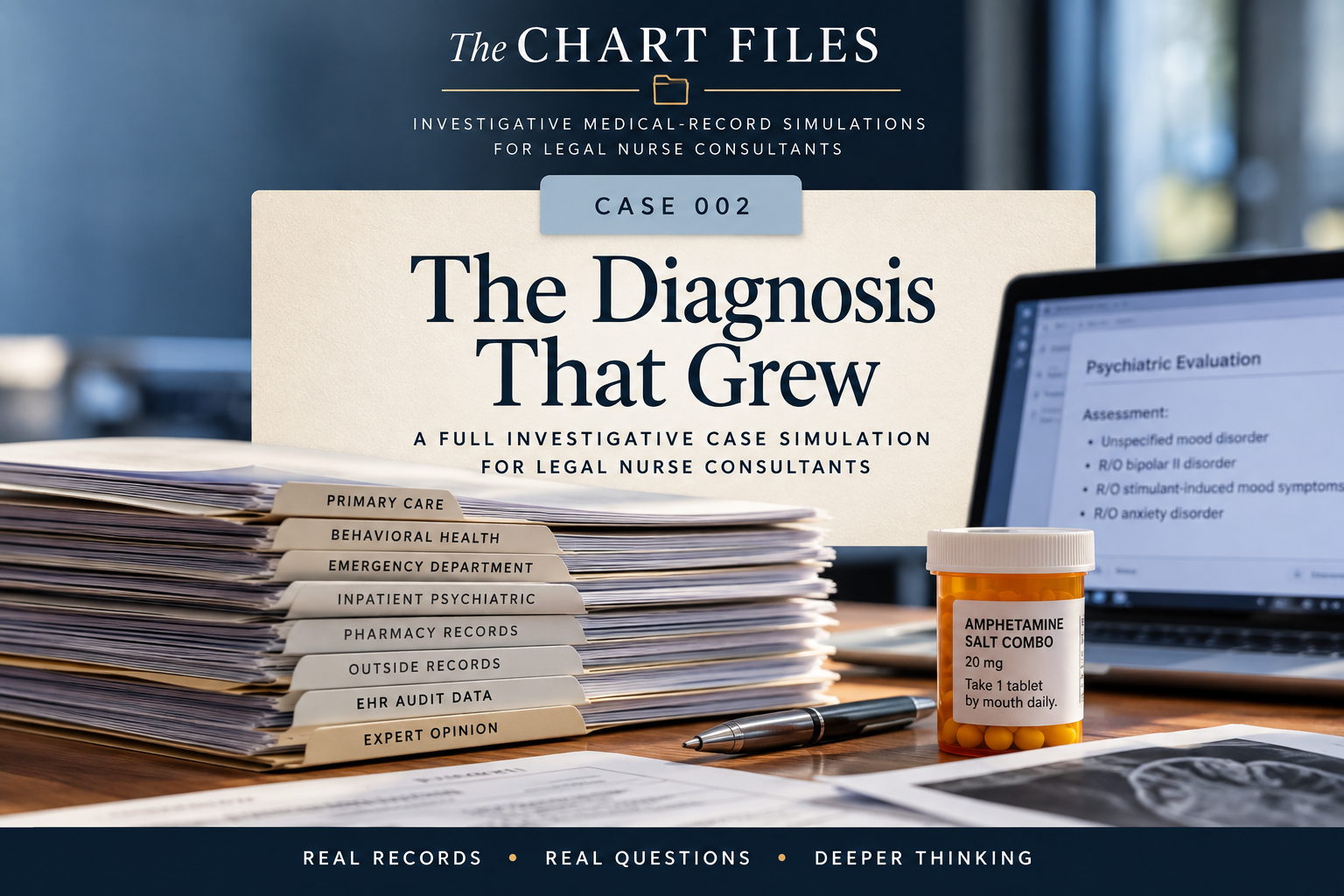
The Chart Files: Case 002 — The Diagnosis That Grew
The Chart Files: Case 002 — The Diagnosis That Grew
A Full Investigative Medical-Record Case Simulation for Legal Nurse Consultants
The diagnosis appears throughout the chart. But how did the chart come to know it?
Natalie Mercer is a 30-year-old elementary-school teacher whose medical record contains what appears to be a well-established history of bipolar II disorder.
An independent psychiatric examiner describes that history as “well-documented,” dating to at least May 2024 and independently documented by multiple providers.
Your job is not to accept that conclusion.
It isn't to reject it, either.
Your job is to investigate the record.
The Diagnosis That Grew places you inside a realistic legal-medical case involving fourteen months of primary care, urgent care, behavioral health, emergency, inpatient psychiatric, pharmacy, and EHR evidence.
You'll receive the case the way an LNC might actually receive it: an engagement letter, an expert opinion to test, a certified Bates-labeled medical-record production, and an investigative assignment.
Then the case evolves.
Additional records arrive.
Pharmacy evidence changes what you know.
Outside psychiatric records complicate the story.
EHR audit data reveals where apparently independent documentation actually came from.
At each stage, you'll have to decide what the evidence establishes — before seeing what comes next.
This is a case simulation, not a case study.
You won't simply read about diagnostic provenance.
You'll investigate it yourself.
Across an 81-page case file containing 35 realistic record documents, you'll reconstruct how a psychiatric diagnosis moved through the medical record — from observations and differential diagnosis to provisional diagnosis, problem list, past medical history, subsequent encounters, hospitalization, and ultimately a forensic psychiatric opinion.
The central question is deliberately narrower than:
Does Natalie Mercer have bipolar II disorder?
Nothing in the file permits you to make that diagnosis.
Instead, you'll investigate:
How did the record come to know that she did — and how certain was the evidence at each point?
What you'll work with
The simulation includes a realistic mixture of:
Primary-care records
Patient portal messages
Urgent-care documentation
Psychiatric evaluations and follow-up notes
Collateral history
Emergency-department records
Inpatient behavioral-health documentation
Medication histories
Laboratory and toxicology findings
Prescription-dispensing data
Outside psychiatric records
Problem-list history
EHR note-source and audit data
An independent forensic psychiatric evaluation
Some evidence supports the prevailing interpretation.
Some complicates it.
Some appears to corroborate earlier documentation — until you investigate where it came from.
And some evidence can tempt you toward a competing explanation that the record doesn't actually prove either.
Skills you'll practice
Case 002 is designed to develop practical clinical-forensic record-review skills, including diagnostic provenance, differential versus established diagnosis, problem-list propagation, copy-forward recognition, EHR text-source analysis, medication and exposure chronology, collateral-history evaluation, competing explanations, and the distinction between repetition and independent corroboration.
You'll also continue using the Chart Files investigative framework:
DOCUMENTED FACT — What the available evidence directly establishes.
INFERENCE — A conclusion reasonably drawn from one or more observations.
HYPOTHESIS — A proposed explanation requiring additional evidence.
UNKNOWN — Something the available record does not permit you to determine.
The challenge is not merely finding information.
It's knowing what you are entitled to conclude from it.
Work the case before you see the answer
The file is intentionally staged.
You'll encounter STOP pages and three investigative checkpoints requiring you to commit to your findings before opening subsequent disclosures.
New evidence may strengthen your analysis.
It may force you to revise it.
Or it may reveal that what looked like new corroboration was simply an old conclusion appearing in a new place.
At the end, you'll face a Final Challenge before opening the sealed Investigator's Analysis and scoring your work against a 22-point assessment.
What's included
One downloadable 81-page PDF case file, including:
Case briefing and engagement materials • Expert psychiatric opinion • 35 realistic medical-record documents • Bates-labeled record production • Staged supplemental disclosures • Outside psychiatric records • PDMP evidence • EHR audit evidence • Three investigative checkpoints • Final Challenge • Sealed Investigator's Analysis • 22-point self-assessment
Difficulty: Moderate
Estimated working time: 60–90 minutes
Format: Digital PDF download
Designed for: Legal Nurse Consultants, nurse reviewers, forensic nurses, and other professionals who want to sharpen medical-record investigative skills
The lesson beneath the case
A diagnosis appearing repeatedly in a medical record can look increasingly authoritative.
But repetition is not necessarily corroboration.
A differential can become a provisional diagnosis. A provisional diagnosis can enter a problem list. A problem-list entry can populate subsequent histories. Those histories can then be cited as evidence that multiple clinicians independently documented the condition.
Or they may not.
Your job is to find out.
Because the most consequential statement in a medical record may not be false.
It may simply be more certain on page 500 than the underlying evidence ever justified on page 50.
The Chart Files — Real records. Deeper thinking.
Don't just read the record. Investigate it.
All persons, facilities, and events in this simulation are fictional. Created for professional training and educational purposes. Licensed for individual training use only. This simulation does not provide legal or medical advice.
The Chart Files: Case 002 — The Diagnosis That Grew
A Full Investigative Medical-Record Case Simulation for Legal Nurse Consultants
The diagnosis appears throughout the chart. But how did the chart come to know it?
Natalie Mercer is a 30-year-old elementary-school teacher whose medical record contains what appears to be a well-established history of bipolar II disorder.
An independent psychiatric examiner describes that history as “well-documented,” dating to at least May 2024 and independently documented by multiple providers.
Your job is not to accept that conclusion.
It isn't to reject it, either.
Your job is to investigate the record.
The Diagnosis That Grew places you inside a realistic legal-medical case involving fourteen months of primary care, urgent care, behavioral health, emergency, inpatient psychiatric, pharmacy, and EHR evidence.
You'll receive the case the way an LNC might actually receive it: an engagement letter, an expert opinion to test, a certified Bates-labeled medical-record production, and an investigative assignment.
Then the case evolves.
Additional records arrive.
Pharmacy evidence changes what you know.
Outside psychiatric records complicate the story.
EHR audit data reveals where apparently independent documentation actually came from.
At each stage, you'll have to decide what the evidence establishes — before seeing what comes next.
This is a case simulation, not a case study.
You won't simply read about diagnostic provenance.
You'll investigate it yourself.
Across an 81-page case file containing 35 realistic record documents, you'll reconstruct how a psychiatric diagnosis moved through the medical record — from observations and differential diagnosis to provisional diagnosis, problem list, past medical history, subsequent encounters, hospitalization, and ultimately a forensic psychiatric opinion.
The central question is deliberately narrower than:
Does Natalie Mercer have bipolar II disorder?
Nothing in the file permits you to make that diagnosis.
Instead, you'll investigate:
How did the record come to know that she did — and how certain was the evidence at each point?
What you'll work with
The simulation includes a realistic mixture of:
Primary-care records
Patient portal messages
Urgent-care documentation
Psychiatric evaluations and follow-up notes
Collateral history
Emergency-department records
Inpatient behavioral-health documentation
Medication histories
Laboratory and toxicology findings
Prescription-dispensing data
Outside psychiatric records
Problem-list history
EHR note-source and audit data
An independent forensic psychiatric evaluation
Some evidence supports the prevailing interpretation.
Some complicates it.
Some appears to corroborate earlier documentation — until you investigate where it came from.
And some evidence can tempt you toward a competing explanation that the record doesn't actually prove either.
Skills you'll practice
Case 002 is designed to develop practical clinical-forensic record-review skills, including diagnostic provenance, differential versus established diagnosis, problem-list propagation, copy-forward recognition, EHR text-source analysis, medication and exposure chronology, collateral-history evaluation, competing explanations, and the distinction between repetition and independent corroboration.
You'll also continue using the Chart Files investigative framework:
DOCUMENTED FACT — What the available evidence directly establishes.
INFERENCE — A conclusion reasonably drawn from one or more observations.
HYPOTHESIS — A proposed explanation requiring additional evidence.
UNKNOWN — Something the available record does not permit you to determine.
The challenge is not merely finding information.
It's knowing what you are entitled to conclude from it.
Work the case before you see the answer
The file is intentionally staged.
You'll encounter STOP pages and three investigative checkpoints requiring you to commit to your findings before opening subsequent disclosures.
New evidence may strengthen your analysis.
It may force you to revise it.
Or it may reveal that what looked like new corroboration was simply an old conclusion appearing in a new place.
At the end, you'll face a Final Challenge before opening the sealed Investigator's Analysis and scoring your work against a 22-point assessment.
What's included
One downloadable 81-page PDF case file, including:
Case briefing and engagement materials • Expert psychiatric opinion • 35 realistic medical-record documents • Bates-labeled record production • Staged supplemental disclosures • Outside psychiatric records • PDMP evidence • EHR audit evidence • Three investigative checkpoints • Final Challenge • Sealed Investigator's Analysis • 22-point self-assessment
Difficulty: Moderate
Estimated working time: 60–90 minutes
Format: Digital PDF download
Designed for: Legal Nurse Consultants, nurse reviewers, forensic nurses, and other professionals who want to sharpen medical-record investigative skills
The lesson beneath the case
A diagnosis appearing repeatedly in a medical record can look increasingly authoritative.
But repetition is not necessarily corroboration.
A differential can become a provisional diagnosis. A provisional diagnosis can enter a problem list. A problem-list entry can populate subsequent histories. Those histories can then be cited as evidence that multiple clinicians independently documented the condition.
Or they may not.
Your job is to find out.
Because the most consequential statement in a medical record may not be false.
It may simply be more certain on page 500 than the underlying evidence ever justified on page 50.
The Chart Files — Real records. Deeper thinking.
Don't just read the record. Investigate it.
All persons, facilities, and events in this simulation are fictional. Created for professional training and educational purposes. Licensed for individual training use only. This simulation does not provide legal or medical advice.