Guides
Filters
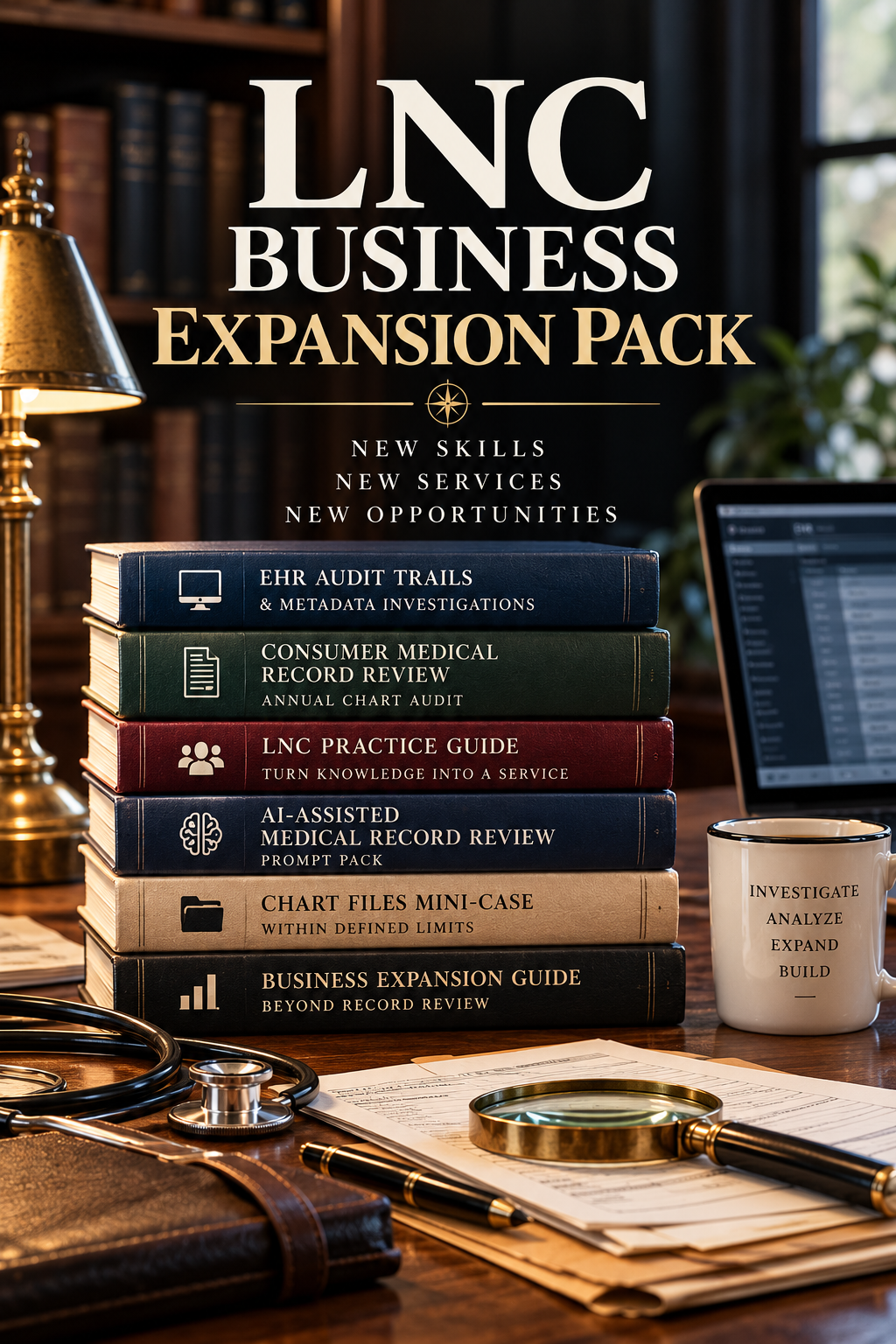
LNC Business Expansion Pack
Don't Just Wait for Attorney Cases. Build Your Practice.
Most Legal Nurse Consultants are introduced to the same core services: medical-record review, chronologies, case summaries, and litigation support.
Those services matter. But they don't have to define your entire business.
And if you're a new LNC, there's an immediate problem with building a practice around them alone:
You can't review an attorney's case until an attorney sends you one.
The LNC Business Expansion Pack was created to help Legal Nurse Consultants develop additional skills, services, and potential revenue streams while continuing to build their traditional attorney-facing practice.
Learn how to investigate electronic health records beyond the printed chart. Explore consumer-facing medical-record services. Develop an annual chart-audit offering. Incorporate AI into record review responsibly. And begin thinking about your nursing and medical-record expertise not simply as one service, but as the foundation for multiple business lines.
What's Included
EHR Audit Trails, Metadata & Digital Medical Record Investigations
Professional Training + Practice Toolkit
Go beyond the PDF medical record and learn to investigate the electronic systems behind it.
This approximately 128-page training and practice system includes the Professional Field Manual, Nine-Step EHR Investigation Workflow, six applied case laboratories, reusable EHR Investigation Chart File, worksheets, request templates, and The Chart Files: Case 003 — The Clean Copy, an advanced audit-trail and EHR revision investigation.
Develop a specialized service capability involving audit trails, metadata, version history, documentation timing, access information, provenance, electronic evidence, and EHR investigation.
The Personal Medical Record Audit — Annual Chart Check
A complete 143-page consumer medical-record auditing system with seven reusable worksheets and 32 ready-to-use letters, messages, and scripts.
Use it to understand how a structured annual medical-record review works and as the foundation for developing consumer-facing services that help individuals examine their records for inaccurate, outdated, duplicated, missing, or questionable information.
Consumer Medical Record Review & Annual Audit — LNC Practice Guide
Expansion Pack Exclusive
The consumer guide teaches patients how to examine their records.
This companion guide teaches the LNC how to turn that knowledge into a service.
Learn how consumer medical-record review and annual chart audits can fit into an independent LNC practice, including service structure, intake, workflow, deliverables, professional boundaries, recurring annual reviews, referral considerations, and practical approaches to packaging the service.
This resource is available exclusively as part of the LNC Business Expansion Pack.
AI-Assisted Medical Record Review Prompt Pack
Includes 16 LNC-specific AI prompts across six categories, verification protocols, a de-identification checklist, an AI Use Verification Log, and an evidentiary framework for using AI as an organizational and analytical assistant without outsourcing professional judgment.
Use AI to help organize, extract, compare, flag, draft, and build chronologies — while keeping the LNC responsible for verification and conclusions.
Chart Files Mini-Case: Within Defined Limits
Put the concepts into practice with a focused EHR investigation involving charting by exception, conflicting assessments, documentation timing, provenance, and audit-trail reasoning.
Rather than simply asking what the chart says, investigate how the documentation got there and what it actually proves.
Beyond Record Review — The LNC Business Expansion Guide
Expansion Pack Exclusive
The roadmap that ties the entire system together.
Explore additional services and specialized capabilities that can be developed from your existing nursing and medical-record expertise, including:
EHR audit-trail and metadata investigation • electronic medical-record investigation • consumer medical-record review • annual personal chart audits • medical-record discrepancy review • record-request strategy • AI-assisted record analysis • documentation provenance and information-availability analysis
For each area, examine what the service is, who might need it, what skills are required, what the LNC can deliver, professional boundaries to consider, and practical ways to begin incorporating it into an independent practice.
Build While You Wait
A new LNC doesn't have to spend the first year simply waiting for an attorney to send a case.
You can use that time to develop specialized capabilities.
You can build consumer-facing services.
You can learn EHR investigation.
You can create repeatable workflows.
You can practice on realistic evidence.
And you can continue marketing to attorneys while developing other reasons for clients to hire you.
For established LNCs, the question is different:
What else could your practice become?
The LNC Business Expansion Pack is designed to help you answer it.
One package. Multiple capabilities. More than one path to building an LNC practice.
Don't just wait for cases. Build capabilities. Build services. Build your practice.
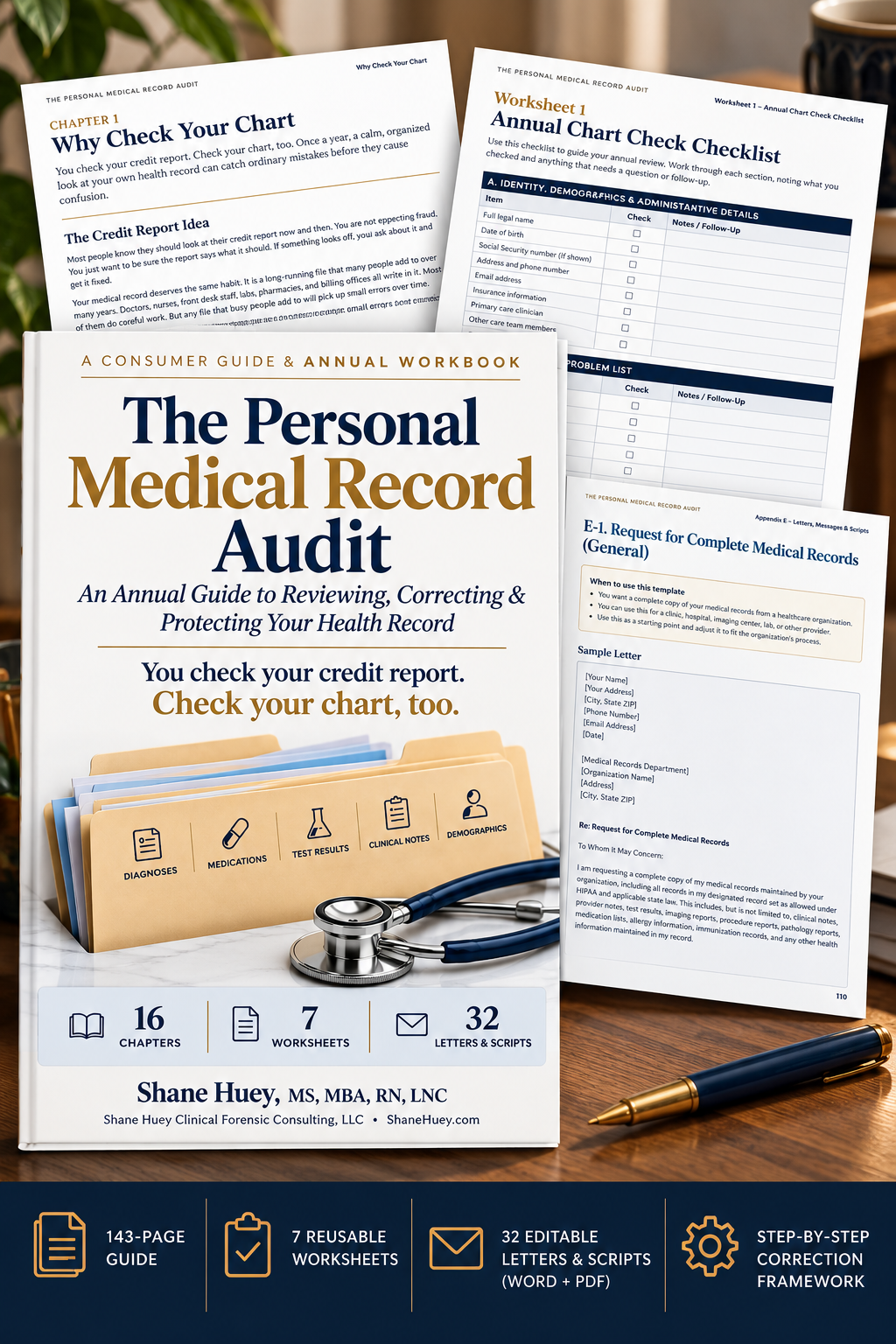
The Personal Medical Record Audit
You check your credit report. Check your chart, too.
Your medical record follows you for life.
It can influence the care you receive, the medications and allergies clinicians see, how your health history is understood, and—in some circumstances—information used in insurance and claims decisions.
But when was the last time you actually checked it?
The Personal Medical Record Audit is a 143-page consumer guide and annual workbook that shows you, step by step, how to review your own medical records for inaccurate, outdated, missing, duplicated, or potentially wrong-patient information—and what to do when you find something that doesn't look right.
No medical background required. No healthcare IT knowledge required. Everything is explained in plain English.
Learn What Your Medical Record Actually Says About You
Your patient portal is useful—but it isn't necessarily your complete medical record.
This guide shows you where your health information can live, how it moves between healthcare organizations, and how to systematically review the information that matters most.
You'll learn how to check:
diagnoses and your problem list;
medications, allergies, and immunizations;
laboratory and imaging results;
procedures and surgeries;
clinical notes and medical history;
demographics, insurance, and administrative information;
information that may be outdated, duplicated, or copied forward;
entries that may belong to another patient; and
records held outside the portal, including health information exchanges, registries, and certain insurance-related databases.
You'll also learn how to read a clinical note—including the difference between what you reported, what a clinician observed, and the clinician's professional assessment—so you can distinguish a genuine factual discrepancy from something that simply looks unfamiliar.
Find Something Wrong? You'll Know What to Do Next.
Finding a questionable entry is only the beginning.
The guide walks you through an Eight-Step Correction Framework for documenting the issue, finding its source, requesting the appropriate records, contacting the right organization, requesting an amendment when appropriate, tracking the response, and verifying what ultimately changed.
It also explains your medical-record rights in understandable language, including HIPAA access and amendment rights, information blocking, designated record sets, health information exchanges, CommonWell, Carequality, TEFCA, registries, MIB and prescription-history reports.
And because correcting information at one healthcare organization doesn't necessarily correct copies that have already traveled elsewhere, you'll learn how to follow the information downstream.
More Than a Guide—It's an Annual System
The goal isn't to make you obsess over your medical record.
It's to make checking it routine.
The Annual Chart Check gives you a repeatable process you can perform once a year, much like reviewing your credit report.
The package includes 7 reusable worksheets to help you inventory your records, document questionable entries, track requests and amendments, follow up, and create an annual audit summary.
And when it's time to actually contact someone, you won't have to wonder what to say.
Includes 32 Ready-to-Use Letters, Messages & Scripts
You'll receive practical templates for situations including:
requesting your complete medical record • requesting a missing record • questioning an unfamiliar diagnosis • updating medication information • requesting an amendment • responding to a denied amendment • asking that corrected information be sent downstream • reporting possible wrong-patient information • following up on unanswered requests • and more.
The templates are also provided in a separate editable Word document, so you can customize them without copying and reformatting text from the guide.
Created by Someone Who Knows the Medical Record From Both Sides of the Screen
Shane Huey, MS, MBA, RN, LNC has been a Registered Nurse for 14 years and has spent more than 11 years building, maintaining, and working with electronic health record systems.
His work sits at the intersection of clinical care, healthcare IT, electronic documentation, and regulatory requirements.
As a Legal Nurse Consultant and Clinical Investigator, he also examines medical records critically—tracing where information came from, comparing conflicting documentation, identifying what may be missing, distinguishing repeated information from independent evidence, and determining what the record actually supports.
The Personal Medical Record Audit brings that experience to consumers in plain English.
What You Receive
The Personal Medical Record Audit — PDF
143-page consumer guide and annual workbook
16 chapters
7 reusable worksheets
Plain-language HIPAA and patient-rights reference
Medical terminology and abbreviation references
Healthcare and regulatory resource directory
32 letters, portal messages, and phone scripts
Editable Letters, Messages & Scripts — Word
All 32 templates in an editable format for easy customization.
$39
Your medical record tells your health story.
Make sure it's telling the right one.
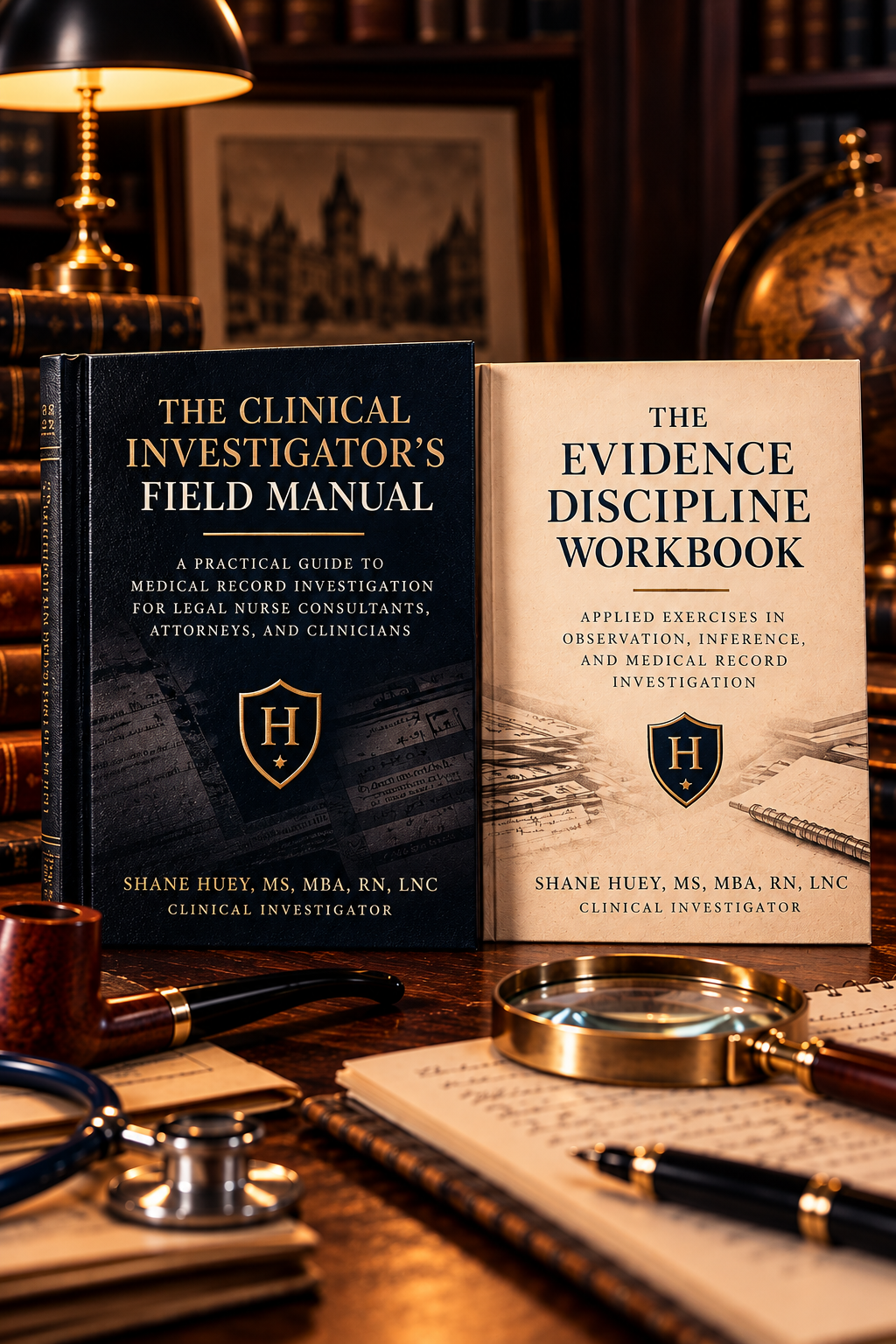
The Evidence Discipline Collection
The Clinical Investigator’s Field Manual + The Evidence Discipline Workbook
Medical-record review is not simply finding information in a chart. It is determining what the record actually establishes, what can reasonably be inferred from it, what remains only a hypothesis, and what the available evidence does not permit you to conclude.
The Evidence Discipline Collection is a two-part professional training system designed for legal nurse consultants, clinical investigators, nurses, advanced practice clinicians, attorneys, and other professionals who analyze medical records in clinical, legal, and investigative settings.
Rather than teaching you simply what to look for, this collection focuses on how to think about what you find.
At its foundation is The Clinical Investigator’s Field Manual, a practical framework for disciplined medical-record investigation. It develops the reasoning skills necessary to move beyond passive chart review and approach the record as evidence — examining chronology, provenance, inconsistencies, missing information, documentation patterns, EHR behavior, competing explanations, and the limits of what the available record can support.
The Field Manual emphasizes a critical distinction that is easily lost during complex case review:
Observation is not inference. Inference is not hypothesis. Hypothesis is not conclusion.
Knowing where one ends and the next begins can profoundly affect the accuracy and defensibility of an analysis.
The companion Evidence Discipline Workbook turns those principles into deliberate practice. Through structured exercises and record-review problems, you will practice separating documented facts from interpretation, identifying unsupported assumptions, generating competing hypotheses, recognizing evidentiary gaps, testing conclusions, and communicating findings with appropriate precision.
Together, the two resources create a learn-and-apply system:
Learn the investigative method in the Field Manual. Practice the method in the Workbook. Carry the discipline into your own cases.
This collection is particularly useful for professionals who work with records involving questions of standard of care, chronology, causation, documentation discrepancies, medication administration, clinical decision-making, EHR workflows, metadata and audit trails, or other situations in which what appears in the chart may not tell the entire story.
The goal is not to teach reviewers to reach more dramatic conclusions.
It is to teach them to reach better-supported ones.
Because a strong clinical investigator must be able to tell counsel not only:
Here is what I found.
But also:
Here is what the record establishes.
Here is what it suggests.
Here is what it does not establish.
Here is what remains unknown.
And here is what I would investigate next.
Included in the Collection
The Clinical Investigator’s Field Manual
A practical reference for approaching medical records as investigative evidence, with an emphasis on observation, inference, hypothesis formation, verification, documentary inconsistencies, evidentiary limits, and disciplined clinical reasoning.
The Evidence Discipline Workbook
A companion practice resource designed to move those concepts off the page and into actual reasoning through structured exercises that challenge you to observe carefully, question assumptions, distinguish fact from interpretation, and defend only what the available evidence supports.
Who It’s For
Legal nurse consultants • Registered nurses • Nurse practitioners and physician assistants • Physicians • Attorneys • Medical-record reviewers • Clinical and forensic investigators
Two resources. One investigative discipline.
Don’t just review the record. Learn to interrogate it.

EHR Audit Trails, Metadata & Digital Medical Record Investigations
Professional Training + Practice Toolkit for Legal Nurse Consultants
The medical record you receive is not always the whole story.
A printed chart or PDF is a rendering of information stored across an electronic health record. Behind it may be audit events, revision histories, access logs, metadata, portal activity, system timestamps, interface data, print settings, and other electronic evidence capable of answering questions the ordinary medical record cannot.
But knowing that data exists is not enough.
You need to know what to look for, what to request, who may hold it, how to interpret what comes back — and what the evidence does and does not allow you to conclude.
EHR Audit Trails, Metadata & Digital Medical Record Investigations is a professional training and practice toolkit designed for legal nurse consultants who want to add EHR documentation, audit-trail, and metadata investigation to their record-review skill set.
This is not simply a book about EHRs.
It is a complete system for learning the methodology, practicing it on realistic evidence, testing yourself against a complex case, and carrying the same workflow into your own consulting matters.
What You'll Learn
By the end of the program, you should be able to distinguish among an EHR audit trail, user access log, metadata, version history, and HIPAA accounting of disclosures — and explain those differences clearly to counsel.
You'll learn how to turn a vague concern such as “something about this chart doesn't add up” into a focused investigative question; identify the electronic evidence that may answer it; develop targeted requests; evaluate what is produced; recognize ordinary EHR behavior before treating it as significant; reconstruct an integrated timeline; and communicate your findings without overstating what the evidence proves.
The guiding principle throughout the program is simple:
An audit event, timestamp, or version difference is a reason to ask a specific question. It is not, by itself, evidence of wrongdoing.
The Complete Training + Practice System
01 | The Professional Field Manual
A comprehensive guide to the foundations and practical methodology of EHR investigation for the LNC.
You'll learn how electronic records are created, revised, timestamped, stored, accessed, and rendered — and why two versions of the “same” record may not actually contain the same information. The program addresses major EHR platforms conceptually while teaching a vendor-independent investigative approach.
The Field Manual includes the complete Nine-Step EHR Investigation Workflow, common EHR issues, request strategies, response evaluation, timeline reconstruction, request templates, worksheets, attorney communication, case scoping, and professional-practice considerations.
02 | Six Applied Case Laboratories
Reading about EHR evidence isn't the same as analyzing it.
Six case laboratories put the methodology to work using realistic record excerpts and audit evidence:
The Late Note
The Carried-Forward Exam
The Wrong Chart
The Cabinet and the MAR
The Corrected Summary
Two Clocks
Each laboratory requires you to work through the evidence yourself before reviewing the complete analysis.
03 | The Chart Files: Case 003 — The Clean Copy
Your advanced capstone investigation.
You are retained by plaintiff's counsel in a fictional wrongful-death matter involving two different versions of the same physician note.
Was the record changed?
When?
By whom?
And, most importantly, what does the evidence actually establish?
You'll work through a realistic 49-page case file containing a client engagement, portal record, certified medical-record production, revision history, access data, portal activity, print-template information, hospital policy, staged supplemental disclosures, and other evidence.
You don't receive everything at once.
New evidence is disclosed in stages, requiring you to commit to your analysis at checkpoints before seeing what comes next. At the conclusion, you'll answer counsel's Final Challenge before opening the sealed Investigator's Analysis and scoring your work.
Difficulty: Advanced
Estimated completion time: 90–120 minutes
Documents: Exhibits A–B + Documents 01–19
Includes: Scored, sealed Investigator's Analysis
04 | The EHR Investigation Chart File
Take the methodology into your own practice.
This separate working case packet organizes an EHR matter from initial intake through the attorney-facing findings summary using the same nine-step workflow taught throughout the program:
DEFINE → MAP → INVENTORY → REQUEST → TRACK → COMPARE → RECONSTRUCT → CORROBORATE → REPORT
The Chart File includes tools for case intake, electronic-record source mapping, production inventory, evidence targeting, audit and metadata request development, request-route tracking, custodian communications, audit-trail analysis, version comparison, timeline reconstruction, corroboration, and reporting.
Licensed individual purchasers may reuse the Chart File, worksheets, and templates in their own client matters.
More Than “Request the Audit Trail”
One of the most common problems in electronic-record investigation is imprecise terminology.
An audit trail is not the same thing as a user access log.
Neither is synonymous with metadata or version history.
And a HIPAA accounting of disclosures is not an internal EHR access log.
The program teaches you to distinguish these sources, understand what each may establish, identify the appropriate custodian, and formulate more precise requests rather than simply asking for “the audit trail.”
You'll also learn to consider evidence that may reside outside the primary EHR — including portals, laboratory systems, PACS, pharmacy and medication-dispensing systems, monitoring devices, HIEs, contracted physician systems, scanning systems, and communications platforms. The accompanying Chart File gives you a structured way to map those potential sources in an actual matter.
Built for the Legal Nurse Consultant
This program sits at the intersection of clinical record review and health-information-technology literacy.
It is not a digital-forensics certification and does not teach the LNC to make legal conclusions, determine intent, or replace the attorney, digital forensic examiner, or standard-of-care expert.
Instead, it teaches a specialized and highly practical consulting skill:
Understanding how electronic clinical documentation is created, changed, timestamped, retained, accessed, and produced well enough to ask better questions — and help counsel understand the answers.
What's Included
Professional Training + Field Manual — 63 pages
Foundations, Nine-Step Workflow, worksheets, request templates, professional practice guidance, six case laboratories, glossary, quick-reference material, and federal access-law appendix.
The EHR Investigation Chart File — 16 pages
A reusable working case packet for EHR documentation, audit-trail, and metadata matters.
The Chart Files: Case 003 — The Clean Copy — 49 pages
An advanced staged case simulation with exhibits, medical records, audit evidence, checkpoints, Final Challenge, and scored Investigator's Analysis.
Approximately 128 pages of professional training, applied investigation, and reusable practice tools.
Individual Professional License Included
Your individual license permits you to use the program yourself and to reuse the EHR Investigation Chart File, worksheets, and templates in your own independent consulting practice and client matters.
Program materials may not be redistributed, shared, resold, posted online, or used to teach others under the individual license. Practice, multi-LNC, and educator licensing are available separately.
Learn the Method. Work the Evidence. Use It in Practice.
Electronic medical records contain far more than what appears on the printed page.
The question is whether you know what else may exist — and what to do with it.
EHR Audit Trails, Metadata & Digital Medical Record Investigations gives you the methodology, practice cases, investigative tools, and advanced capstone to begin developing that skill as part of your LNC practice.
Learn. Practice. Prove. Apply.
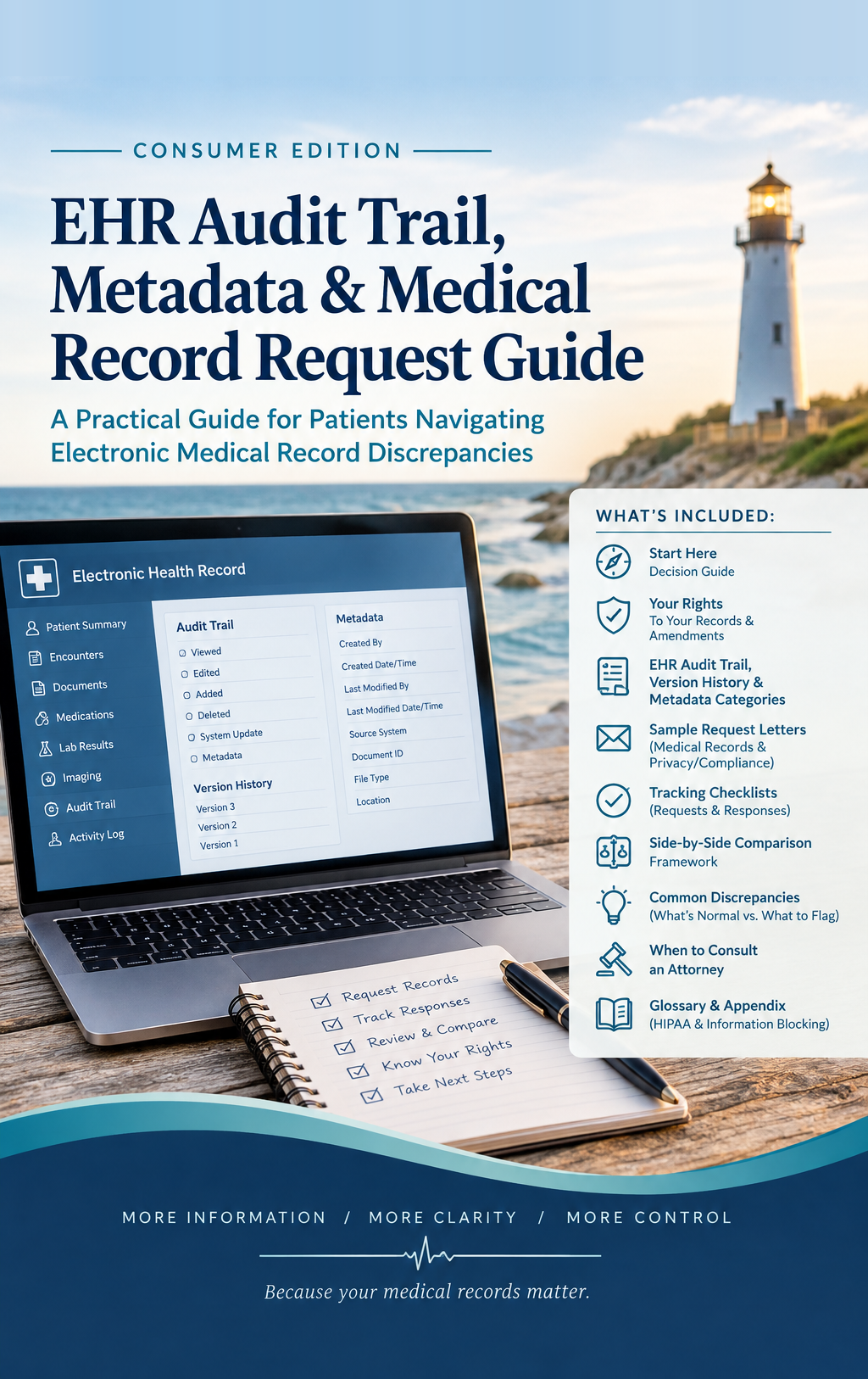
A Practical Guide for Patients Navigating Electronic Medical Record Discrepancies
Description:
Getting a copy of your medical record is only half the story. Behind every chart is a digital paper trail — an audit log, a version history, system metadata — that shows when an entry was really created, whether it was edited later, and by whom. Most patients don't know this information exists, let alone how to ask for it.
This 35-page guide gives you the same framework a legal nurse consultant uses to start this kind of work, organized into a clear, step-by-step process you can follow on your own — before deciding whether you need anything more.
What's included:
A "start here" decision guide to point you to exactly what you need
Plain-language explanation of your federal rights to your records, amendments, and access
A complete list of the EHR audit trail, version history, and metadata categories worth requesting
Ready-to-adapt sample request letters for Medical Records and Privacy/Compliance offices
Request and response tracking checklists
A side-by-side comparison framework for evaluating what you receive
A guide to common, non-malicious causes of documentation discrepancies — so you know what's actually worth flagging
Guidance on when it's time to consult an attorney
Glossary and a plain-language HIPAA/information blocking reference appendix
Format: Delivered as both a Word document and a PDF, so you can fill in the worksheets directly or simply read and print. Licensed for personal use by a single purchaser. Includes limited follow-up email support to help you apply the guide.
How to Become an LNC
A Realistic Roadmap for Nurses Considering Legal Nurse Consulting
Free — 46 pages of real answers, not recruitment copy.
Most information about becoming an LNC comes from people selling a certification program — which means it's optimistic by design. This guide isn't. It's written by a working legal and forensic nurse consultant who's built the business from the ground up, covering what the field actually requires: the clinical foundation, the legal fluency, how training and certification really work, and — most importantly — the relationship-driven business reality that determines whether a new LNC's practice survives its first two years.
Inside the guide:
What an LNC actually does, day to day — beyond "reads medical records for lawyers"
The clinical experience you need before you're ready, and why
Understanding the legal side without needing a law degree
Training and certification paths, including a full breakdown of CLS by BARBRI and why joining AALNC early is worth it
The honest truth about how slow the first year really is, and why that's normal
Choosing your path: part-time freelance, full-time solo, subcontracting, or W-2
Specializing vs. staying a generalist — and branching into forensics
The tools and systems every new LNC needs from day one
Common mistakes that have nothing to do with clinical skill
Realistic income expectations, by employment model
No sign-up funnel tricks, no inflated income promises — just the roadmap a new LNC actually needs, from someone who's walked it.
Download now for free.
No results found
No results match your search. Try removing a few filters.