 Image 1 of 1
A medical record can look complete, consistent, and convincing — until you start asking the right questions.
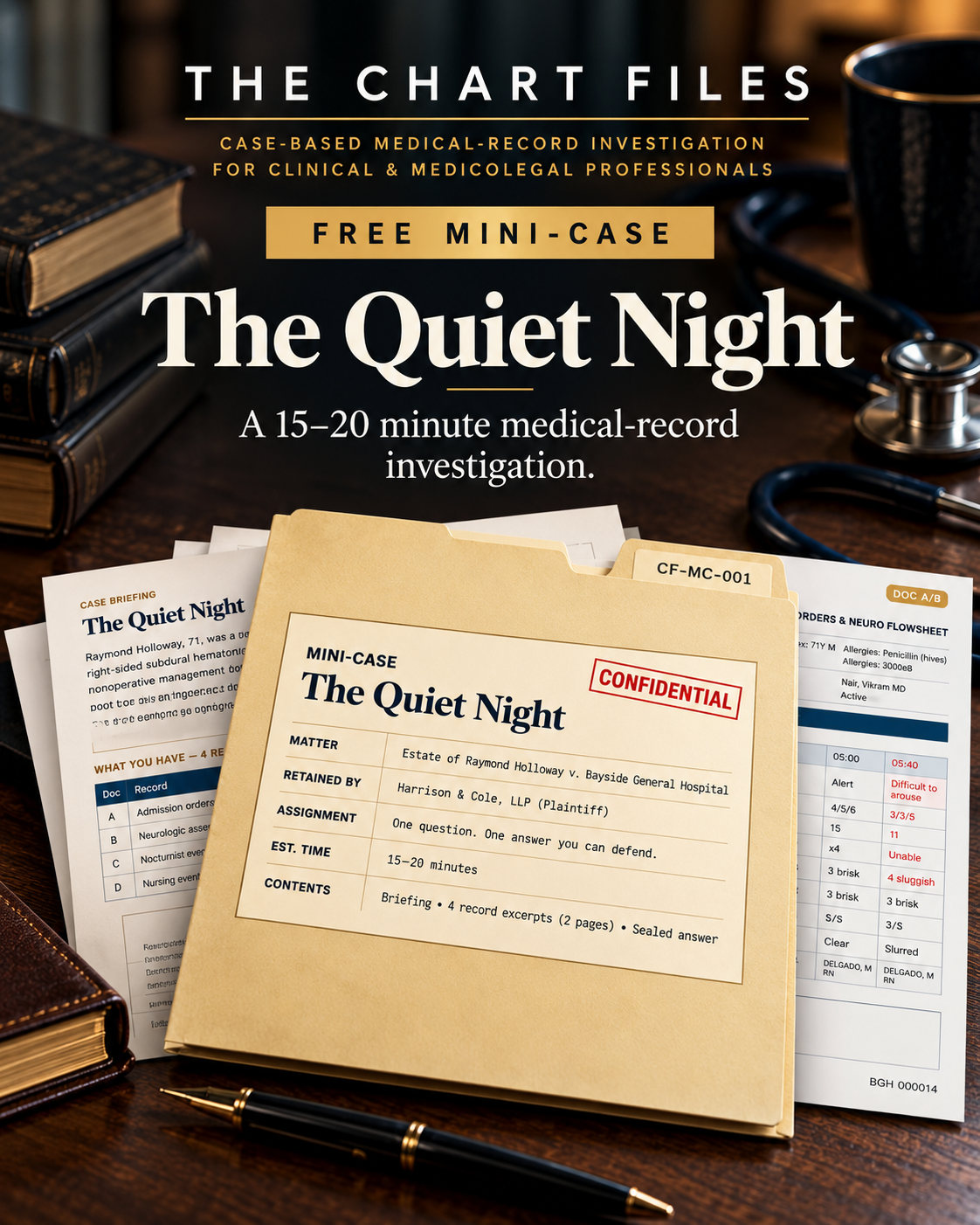
In The Quiet Night, a 71-year-old patient with a subdural hematoma deteriorates overnight. His flowsheet appears reassuring: hourly neurologic assessments, consistently normal, right up until the moment his condition dramatically changes.
But is that what actually happened?
You’ll receive a realistic case briefing and four medical-record excerpts and be asked to answer the same deceptively simple question posed to the consultant: Were the hourly neurologic checks done as ordered?
Work the evidence yourself. Compare records. Examine timestamps. Separate documented fact from inference, hypothesis, and the unknown. Then commit to an answer before breaking the seal on the case analysis.
Inside the sealed section, you'll discover additional evidence that changes how the record must be interpreted — and see how an investigator can identify a serious documentation problem without claiming more than the evidence actually proves.
Designed to take approximately 15–20 minutes, The Quiet Night is a compact introduction to The Chart Files — realistic medical-record investigations designed to sharpen observation, chronology, corroboration, evidence discipline, and clinical reasoning.
Built for legal nurse consultants, RNs, NPs, PAs, physicians, attorneys, and medical-record reviewers.
If you enjoy The Quiet Night, the full Chart Files take the investigation much deeper — with larger Bates-labeled record productions, EHR audit evidence, staged disclosures, investigative checkpoints, final challenges, and detailed analysis.
The record is not the event. It is evidence of the event.
A medical record can look complete, consistent, and convincing — until you start asking the right questions.
In The Quiet Night, a 71-year-old patient with a subdural hematoma deteriorates overnight. His flowsheet appears reassuring: hourly neurologic assessments, consistently normal, right up until the moment his condition dramatically changes.
But is that what actually happened?
You’ll receive a realistic case briefing and four medical-record excerpts and be asked to answer the same deceptively simple question posed to the consultant: Were the hourly neurologic checks done as ordered?
Work the evidence yourself. Compare records. Examine timestamps. Separate documented fact from inference, hypothesis, and the unknown. Then commit to an answer before breaking the seal on the case analysis.
Inside the sealed section, you'll discover additional evidence that changes how the record must be interpreted — and see how an investigator can identify a serious documentation problem without claiming more than the evidence actually proves.
Designed to take approximately 15–20 minutes, The Quiet Night is a compact introduction to The Chart Files — realistic medical-record investigations designed to sharpen observation, chronology, corroboration, evidence discipline, and clinical reasoning.
Built for legal nurse consultants, RNs, NPs, PAs, physicians, attorneys, and medical-record reviewers.
If you enjoy The Quiet Night, the full Chart Files take the investigation much deeper — with larger Bates-labeled record productions, EHR audit evidence, staged disclosures, investigative checkpoints, final challenges, and detailed analysis.
The record is not the event. It is evidence of the event.