 Image 1 of 1
The Chart Files — Case 006: Numerator Met
The Chart Files — Case 006: Numerator Met
This isn't a simulated chart review. It's a simulated case investigation.
A 66-year-old woman enters the hospital with pneumonia. Three weeks later, she leaves the healthcare system without her left leg.
The outcome is devastating.
The outcome, however, is not your question.
Your question is the one an attorney must answer before investing a client's money and an expert's reputation:
Does the evidence support going further, against whom, under what standard, and what would be needed to prove it?
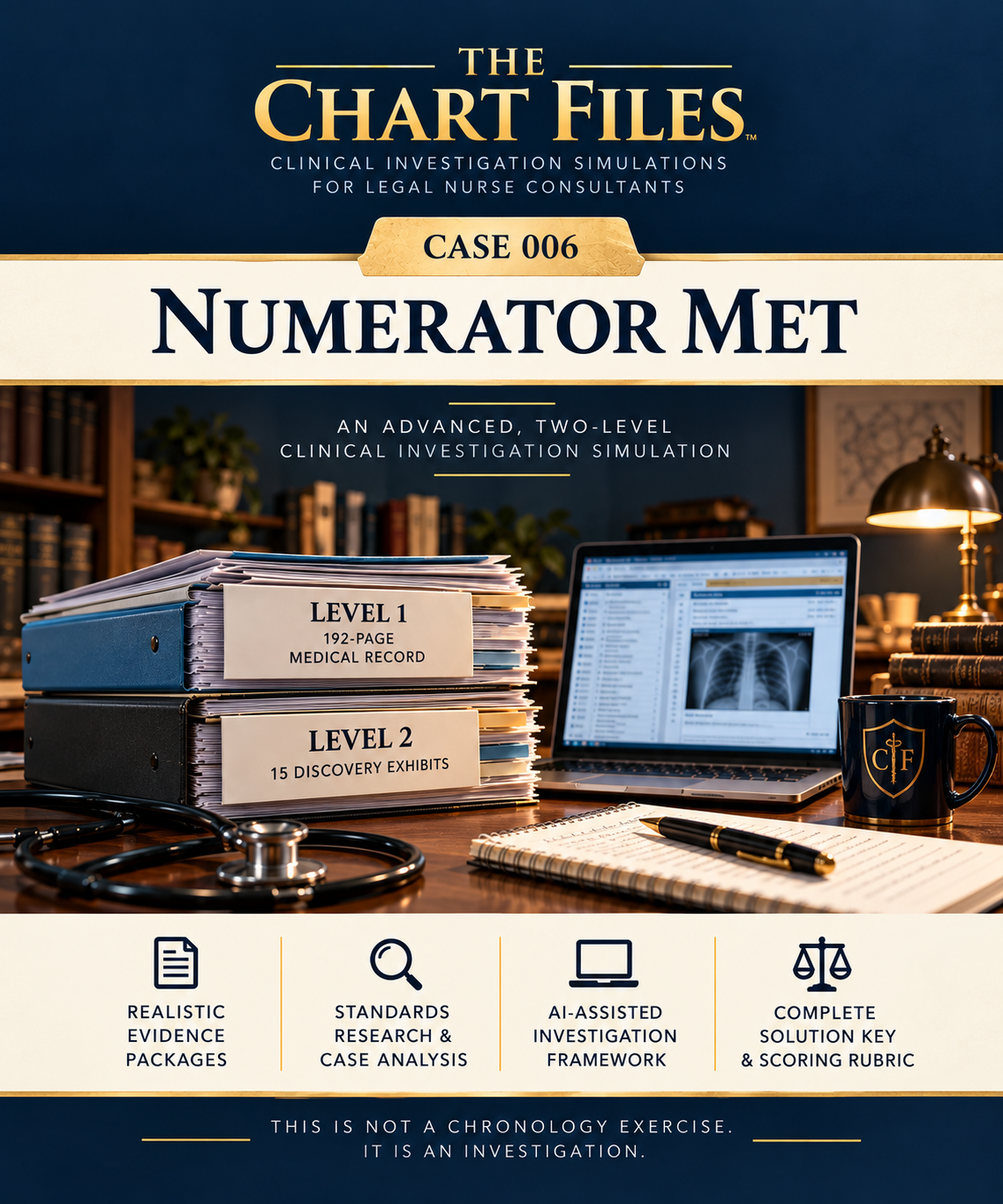
Numerator Met is an advanced, two-level clinical investigation designed to move legal nurse consultants and clinical reviewers beyond chronology building and into evidence-based case investigation.
You will encounter duty, standards of care, potential breach, causation, scope and privileging, EHR audit evidence, provider communication, clinical decision support, electronic quality measures, transitions of care, document provenance, competing case theories — and evidence that does not always mean what it first appears to mean.
Some things went wrong.
Some things only look wrong.
And at least one decision that looks wrong in hindsight was reasonable based on the information available at the time.
You cannot solve this case by finding the bad outcome and reasoning backward.
Level 1 — The Merit Review
You begin where an LNC often begins:
An attorney. A potential medical-negligence claim. And a 192-page certified legal medical record.
That's all you get.
There is no answer key telling you where to look. There is no curated list of significant events. And important categories of evidence are not contained in the legal medical record you received.
Your assignment is not to summarize 192 pages.
It is to determine what matters.
You'll identify who owed relevant duties to the patient, research real and applicable authorities, distinguish evidence of the standard of care from the standard itself, identify and rank potential deviations, analyze plausible causal chains, recognize apparent problems that should not support your opinion, and determine what additional evidence should be requested.
Then you'll produce an attorney-facing merit memorandum limited to four pages.
You must decide:
Is there reasonable support for further investigation — and can you defend why?
Then the Case Changes.
Complete and save your Level 1 analysis.
Only then do you open Level 2.
Your requests have produced discovery.
You now receive 15 additional exhibits containing evidence that wasn't available during your initial review:
EHR access and results-inbox audit data. Secure messages. Physician handoffs. Clinical decision-support alert history. Nursing-note metadata. Document version history. The actual Summary of Care transmitted electronically. Direct secure messaging transmission records. Outside medical records. Hospital policies and protocols. Credentialing and privileging documents. Quality-reporting extracts. Deposition testimony.
Now investigate the case again.
Some evidence will confirm what you suspected.
Some will strengthen it.
Some may undermine your original conclusions.
Some may move responsibility from one person or entity to another.
And some questions will remain unresolved.
Just as they do in real cases.
Level 2 — Clinical Case Investigation
Now you're no longer performing a preliminary merit review.
You're reconstructing the evidence.
You'll build a layered evidentiary timeline covering the critical period of the case — not simply a list of medical events, but multiple simultaneous layers:
Clinical event | Documentation | Communication | EHR/system evidence | Standard/duty | Variance | Source | Confidence/provenance
Every material proposition must be traceable to evidence.
And not all evidence is treated equally.
You'll classify information as:
Documented fact.
System-derived fact.
Reported fact.
Inference.
Unresolved contradiction.
That distinction matters.
An EHR may record that a result was acknowledged.
That does not necessarily establish that the clinician read it.
A message may be recorded as read.
That does not establish that it was understood.
A document may exist in the medical record today.
That does not necessarily establish that the same version existed — or was transmitted — at the time of the event.
Numerator Met requires you to keep asking:
What does this evidence actually prove?
Duty. Standard. Breach. Causation. Damages.
Finding something concerning isn't enough.
You must connect the evidence.
Your final case theory is constructed as a defensible chain:
Duty → Applicable Standard → Evidence of What Occurred → Specific Deviation → Foreseeable Consequence → Causal Relationship → Injury and Damages
You'll choose the theory you would be prepared to carry forward and explain why other tempting theories should be set aside.
You'll also classify the important propositions in the case as established, disputed, expert-dependent, unresolved, or requiring additional evidence.
The goal isn't merely to be right.
The goal is to produce reasoning that can survive scrutiny.
The Regulatory and Quality Layer
The title Numerator Met is not incidental.
The case incorporates electronic clinical quality measurement and forces you to confront a distinction increasingly important in modern healthcare litigation and record analysis:
A quality measure can be satisfied while the subsequent clinical care remains very much in question.
You'll encounter apparently compliant quality data and determine what that data establishes — and, more importantly, what it does not establish about the standard of care.
The case also introduces questions involving institutional protocols, practitioner scope and privileging, clinical decision support, transitions of care, and the difference between what an information system records and what can legitimately be inferred about human action.
AI-Assisted. Human Investigated.
AI use is permitted.
Blind reliance on it is not.
Use AI to help extract, organize, sort, and convert evidence if you choose. But you remain responsible for verifying the source, checking every material assertion, validating time conversions, researching standards, assigning provenance, and making the investigative judgments.
AI does not decide whether a variance occurred.
You do.
The exercise is deliberately designed to expose one of the greatest risks of AI-assisted medical-record review:
A beautifully organized inference is still an inference.
And There Is a Ground Truth.
After completing both levels, unseal the Solution Key.
This isn't a few pages of answers.
The key walks through what actually happened, the applicable authorities and their limitations, the duty map, evidentiary traps, red herrings, timeline reconstruction, model merit analysis, case theory, quality-measure issues, and the evidence that remains genuinely unresolved.
A detailed 100-point scoring rubric evaluates both stages of the investigation, including your standards research, breach analysis, causation reasoning, timeline accuracy, provenance discipline, case theory, fact classification — and whether you were willing to revise your original conclusions when better evidence became available.
Because that, too, is part of investigation.
Difficulty: Advanced
Estimated investigation time: 8–12 hours
Case setting: Fictional U.S. medical-negligence matter
Your case includes:
Investigator Briefing
192-page Level 1 certified medical record
Level 2 discovery package with 15 additional exhibits
Layered evidentiary timeline assignment
AI-assisted investigation framework
Case-theory and fact-classification exercises
Sealed Solution Key
100-point scoring rubric
The simulated action is venued in Florida and incorporates selected Florida authorities, but the investigative methods and evidence-analysis skills taught throughout the case are broadly applicable to legal nurse consulting and clinical case investigation.
The record is evidence about the event. It is not the event.
This is not a chronology exercise. It is an investigation.
Every patient, provider, facility, and event in this simulation is fictional. Created for professional education and investigative training; not legal or medical advice.
The Chart Files — Case 006: Numerator Met
This isn't a simulated chart review. It's a simulated case investigation.
A 66-year-old woman enters the hospital with pneumonia. Three weeks later, she leaves the healthcare system without her left leg.
The outcome is devastating.
The outcome, however, is not your question.
Your question is the one an attorney must answer before investing a client's money and an expert's reputation:
Does the evidence support going further, against whom, under what standard, and what would be needed to prove it?
Numerator Met is an advanced, two-level clinical investigation designed to move legal nurse consultants and clinical reviewers beyond chronology building and into evidence-based case investigation.
You will encounter duty, standards of care, potential breach, causation, scope and privileging, EHR audit evidence, provider communication, clinical decision support, electronic quality measures, transitions of care, document provenance, competing case theories — and evidence that does not always mean what it first appears to mean.
Some things went wrong.
Some things only look wrong.
And at least one decision that looks wrong in hindsight was reasonable based on the information available at the time.
You cannot solve this case by finding the bad outcome and reasoning backward.
Level 1 — The Merit Review
You begin where an LNC often begins:
An attorney. A potential medical-negligence claim. And a 192-page certified legal medical record.
That's all you get.
There is no answer key telling you where to look. There is no curated list of significant events. And important categories of evidence are not contained in the legal medical record you received.
Your assignment is not to summarize 192 pages.
It is to determine what matters.
You'll identify who owed relevant duties to the patient, research real and applicable authorities, distinguish evidence of the standard of care from the standard itself, identify and rank potential deviations, analyze plausible causal chains, recognize apparent problems that should not support your opinion, and determine what additional evidence should be requested.
Then you'll produce an attorney-facing merit memorandum limited to four pages.
You must decide:
Is there reasonable support for further investigation — and can you defend why?
Then the Case Changes.
Complete and save your Level 1 analysis.
Only then do you open Level 2.
Your requests have produced discovery.
You now receive 15 additional exhibits containing evidence that wasn't available during your initial review:
EHR access and results-inbox audit data. Secure messages. Physician handoffs. Clinical decision-support alert history. Nursing-note metadata. Document version history. The actual Summary of Care transmitted electronically. Direct secure messaging transmission records. Outside medical records. Hospital policies and protocols. Credentialing and privileging documents. Quality-reporting extracts. Deposition testimony.
Now investigate the case again.
Some evidence will confirm what you suspected.
Some will strengthen it.
Some may undermine your original conclusions.
Some may move responsibility from one person or entity to another.
And some questions will remain unresolved.
Just as they do in real cases.
Level 2 — Clinical Case Investigation
Now you're no longer performing a preliminary merit review.
You're reconstructing the evidence.
You'll build a layered evidentiary timeline covering the critical period of the case — not simply a list of medical events, but multiple simultaneous layers:
Clinical event | Documentation | Communication | EHR/system evidence | Standard/duty | Variance | Source | Confidence/provenance
Every material proposition must be traceable to evidence.
And not all evidence is treated equally.
You'll classify information as:
Documented fact.
System-derived fact.
Reported fact.
Inference.
Unresolved contradiction.
That distinction matters.
An EHR may record that a result was acknowledged.
That does not necessarily establish that the clinician read it.
A message may be recorded as read.
That does not establish that it was understood.
A document may exist in the medical record today.
That does not necessarily establish that the same version existed — or was transmitted — at the time of the event.
Numerator Met requires you to keep asking:
What does this evidence actually prove?
Duty. Standard. Breach. Causation. Damages.
Finding something concerning isn't enough.
You must connect the evidence.
Your final case theory is constructed as a defensible chain:
Duty → Applicable Standard → Evidence of What Occurred → Specific Deviation → Foreseeable Consequence → Causal Relationship → Injury and Damages
You'll choose the theory you would be prepared to carry forward and explain why other tempting theories should be set aside.
You'll also classify the important propositions in the case as established, disputed, expert-dependent, unresolved, or requiring additional evidence.
The goal isn't merely to be right.
The goal is to produce reasoning that can survive scrutiny.
The Regulatory and Quality Layer
The title Numerator Met is not incidental.
The case incorporates electronic clinical quality measurement and forces you to confront a distinction increasingly important in modern healthcare litigation and record analysis:
A quality measure can be satisfied while the subsequent clinical care remains very much in question.
You'll encounter apparently compliant quality data and determine what that data establishes — and, more importantly, what it does not establish about the standard of care.
The case also introduces questions involving institutional protocols, practitioner scope and privileging, clinical decision support, transitions of care, and the difference between what an information system records and what can legitimately be inferred about human action.
AI-Assisted. Human Investigated.
AI use is permitted.
Blind reliance on it is not.
Use AI to help extract, organize, sort, and convert evidence if you choose. But you remain responsible for verifying the source, checking every material assertion, validating time conversions, researching standards, assigning provenance, and making the investigative judgments.
AI does not decide whether a variance occurred.
You do.
The exercise is deliberately designed to expose one of the greatest risks of AI-assisted medical-record review:
A beautifully organized inference is still an inference.
And There Is a Ground Truth.
After completing both levels, unseal the Solution Key.
This isn't a few pages of answers.
The key walks through what actually happened, the applicable authorities and their limitations, the duty map, evidentiary traps, red herrings, timeline reconstruction, model merit analysis, case theory, quality-measure issues, and the evidence that remains genuinely unresolved.
A detailed 100-point scoring rubric evaluates both stages of the investigation, including your standards research, breach analysis, causation reasoning, timeline accuracy, provenance discipline, case theory, fact classification — and whether you were willing to revise your original conclusions when better evidence became available.
Because that, too, is part of investigation.
Difficulty: Advanced
Estimated investigation time: 8–12 hours
Case setting: Fictional U.S. medical-negligence matter
Your case includes:
Investigator Briefing
192-page Level 1 certified medical record
Level 2 discovery package with 15 additional exhibits
Layered evidentiary timeline assignment
AI-assisted investigation framework
Case-theory and fact-classification exercises
Sealed Solution Key
100-point scoring rubric
The simulated action is venued in Florida and incorporates selected Florida authorities, but the investigative methods and evidence-analysis skills taught throughout the case are broadly applicable to legal nurse consulting and clinical case investigation.
The record is evidence about the event. It is not the event.
This is not a chronology exercise. It is an investigation.
Every patient, provider, facility, and event in this simulation is fictional. Created for professional education and investigative training; not legal or medical advice.