 Image 1 of 1
The Chart Files: Case 005 — The Clean Timeline
The Chart Files: Case 005 — The Clean Timeline
Capstone Medical-Record Investigation: AI, EHR Evidence & Timeline Verification
The timeline is clean.
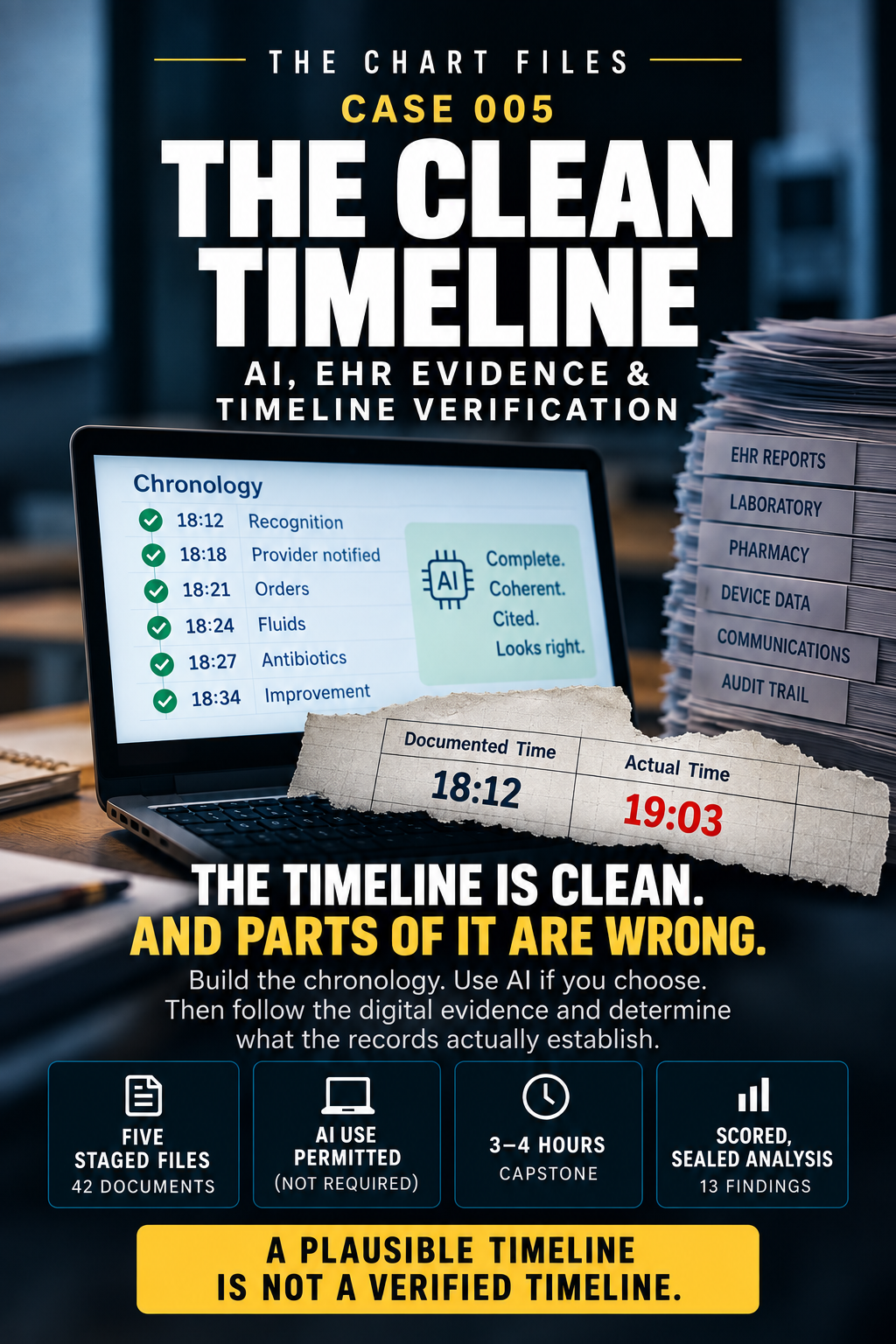
Recognition at 18:12. Provider notified at 18:18. Orders at 18:21. Fluids at 18:24. Antibiotics at 18:27. Improvement at 18:34.
It is coherent. It is supported by citations. An AI chronology tool reaches essentially the same conclusion.
And parts of it are wrong.
Not because the AI hallucinated.
Not because it failed to read the chart.
Because the medical record it was given could not tell the whole story.
Welcome to Case 005 — The Clean Timeline, the capstone investigation in The Chart Files.
This time, you're encouraged to bring AI with you.
Then you're going to investigate whether you can trust what it tells you.
Your Assignment
You have been retained by defense counsel in Pruitt v. Marsh Harbor General Hospital.
A 67-year-old postoperative patient develops an anastomotic leak, septic shock, acute kidney injury, and a prolonged hospitalization. Counsel needs a defensible chronology of the deterioration and response.
You receive the hospital's 46-page certified medical-record production.
Your first task sounds straightforward:
Reconstruct what happened.
You may use an AI system of your choice to help extract events, identify inconsistencies, classify timestamps, and build the chronology. In fact, AI use is permitted and encouraged.
And AI may do an impressive job.
But there is a problem hiding in plain sight.
The certified production consists of printed EHR reports. It does not include audit trails, device data, alert history, dispensing-cabinet records, infusion-pump data, communication logs, or other system metadata. And its flowsheet and MAR reports display documented performed time.
So before you trust your timeline, you'll have to answer a harder question:
What does the evidence actually establish?
Build the Timeline. Then Try to Break It.
This is not a case where you receive every document at once.
You work the investigation in stages.
First, you'll analyze the conventional medical record and build your chronology. You'll commit to your findings before seeing what comes next.
Then counsel obtains the underlying digital evidence.
Audit data. Device records. Alert history. Laboratory metadata. Pharmacy records. Barcode scans. Infusion-pump data. Communication logs. Access records.
Now you have a new assignment:
Audit your own timeline.
Which events survive?
Which need to be qualified?
Which happened at a different time than the conventional chart suggests?
And which “facts” were never facts at all?
Stage II explicitly asks you to compare your initial chronology against system data and determine “what survives.”
One Patient. Multiple Systems. Multiple Kinds of Time.
Modern medical records don't contain one clock.
They contain many.
An event may have a performed time, entry time, signed time, collection time, result time, order time, service time, device time, alert time, administration time, or access time.
Those distinctions can completely change a chronology.
In The Clean Timeline, you'll encounter documentation showing one sequence of events while underlying electronic systems preserve another.
You'll have to determine:
When did the patient's condition actually deteriorate?
When was it recognized?
When was the provider actually contacted?
When were orders placed?
When did fluids actually begin?
When did the antibiotic reach the patient?
When were laboratory results available — and when did a clinician actually see them?
And perhaps most importantly:
Which of those questions can the evidence answer at all?
AI Isn't the Villain in This Case.
That's what makes Case 005 different.
AI may catch something you miss.
It can cross-reference dozens of pages rapidly. It can identify conflicting medication doses, suspicious sequences, duplicated language, and inconsistencies buried across a large medical record.
In development testing, AI identified several meaningful discrepancies in the Stage I record—including one that a tired human reviewer could easily overlook.
But it still constructed key intervals around the documented chronology because the evidence necessary to disprove those times wasn't yet available to it.
That distinction is the heart of the case.
AI can extract what a record says.
The investigator still has to determine what the evidence proves.
Then You Get Someone Else's AI Work Product.
Just when you think you've reconstructed the case, counsel sends you one more document.
A litigation-support vendor previously processed the certified record through an AI chronology system.
The result looks excellent.
It's polished.
It's cited.
It's been reviewed by a paralegal.
It identifies genuine discrepancies.
And it reaches conclusions counsel would very much like to believe.
Your assignment:
Audit it.
You'll evaluate the vendor's chronology statement by statement and identify problems such as:
documented time treated as event time;
patient report treated as established fact;
order time treated as administration;
result time treated as clinician awareness;
copied-forward text treated as a current finding;
correct citation paired with an unsupported conclusion;
events improperly merged or attributed;
and conclusions resting on unreliable premises.
This isn't an exercise in finding silly AI hallucinations.
The difficult errors are the ones that sound reasonable, cite the correct record, and still aren't supported by the evidence.
Six Questions. Every Event.
Throughout the investigation, you'll apply the Case 005 framework:
1. What happened?
The clinical event, as best the evidence establishes it.
2. What was documented?
The words and values appearing in the record.
3. When was it documented?
The entry time—not necessarily the time printed beside it.
4. What does the digital evidence establish?
Devices, alerts, scans, logs, access and other system evidence.
5. What did AI infer?
What your tool—or someone else's—concluded from the evidence.
6. What survives?
Only what you can verify against the source evidence.
That last question is the one that matters.
This Is More Than Timeline Building.
Case 005 combines the skills developed throughout The Chart Files into a single investigation:
clinical medical-record review + chronology reconstruction + EHR audit evidence + metadata + device data + medication evidence + source provenance + AI-assisted analysis + human verification.
You'll have to distinguish Fact, Inference, Hypothesis, and Unknown throughout the investigation—and recognize when a perfectly plausible conclusion exceeds what the available evidence can actually establish.
You are not being asked to determine standard of care, causation, or intent.
You're being asked to do something more fundamental:
Establish the factual record on which those opinions may eventually depend.
What's Included
The complete Case 005 investigation contains five staged files and 42 documents, including a 46-page certified clinical record; investigator workbook; audit trails and EHR metadata; device and sepsis-alert data; laboratory timing and access evidence; pharmacy, dispensing-cabinet, barcode and infusion-pump records; communication and system-access logs; a prior reviewer's AI-generated chronology; three investigative checkpoints; a 90-second attorney-facing Final Challenge; and a scored, sealed Investigator's Analysis containing the verified timeline, 13 scored findings, vendor audit key, model response, records to request, and Chart Files Principles.
Difficulty: Capstone — the hardest file in the series
Estimated Investigation Time: 3–4 hours
Recommended: Complete Cases 003 and 004 first
AI: Permitted and encouraged, but not required
The Real Test
The danger isn't that AI will produce an obviously bad chronology.
The danger is that it will produce a very good one.
Fast. Organized. Cited. Persuasive.
And just wrong enough to matter.
Your job as the investigator isn't to reject AI.
It's to know when to use it, when to question it, how to verify it, and where its conclusions must stop.
Because in a medical-record investigation:
A plausible timeline is not a verified timeline.
AI can accelerate the investigation.
It cannot assume responsibility for it.
Build the timeline. Audit the AI. Follow the digital evidence. Determine what survives.
The Chart Files: Case 005 — The Clean Timeline
Capstone Medical-Record Investigation | Five Staged Files | Digital Download | $69.95
The Chart Files: Case 005 — The Clean Timeline
Capstone Medical-Record Investigation: AI, EHR Evidence & Timeline Verification
The timeline is clean.
Recognition at 18:12. Provider notified at 18:18. Orders at 18:21. Fluids at 18:24. Antibiotics at 18:27. Improvement at 18:34.
It is coherent. It is supported by citations. An AI chronology tool reaches essentially the same conclusion.
And parts of it are wrong.
Not because the AI hallucinated.
Not because it failed to read the chart.
Because the medical record it was given could not tell the whole story.
Welcome to Case 005 — The Clean Timeline, the capstone investigation in The Chart Files.
This time, you're encouraged to bring AI with you.
Then you're going to investigate whether you can trust what it tells you.
Your Assignment
You have been retained by defense counsel in Pruitt v. Marsh Harbor General Hospital.
A 67-year-old postoperative patient develops an anastomotic leak, septic shock, acute kidney injury, and a prolonged hospitalization. Counsel needs a defensible chronology of the deterioration and response.
You receive the hospital's 46-page certified medical-record production.
Your first task sounds straightforward:
Reconstruct what happened.
You may use an AI system of your choice to help extract events, identify inconsistencies, classify timestamps, and build the chronology. In fact, AI use is permitted and encouraged.
And AI may do an impressive job.
But there is a problem hiding in plain sight.
The certified production consists of printed EHR reports. It does not include audit trails, device data, alert history, dispensing-cabinet records, infusion-pump data, communication logs, or other system metadata. And its flowsheet and MAR reports display documented performed time.
So before you trust your timeline, you'll have to answer a harder question:
What does the evidence actually establish?
Build the Timeline. Then Try to Break It.
This is not a case where you receive every document at once.
You work the investigation in stages.
First, you'll analyze the conventional medical record and build your chronology. You'll commit to your findings before seeing what comes next.
Then counsel obtains the underlying digital evidence.
Audit data. Device records. Alert history. Laboratory metadata. Pharmacy records. Barcode scans. Infusion-pump data. Communication logs. Access records.
Now you have a new assignment:
Audit your own timeline.
Which events survive?
Which need to be qualified?
Which happened at a different time than the conventional chart suggests?
And which “facts” were never facts at all?
Stage II explicitly asks you to compare your initial chronology against system data and determine “what survives.”
One Patient. Multiple Systems. Multiple Kinds of Time.
Modern medical records don't contain one clock.
They contain many.
An event may have a performed time, entry time, signed time, collection time, result time, order time, service time, device time, alert time, administration time, or access time.
Those distinctions can completely change a chronology.
In The Clean Timeline, you'll encounter documentation showing one sequence of events while underlying electronic systems preserve another.
You'll have to determine:
When did the patient's condition actually deteriorate?
When was it recognized?
When was the provider actually contacted?
When were orders placed?
When did fluids actually begin?
When did the antibiotic reach the patient?
When were laboratory results available — and when did a clinician actually see them?
And perhaps most importantly:
Which of those questions can the evidence answer at all?
AI Isn't the Villain in This Case.
That's what makes Case 005 different.
AI may catch something you miss.
It can cross-reference dozens of pages rapidly. It can identify conflicting medication doses, suspicious sequences, duplicated language, and inconsistencies buried across a large medical record.
In development testing, AI identified several meaningful discrepancies in the Stage I record—including one that a tired human reviewer could easily overlook.
But it still constructed key intervals around the documented chronology because the evidence necessary to disprove those times wasn't yet available to it.
That distinction is the heart of the case.
AI can extract what a record says.
The investigator still has to determine what the evidence proves.
Then You Get Someone Else's AI Work Product.
Just when you think you've reconstructed the case, counsel sends you one more document.
A litigation-support vendor previously processed the certified record through an AI chronology system.
The result looks excellent.
It's polished.
It's cited.
It's been reviewed by a paralegal.
It identifies genuine discrepancies.
And it reaches conclusions counsel would very much like to believe.
Your assignment:
Audit it.
You'll evaluate the vendor's chronology statement by statement and identify problems such as:
documented time treated as event time;
patient report treated as established fact;
order time treated as administration;
result time treated as clinician awareness;
copied-forward text treated as a current finding;
correct citation paired with an unsupported conclusion;
events improperly merged or attributed;
and conclusions resting on unreliable premises.
This isn't an exercise in finding silly AI hallucinations.
The difficult errors are the ones that sound reasonable, cite the correct record, and still aren't supported by the evidence.
Six Questions. Every Event.
Throughout the investigation, you'll apply the Case 005 framework:
1. What happened?
The clinical event, as best the evidence establishes it.
2. What was documented?
The words and values appearing in the record.
3. When was it documented?
The entry time—not necessarily the time printed beside it.
4. What does the digital evidence establish?
Devices, alerts, scans, logs, access and other system evidence.
5. What did AI infer?
What your tool—or someone else's—concluded from the evidence.
6. What survives?
Only what you can verify against the source evidence.
That last question is the one that matters.
This Is More Than Timeline Building.
Case 005 combines the skills developed throughout The Chart Files into a single investigation:
clinical medical-record review + chronology reconstruction + EHR audit evidence + metadata + device data + medication evidence + source provenance + AI-assisted analysis + human verification.
You'll have to distinguish Fact, Inference, Hypothesis, and Unknown throughout the investigation—and recognize when a perfectly plausible conclusion exceeds what the available evidence can actually establish.
You are not being asked to determine standard of care, causation, or intent.
You're being asked to do something more fundamental:
Establish the factual record on which those opinions may eventually depend.
What's Included
The complete Case 005 investigation contains five staged files and 42 documents, including a 46-page certified clinical record; investigator workbook; audit trails and EHR metadata; device and sepsis-alert data; laboratory timing and access evidence; pharmacy, dispensing-cabinet, barcode and infusion-pump records; communication and system-access logs; a prior reviewer's AI-generated chronology; three investigative checkpoints; a 90-second attorney-facing Final Challenge; and a scored, sealed Investigator's Analysis containing the verified timeline, 13 scored findings, vendor audit key, model response, records to request, and Chart Files Principles.
Difficulty: Capstone — the hardest file in the series
Estimated Investigation Time: 3–4 hours
Recommended: Complete Cases 003 and 004 first
AI: Permitted and encouraged, but not required
The Real Test
The danger isn't that AI will produce an obviously bad chronology.
The danger is that it will produce a very good one.
Fast. Organized. Cited. Persuasive.
And just wrong enough to matter.
Your job as the investigator isn't to reject AI.
It's to know when to use it, when to question it, how to verify it, and where its conclusions must stop.
Because in a medical-record investigation:
A plausible timeline is not a verified timeline.
AI can accelerate the investigation.
It cannot assume responsibility for it.
Build the timeline. Audit the AI. Follow the digital evidence. Determine what survives.
The Chart Files: Case 005 — The Clean Timeline
Capstone Medical-Record Investigation | Five Staged Files | Digital Download | $69.95