LNC Tools & Resources
Filters
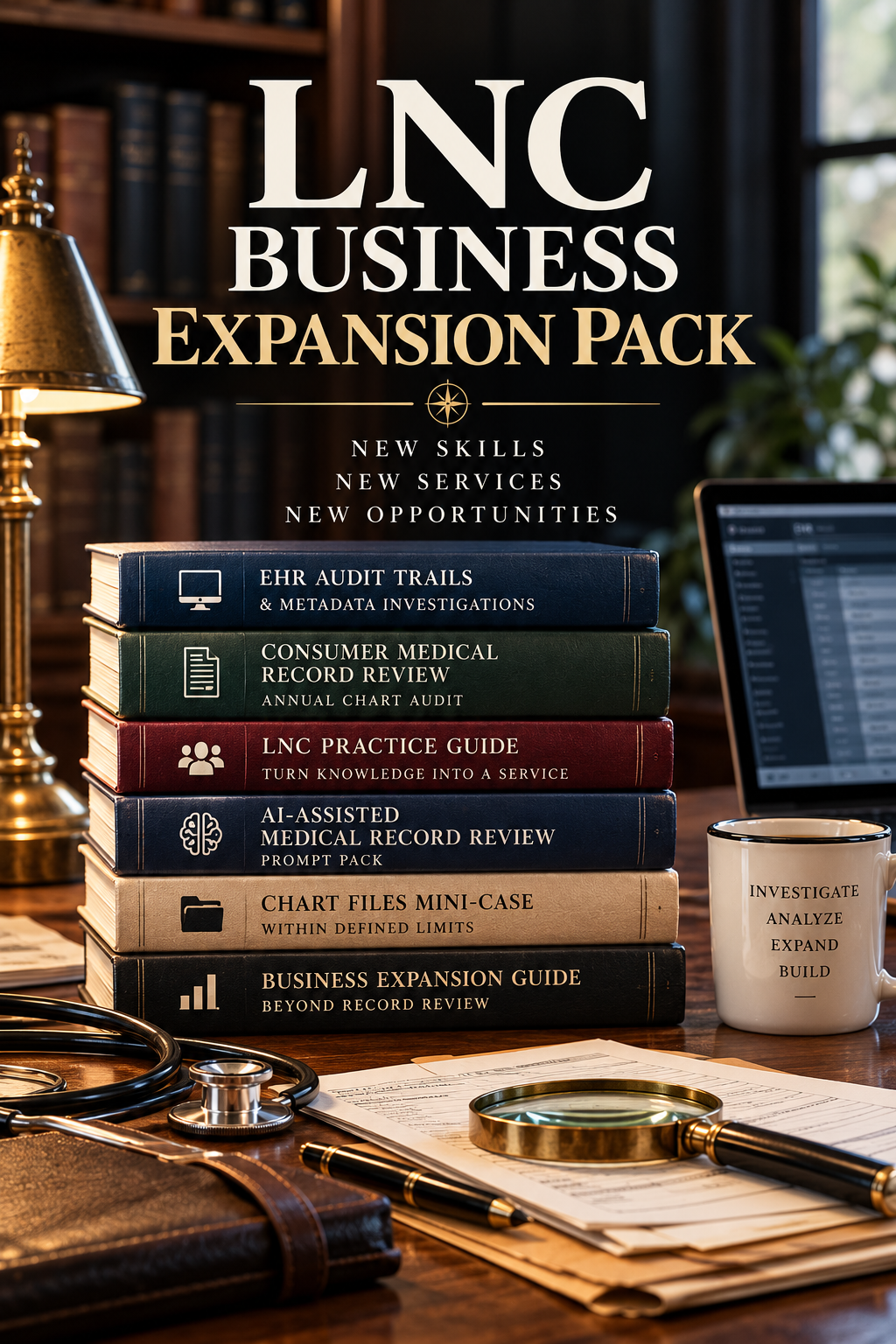
LNC Business Expansion Pack
Don't Just Wait for Attorney Cases. Build Your Practice.
Most Legal Nurse Consultants are introduced to the same core services: medical-record review, chronologies, case summaries, and litigation support.
Those services matter. But they don't have to define your entire business.
And if you're a new LNC, there's an immediate problem with building a practice around them alone:
You can't review an attorney's case until an attorney sends you one.
The LNC Business Expansion Pack was created to help Legal Nurse Consultants develop additional skills, services, and potential revenue streams while continuing to build their traditional attorney-facing practice.
Learn how to investigate electronic health records beyond the printed chart. Explore consumer-facing medical-record services. Develop an annual chart-audit offering. Incorporate AI into record review responsibly. And begin thinking about your nursing and medical-record expertise not simply as one service, but as the foundation for multiple business lines.
What's Included
EHR Audit Trails, Metadata & Digital Medical Record Investigations
Professional Training + Practice Toolkit
Go beyond the PDF medical record and learn to investigate the electronic systems behind it.
This approximately 128-page training and practice system includes the Professional Field Manual, Nine-Step EHR Investigation Workflow, six applied case laboratories, reusable EHR Investigation Chart File, worksheets, request templates, and The Chart Files: Case 003 — The Clean Copy, an advanced audit-trail and EHR revision investigation.
Develop a specialized service capability involving audit trails, metadata, version history, documentation timing, access information, provenance, electronic evidence, and EHR investigation.
The Personal Medical Record Audit — Annual Chart Check
A complete 143-page consumer medical-record auditing system with seven reusable worksheets and 32 ready-to-use letters, messages, and scripts.
Use it to understand how a structured annual medical-record review works and as the foundation for developing consumer-facing services that help individuals examine their records for inaccurate, outdated, duplicated, missing, or questionable information.
Consumer Medical Record Review & Annual Audit — LNC Practice Guide
Expansion Pack Exclusive
The consumer guide teaches patients how to examine their records.
This companion guide teaches the LNC how to turn that knowledge into a service.
Learn how consumer medical-record review and annual chart audits can fit into an independent LNC practice, including service structure, intake, workflow, deliverables, professional boundaries, recurring annual reviews, referral considerations, and practical approaches to packaging the service.
This resource is available exclusively as part of the LNC Business Expansion Pack.
AI-Assisted Medical Record Review Prompt Pack
Includes 16 LNC-specific AI prompts across six categories, verification protocols, a de-identification checklist, an AI Use Verification Log, and an evidentiary framework for using AI as an organizational and analytical assistant without outsourcing professional judgment.
Use AI to help organize, extract, compare, flag, draft, and build chronologies — while keeping the LNC responsible for verification and conclusions.
Chart Files Mini-Case: Within Defined Limits
Put the concepts into practice with a focused EHR investigation involving charting by exception, conflicting assessments, documentation timing, provenance, and audit-trail reasoning.
Rather than simply asking what the chart says, investigate how the documentation got there and what it actually proves.
Beyond Record Review — The LNC Business Expansion Guide
Expansion Pack Exclusive
The roadmap that ties the entire system together.
Explore additional services and specialized capabilities that can be developed from your existing nursing and medical-record expertise, including:
EHR audit-trail and metadata investigation • electronic medical-record investigation • consumer medical-record review • annual personal chart audits • medical-record discrepancy review • record-request strategy • AI-assisted record analysis • documentation provenance and information-availability analysis
For each area, examine what the service is, who might need it, what skills are required, what the LNC can deliver, professional boundaries to consider, and practical ways to begin incorporating it into an independent practice.
Build While You Wait
A new LNC doesn't have to spend the first year simply waiting for an attorney to send a case.
You can use that time to develop specialized capabilities.
You can build consumer-facing services.
You can learn EHR investigation.
You can create repeatable workflows.
You can practice on realistic evidence.
And you can continue marketing to attorneys while developing other reasons for clients to hire you.
For established LNCs, the question is different:
What else could your practice become?
The LNC Business Expansion Pack is designed to help you answer it.
One package. Multiple capabilities. More than one path to building an LNC practice.
Don't just wait for cases. Build capabilities. Build services. Build your practice.
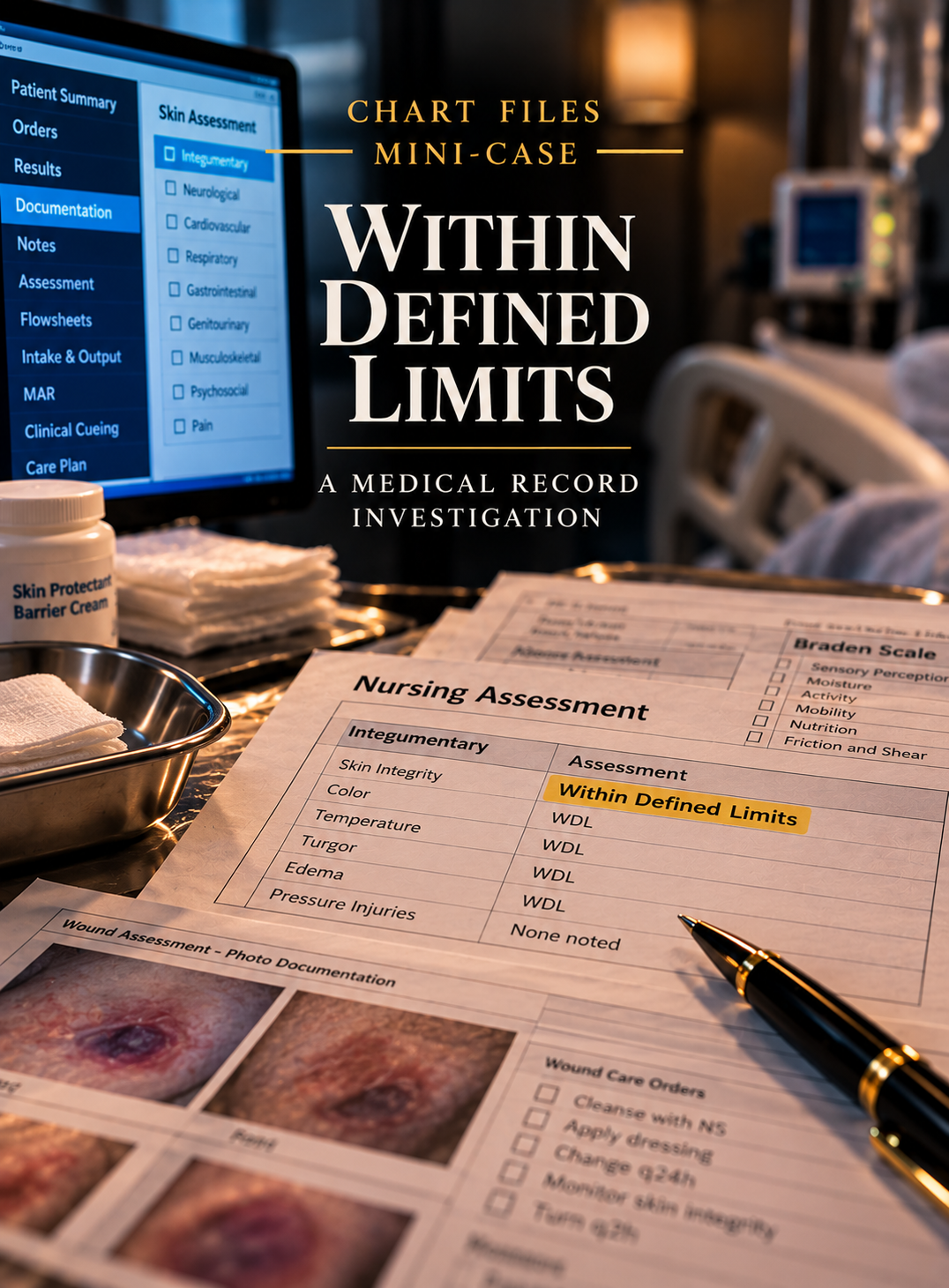
Chart Files Mini-Case: Within Defined Limits
What does “Within Defined Limits” actually establish?
An elderly patient is hospitalized after a prolonged period on the floor and later develops a significant sacral pressure injury. The medical record contains an apparently reassuring finding: the patient's integumentary assessment was documented Within Defined Limits (WDL).
That entry seems important.
But before relying on it, an investigator needs to ask a different question:
How did that documentation get there?
Within Defined Limits is a 20–30 minute Chart Files Mini-Case designed for legal nurse consultants and medical record reviewers who want to look beyond the rendered chart and investigate the EHR processes that created it.
You'll examine conflicting skin assessments, charting by exception, documentation timing, and the evidentiary significance of EHR workflow. The case challenges you to determine how much weight should be given to an apparently specific clinical entry when the mechanism behind that entry tells a more complicated story.
This isn't simply a pressure-injury case.
It's an investigation into what an EHR entry actually proves — and what it doesn't.
One question. One answer you can defend.
Skills practiced: EHR documentation, charting by exception, conflicting clinical findings, present-on-admission analysis, audit-trail reasoning, documentation provenance, and evidence-based conclusions.
Estimated completion time: 20–30 minutes.
Format: Digital PDF mini-case with case materials and sealed analysis.
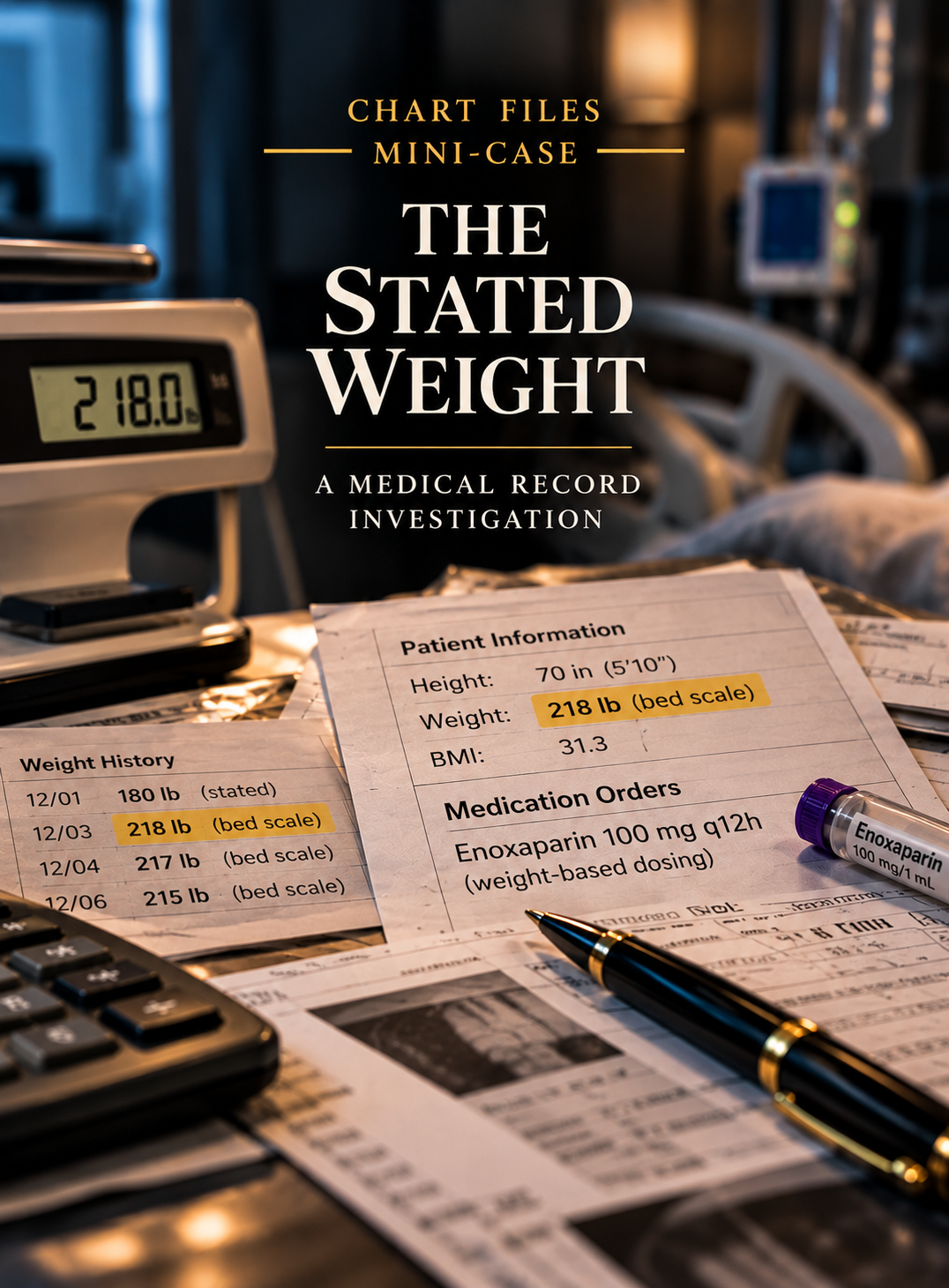
Chart Files Mini-Case: The Stated Weight
Every number in a medical record has a first source. Find it before you trust what was calculated from it.
A hospitalized patient receives weight-based anticoagulation and later develops a significant bleeding complication. The case theory seems straightforward: an incorrect patient weight resulted in an excessive medication dose.
The numbers appear to support it.
But do they?
The Stated Weight is a 20–30 minute Chart Files Mini-Case designed for legal nurse consultants and medical record reviewers who want to practice investigating the record rather than simply accepting its contents at face value.
You'll examine conflicting patient weights, medication dosing, EHR data provenance, and the difference between stated and measured information. Your task is to trace a seemingly simple clinical value back to its source and determine whether the proposed explanation actually survives the evidence.
This isn't an exercise in finding facts that support the theory you've been given. It's an exercise in testing the theory itself.
One question. One answer you can defend.
Skills practiced: medical record investigation, data provenance, weight-based medication dosing, stated vs. measured values, chronology, competing hypotheses, and evidence-based conclusions.
Estimated completion time: 20–30 minutes.
Format: Digital PDF mini-case with case materials and sealed analysis.
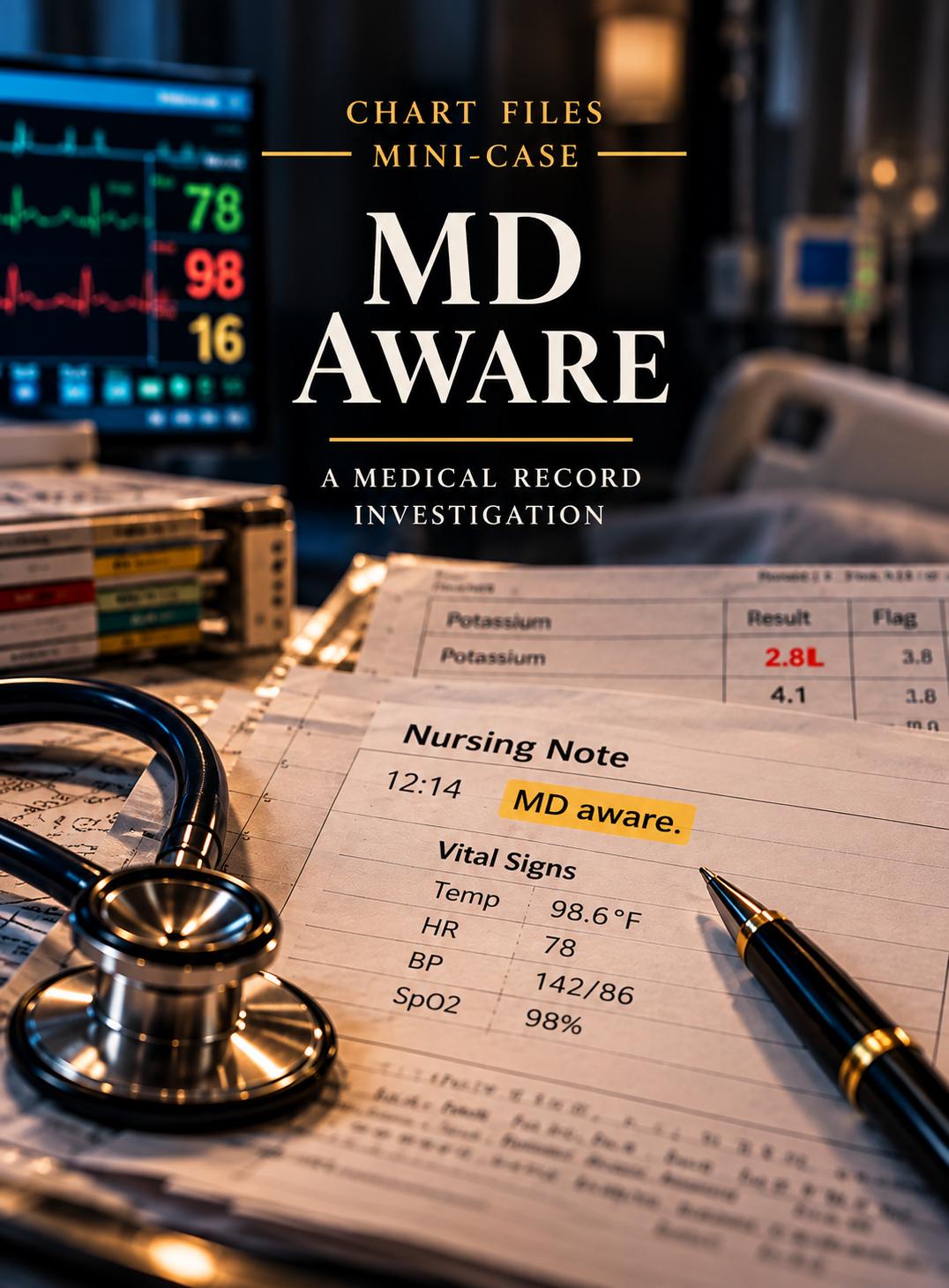
Chart Files Mini-Case: MD Aware
Can two words in a nursing note prove that a physician was notified?
A hospitalized patient has a critical potassium result. The nursing documentation says “MD aware.” The attending physician later says no one called him.
The answer appears simple — until you examine the timestamps, laboratory results, telephone orders, and attribution behind the documentation.
MD Aware is a short, case-based medical record investigation designed for legal nurse consultants and other clinical reviewers who want to sharpen their evidentiary reasoning.
You'll investigate a realistic medical record and work through questions involving critical-value communication, nursing documentation, physician attribution, telephone orders, and the danger of treating two separate laboratory results as though they were one event.
Your task is deliberately narrow:
One question. One answer you can defend.
The case is designed to strengthen your ability to separate documented fact from inference, hypothesis, and what the available record simply cannot establish.
Skills practiced: medical record investigation, critical laboratory values, documentation attribution, temporal reasoning, telephone orders, and evidence-based conclusions.
Estimated completion time: 20–30 minutes.
The Evidence Discipline Collection
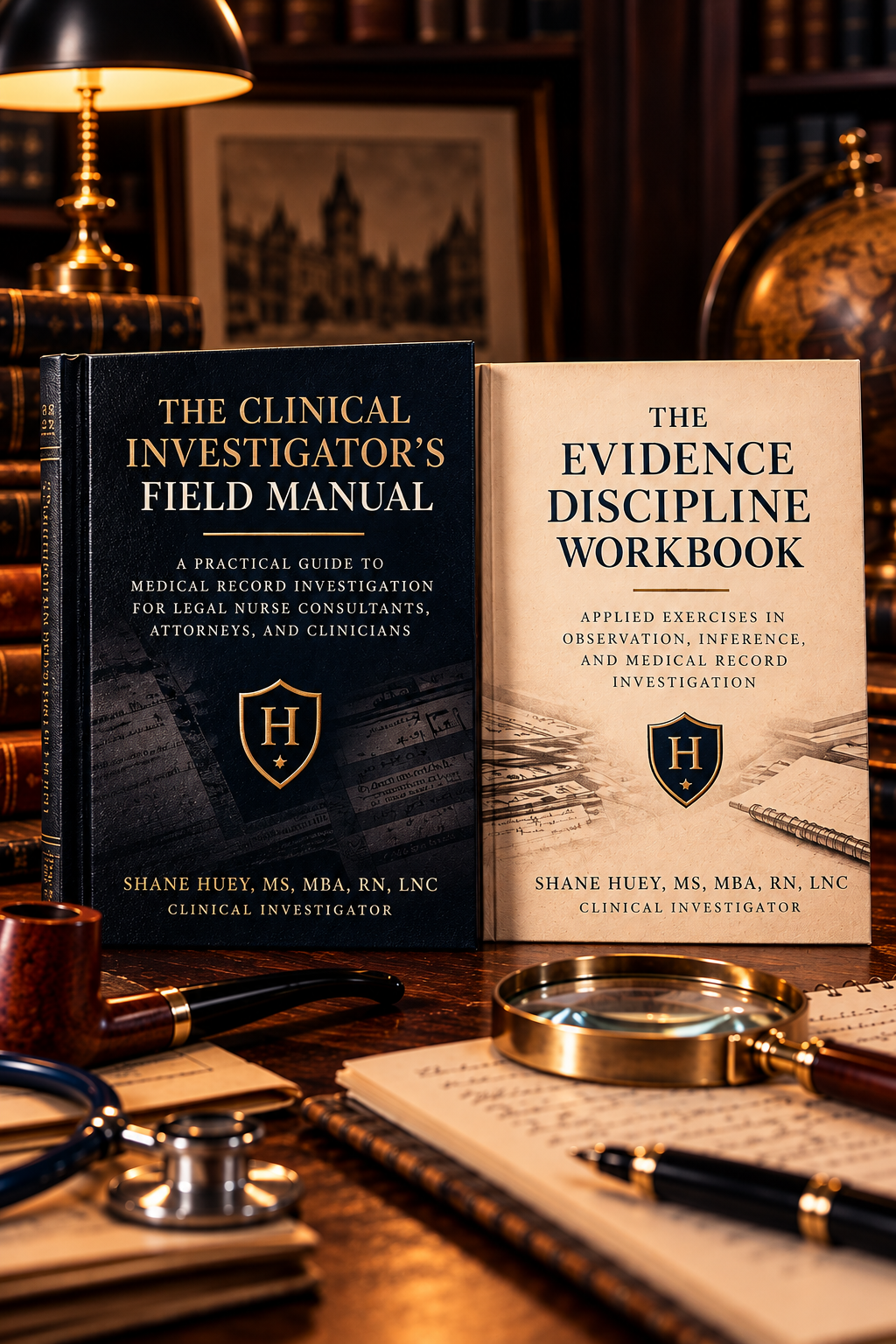
The Clinical Investigator’s Field Manual + The Evidence Discipline Workbook
Medical-record review is not simply finding information in a chart. It is determining what the record actually establishes, what can reasonably be inferred from it, what remains only a hypothesis, and what the available evidence does not permit you to conclude.
The Evidence Discipline Collection is a two-part professional training system designed for legal nurse consultants, clinical investigators, nurses, advanced practice clinicians, attorneys, and other professionals who analyze medical records in clinical, legal, and investigative settings.
Rather than teaching you simply what to look for, this collection focuses on how to think about what you find.
At its foundation is The Clinical Investigator’s Field Manual, a practical framework for disciplined medical-record investigation. It develops the reasoning skills necessary to move beyond passive chart review and approach the record as evidence — examining chronology, provenance, inconsistencies, missing information, documentation patterns, EHR behavior, competing explanations, and the limits of what the available record can support.
The Field Manual emphasizes a critical distinction that is easily lost during complex case review:
Observation is not inference. Inference is not hypothesis. Hypothesis is not conclusion.
Knowing where one ends and the next begins can profoundly affect the accuracy and defensibility of an analysis.
The companion Evidence Discipline Workbook turns those principles into deliberate practice. Through structured exercises and record-review problems, you will practice separating documented facts from interpretation, identifying unsupported assumptions, generating competing hypotheses, recognizing evidentiary gaps, testing conclusions, and communicating findings with appropriate precision.
Together, the two resources create a learn-and-apply system:
Learn the investigative method in the Field Manual. Practice the method in the Workbook. Carry the discipline into your own cases.
This collection is particularly useful for professionals who work with records involving questions of standard of care, chronology, causation, documentation discrepancies, medication administration, clinical decision-making, EHR workflows, metadata and audit trails, or other situations in which what appears in the chart may not tell the entire story.
The goal is not to teach reviewers to reach more dramatic conclusions.
It is to teach them to reach better-supported ones.
Because a strong clinical investigator must be able to tell counsel not only:
Here is what I found.
But also:
Here is what the record establishes.
Here is what it suggests.
Here is what it does not establish.
Here is what remains unknown.
And here is what I would investigate next.
Included in the Collection
The Clinical Investigator’s Field Manual
A practical reference for approaching medical records as investigative evidence, with an emphasis on observation, inference, hypothesis formation, verification, documentary inconsistencies, evidentiary limits, and disciplined clinical reasoning.
The Evidence Discipline Workbook
A companion practice resource designed to move those concepts off the page and into actual reasoning through structured exercises that challenge you to observe carefully, question assumptions, distinguish fact from interpretation, and defend only what the available evidence supports.
Who It’s For
Legal nurse consultants • Registered nurses • Nurse practitioners and physician assistants • Physicians • Attorneys • Medical-record reviewers • Clinical and forensic investigators
Two resources. One investigative discipline.
Don’t just review the record. Learn to interrogate it.
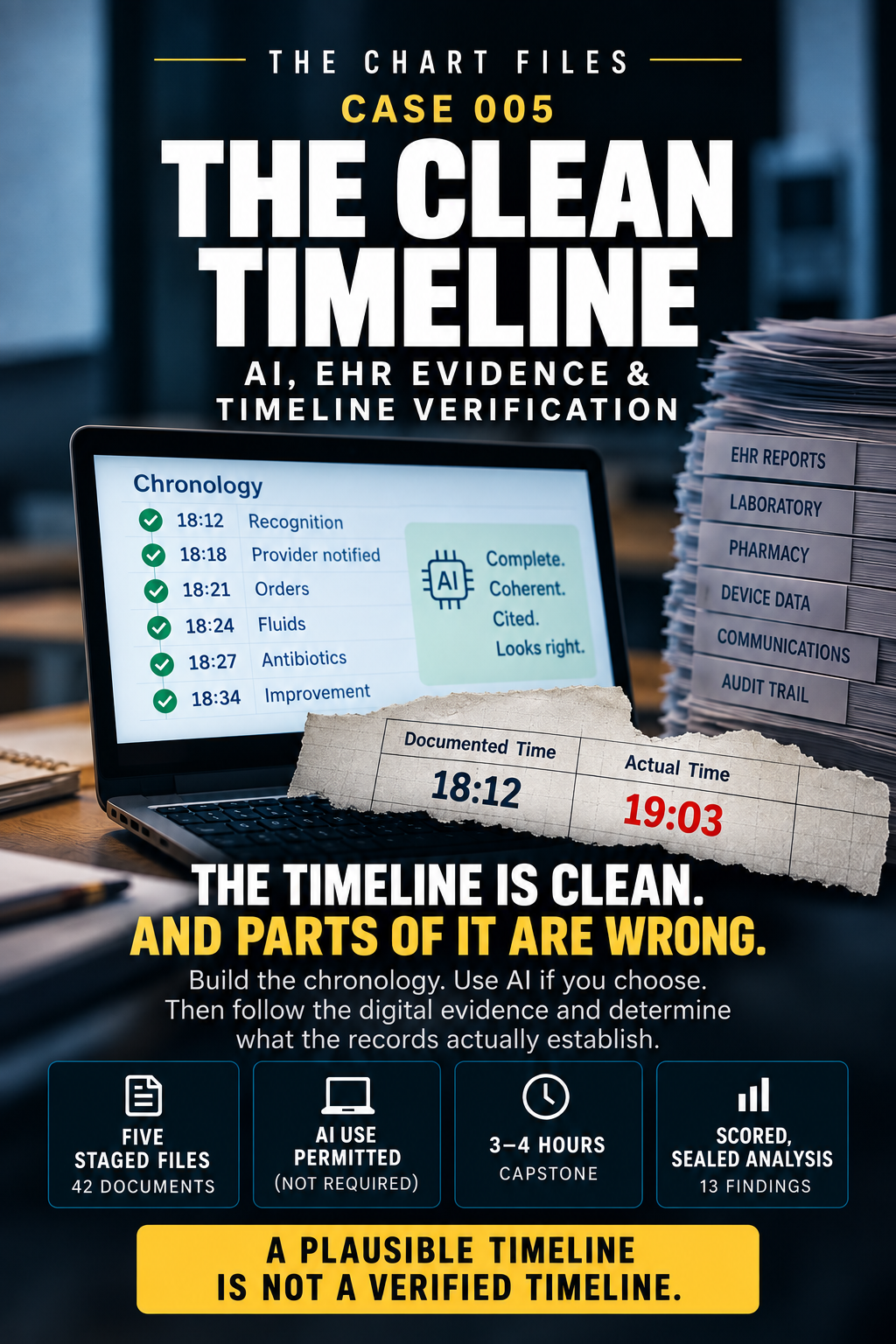
The Chart Files: Case 005 — The Clean Timeline
Capstone Medical-Record Investigation: AI, EHR Evidence & Timeline Verification
The timeline is clean.
Recognition at 18:12. Provider notified at 18:18. Orders at 18:21. Fluids at 18:24. Antibiotics at 18:27. Improvement at 18:34.
It is coherent. It is supported by citations. An AI chronology tool reaches essentially the same conclusion.
And parts of it are wrong.
Not because the AI hallucinated.
Not because it failed to read the chart.
Because the medical record it was given could not tell the whole story.
Welcome to Case 005 — The Clean Timeline, the capstone investigation in The Chart Files.
This time, you're encouraged to bring AI with you.
Then you're going to investigate whether you can trust what it tells you.
Your Assignment
You have been retained by defense counsel in Pruitt v. Marsh Harbor General Hospital.
A 67-year-old postoperative patient develops an anastomotic leak, septic shock, acute kidney injury, and a prolonged hospitalization. Counsel needs a defensible chronology of the deterioration and response.
You receive the hospital's 46-page certified medical-record production.
Your first task sounds straightforward:
Reconstruct what happened.
You may use an AI system of your choice to help extract events, identify inconsistencies, classify timestamps, and build the chronology. In fact, AI use is permitted and encouraged.
And AI may do an impressive job.
But there is a problem hiding in plain sight.
The certified production consists of printed EHR reports. It does not include audit trails, device data, alert history, dispensing-cabinet records, infusion-pump data, communication logs, or other system metadata. And its flowsheet and MAR reports display documented performed time.
So before you trust your timeline, you'll have to answer a harder question:
What does the evidence actually establish?
Build the Timeline. Then Try to Break It.
This is not a case where you receive every document at once.
You work the investigation in stages.
First, you'll analyze the conventional medical record and build your chronology. You'll commit to your findings before seeing what comes next.
Then counsel obtains the underlying digital evidence.
Audit data. Device records. Alert history. Laboratory metadata. Pharmacy records. Barcode scans. Infusion-pump data. Communication logs. Access records.
Now you have a new assignment:
Audit your own timeline.
Which events survive?
Which need to be qualified?
Which happened at a different time than the conventional chart suggests?
And which “facts” were never facts at all?
Stage II explicitly asks you to compare your initial chronology against system data and determine “what survives.”
One Patient. Multiple Systems. Multiple Kinds of Time.
Modern medical records don't contain one clock.
They contain many.
An event may have a performed time, entry time, signed time, collection time, result time, order time, service time, device time, alert time, administration time, or access time.
Those distinctions can completely change a chronology.
In The Clean Timeline, you'll encounter documentation showing one sequence of events while underlying electronic systems preserve another.
You'll have to determine:
When did the patient's condition actually deteriorate?
When was it recognized?
When was the provider actually contacted?
When were orders placed?
When did fluids actually begin?
When did the antibiotic reach the patient?
When were laboratory results available — and when did a clinician actually see them?
And perhaps most importantly:
Which of those questions can the evidence answer at all?
AI Isn't the Villain in This Case.
That's what makes Case 005 different.
AI may catch something you miss.
It can cross-reference dozens of pages rapidly. It can identify conflicting medication doses, suspicious sequences, duplicated language, and inconsistencies buried across a large medical record.
In development testing, AI identified several meaningful discrepancies in the Stage I record—including one that a tired human reviewer could easily overlook.
But it still constructed key intervals around the documented chronology because the evidence necessary to disprove those times wasn't yet available to it.
That distinction is the heart of the case.
AI can extract what a record says.
The investigator still has to determine what the evidence proves.
Then You Get Someone Else's AI Work Product.
Just when you think you've reconstructed the case, counsel sends you one more document.
A litigation-support vendor previously processed the certified record through an AI chronology system.
The result looks excellent.
It's polished.
It's cited.
It's been reviewed by a paralegal.
It identifies genuine discrepancies.
And it reaches conclusions counsel would very much like to believe.
Your assignment:
Audit it.
You'll evaluate the vendor's chronology statement by statement and identify problems such as:
documented time treated as event time;
patient report treated as established fact;
order time treated as administration;
result time treated as clinician awareness;
copied-forward text treated as a current finding;
correct citation paired with an unsupported conclusion;
events improperly merged or attributed;
and conclusions resting on unreliable premises.
This isn't an exercise in finding silly AI hallucinations.
The difficult errors are the ones that sound reasonable, cite the correct record, and still aren't supported by the evidence.
Six Questions. Every Event.
Throughout the investigation, you'll apply the Case 005 framework:
1. What happened?
The clinical event, as best the evidence establishes it.
2. What was documented?
The words and values appearing in the record.
3. When was it documented?
The entry time—not necessarily the time printed beside it.
4. What does the digital evidence establish?
Devices, alerts, scans, logs, access and other system evidence.
5. What did AI infer?
What your tool—or someone else's—concluded from the evidence.
6. What survives?
Only what you can verify against the source evidence.
That last question is the one that matters.
This Is More Than Timeline Building.
Case 005 combines the skills developed throughout The Chart Files into a single investigation:
clinical medical-record review + chronology reconstruction + EHR audit evidence + metadata + device data + medication evidence + source provenance + AI-assisted analysis + human verification.
You'll have to distinguish Fact, Inference, Hypothesis, and Unknown throughout the investigation—and recognize when a perfectly plausible conclusion exceeds what the available evidence can actually establish.
You are not being asked to determine standard of care, causation, or intent.
You're being asked to do something more fundamental:
Establish the factual record on which those opinions may eventually depend.
What's Included
The complete Case 005 investigation contains five staged files and 42 documents, including a 46-page certified clinical record; investigator workbook; audit trails and EHR metadata; device and sepsis-alert data; laboratory timing and access evidence; pharmacy, dispensing-cabinet, barcode and infusion-pump records; communication and system-access logs; a prior reviewer's AI-generated chronology; three investigative checkpoints; a 90-second attorney-facing Final Challenge; and a scored, sealed Investigator's Analysis containing the verified timeline, 13 scored findings, vendor audit key, model response, records to request, and Chart Files Principles.
Difficulty: Capstone — the hardest file in the series
Estimated Investigation Time: 3–4 hours
Recommended: Complete Cases 003 and 004 first
AI: Permitted and encouraged, but not required
The Real Test
The danger isn't that AI will produce an obviously bad chronology.
The danger is that it will produce a very good one.
Fast. Organized. Cited. Persuasive.
And just wrong enough to matter.
Your job as the investigator isn't to reject AI.
It's to know when to use it, when to question it, how to verify it, and where its conclusions must stop.
Because in a medical-record investigation:
A plausible timeline is not a verified timeline.
AI can accelerate the investigation.
It cannot assume responsibility for it.
Build the timeline. Audit the AI. Follow the digital evidence. Determine what survives.
The Chart Files: Case 005 — The Clean Timeline
Capstone Medical-Record Investigation | Five Staged Files | Digital Download | $69.95
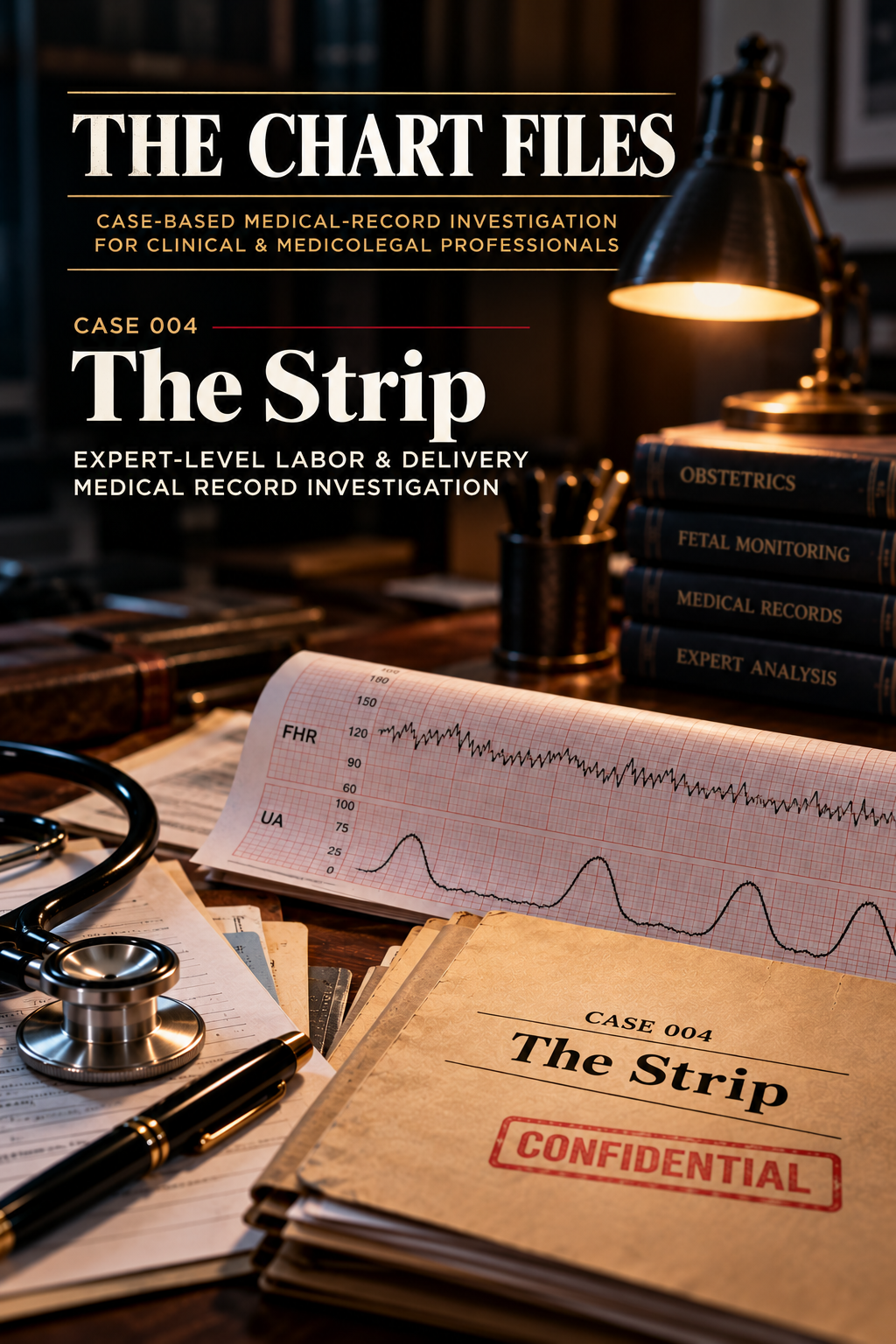
The Chart Files: Case 004 — The Strip
Expert-Level Labor & Delivery Medical Record Investigation
The baby is healthy. The mother is not.
An emergency cesarean results in a bladder injury. The patient maintains that the surgery was unnecessary. A board-certified obstetrician has reviewed the record and agrees — and plaintiff's counsel has retained you to help support the case.
The expert's preliminary opinion appears compelling.
The certified medical record appears to support it.
Until you start investigating the record itself.
Because buried across fetal monitoring data, nursing documentation, medication records, device logs, communication records, and EHR evidence is a problem counsel doesn't yet know exists:
Some of the factual premises supporting your own expert's opinion may not survive scrutiny.
And she's headed toward deposition.
Your Assignment
In Case 004 — The Strip, you are the consulting Legal Nurse Consultant in Dunbar v. Tidewater Regional Medical Center.
Counsel provides you with the hospital's certified medical-record production, the plaintiff's preliminary expert opinion, fetal monitoring records, and a focused assignment:
Determine whether the record actually supports the factual premises underlying the expert's opinions — and identify what additional evidence should be obtained before she testifies.
You are not being asked to decide whether the cesarean was necessary or whether the standard of care was breached.
Your job is harder in a different way.
You must determine what the records actually establish.
This Is Not a Case Study. It's an Investigation.
You will not receive every relevant document at once.
You begin with the evidence available to the litigation team and work the case as an investigator would.
Build the chronology. Identify inconsistencies. Separate documented fact from inference. Decide what the existing production can — and cannot — establish.
Then commit to your findings.
Only after doing so will you receive additional evidence.
New records may confirm your conclusions.
They may change them.
Or they may reveal that something you initially accepted as fact was never established at all.
Across three investigative stages, you'll repeatedly reassess the case as new evidence becomes available — exactly when changing your mind is more important than defending your first theory.
One Patient. Multiple Electronic Records. Multiple Clocks.
The clinical story does not exist in a single chart.
To reconstruct the critical period, you'll have to compare evidence generated by different systems with different purposes, timestamps, and evidentiary limitations.
You'll investigate:
fetal monitoring strips and NICHD terminology;
EHR flowsheet and medication documentation;
late entries and contemporaneous electronic evidence;
infusion-pump event data;
device-clock offsets and timestamp reconciliation;
physician-notification and communication records;
fetal-monitor annotations;
operative documentation;
hospital policies;
the completeness of a certified medical-record production;
and the factual assumptions underlying a retained expert's opinion.
Some sources will agree.
Others won't.
Your task is not merely to spot the discrepancy.
You have to determine which source can establish which fact — and why.
Can You Reconstruct What Actually Happened?
A chart might say a medication was discontinued at one time.
A device may tell a different story.
A nursing narrative may describe an event hours later.
A contemporaneous annotation may place it somewhere else.
And a physician's operative report may characterize the tracing differently from the archived fetal-monitor data.
Which timestamp matters?
Which record was created contemporaneously?
Which was entered later?
Does a device clock match the hospital's clock?
Can an apparent discrepancy be reconciled?
Does the evidence establish that documentation is wrong — or merely that additional investigation is required?
Those distinctions matter.
Finding a discrepancy is easy. Knowing what you're entitled to conclude from it is the real work.
The Certified Record May Not Be the Entire Record
You'll also confront a problem increasingly important in modern medical-record investigation:
What exactly did the hospital produce?
The certified chart may not contain every electronically maintained source relevant to the case.
You'll have to recognize evidence that may exist outside the conventional legal medical record, determine what additional records should be requested, and understand why “not included in the certified chart” does not necessarily mean “does not exist.”
The case forces you to think beyond the PDF.
Then Your Own Expert Becomes Part of the Investigation
The plaintiff's expert has already formed preliminary opinions.
Your job is not to validate them.
Your job is to test their factual foundation against the evidence.
What happens if the expert relied upon documentation that later evidence contradicts?
Which opinions remain supported?
Which require reconsideration?
What new questions should be taken back to the nursing or obstetrical experts?
And most importantly:
What does counsel need to know before the opposing side discovers it first?
This is where medical-record review becomes investigation.
What You'll Practice
The Strip is designed to challenge your ability to reconstruct chronology, evaluate source provenance, reconcile timestamps, distinguish clinical events from documentation events, identify missing evidence, test competing explanations, communicate evidentiary limitations, and recognize when a conclusion exceeds what the record can support.
You won't earn points for accusing someone of wrongdoing.
You won't earn points for deciding whether the surgery was necessary.
You'll earn them by knowing what the evidence establishes, what it suggests, what remains unknown — and what should happen next.
What's Included
55-page digital investigation file, including:
Investigator Workbook
Case Briefing and Assignment
Plaintiff's Preliminary Expert Opinion
Documents 01–20
Fetal Monitoring Strips
EHR and Clinical Documentation
Infusion-Pump Data
Communication Evidence
Policies and Supplemental Records
Three Staged Investigative Checkpoints
Final Attorney-Facing Challenge
Scored, Sealed Investigator's Analysis
NICHD Fetal Heart-Rate Reference
Difficulty: Expert — One of the most challenging Chart Files to date
Estimated Investigation Time: 2–3 hours
Prerequisite: Working knowledge of NICHD fetal heart-rate definitions; a one-page reference is included.
The Real Test
Anyone can review a medical record looking for evidence that supports the client's theory.
A clinical investigator has to be willing to discover that the theory is wrong.
The strongest LNC isn't the one who finds what counsel hoped was there.
It's the one who finds what is actually there, understands what it means, recognizes what it doesn't establish, and tells counsel before the other side does.
Work the file. Follow the evidence. Defend your conclusion.
The Chart Files: Case 004 — The Strip
Expert-Level Case Simulation | Digital PDF Download | $49.95

EHR Audit Trails, Metadata & Digital Medical Record Investigations
Professional Training + Practice Toolkit for Legal Nurse Consultants
The medical record you receive is not always the whole story.
A printed chart or PDF is a rendering of information stored across an electronic health record. Behind it may be audit events, revision histories, access logs, metadata, portal activity, system timestamps, interface data, print settings, and other electronic evidence capable of answering questions the ordinary medical record cannot.
But knowing that data exists is not enough.
You need to know what to look for, what to request, who may hold it, how to interpret what comes back — and what the evidence does and does not allow you to conclude.
EHR Audit Trails, Metadata & Digital Medical Record Investigations is a professional training and practice toolkit designed for legal nurse consultants who want to add EHR documentation, audit-trail, and metadata investigation to their record-review skill set.
This is not simply a book about EHRs.
It is a complete system for learning the methodology, practicing it on realistic evidence, testing yourself against a complex case, and carrying the same workflow into your own consulting matters.
What You'll Learn
By the end of the program, you should be able to distinguish among an EHR audit trail, user access log, metadata, version history, and HIPAA accounting of disclosures — and explain those differences clearly to counsel.
You'll learn how to turn a vague concern such as “something about this chart doesn't add up” into a focused investigative question; identify the electronic evidence that may answer it; develop targeted requests; evaluate what is produced; recognize ordinary EHR behavior before treating it as significant; reconstruct an integrated timeline; and communicate your findings without overstating what the evidence proves.
The guiding principle throughout the program is simple:
An audit event, timestamp, or version difference is a reason to ask a specific question. It is not, by itself, evidence of wrongdoing.
The Complete Training + Practice System
01 | The Professional Field Manual
A comprehensive guide to the foundations and practical methodology of EHR investigation for the LNC.
You'll learn how electronic records are created, revised, timestamped, stored, accessed, and rendered — and why two versions of the “same” record may not actually contain the same information. The program addresses major EHR platforms conceptually while teaching a vendor-independent investigative approach.
The Field Manual includes the complete Nine-Step EHR Investigation Workflow, common EHR issues, request strategies, response evaluation, timeline reconstruction, request templates, worksheets, attorney communication, case scoping, and professional-practice considerations.
02 | Six Applied Case Laboratories
Reading about EHR evidence isn't the same as analyzing it.
Six case laboratories put the methodology to work using realistic record excerpts and audit evidence:
The Late Note
The Carried-Forward Exam
The Wrong Chart
The Cabinet and the MAR
The Corrected Summary
Two Clocks
Each laboratory requires you to work through the evidence yourself before reviewing the complete analysis.
03 | The Chart Files: Case 003 — The Clean Copy
Your advanced capstone investigation.
You are retained by plaintiff's counsel in a fictional wrongful-death matter involving two different versions of the same physician note.
Was the record changed?
When?
By whom?
And, most importantly, what does the evidence actually establish?
You'll work through a realistic 49-page case file containing a client engagement, portal record, certified medical-record production, revision history, access data, portal activity, print-template information, hospital policy, staged supplemental disclosures, and other evidence.
You don't receive everything at once.
New evidence is disclosed in stages, requiring you to commit to your analysis at checkpoints before seeing what comes next. At the conclusion, you'll answer counsel's Final Challenge before opening the sealed Investigator's Analysis and scoring your work.
Difficulty: Advanced
Estimated completion time: 90–120 minutes
Documents: Exhibits A–B + Documents 01–19
Includes: Scored, sealed Investigator's Analysis
04 | The EHR Investigation Chart File
Take the methodology into your own practice.
This separate working case packet organizes an EHR matter from initial intake through the attorney-facing findings summary using the same nine-step workflow taught throughout the program:
DEFINE → MAP → INVENTORY → REQUEST → TRACK → COMPARE → RECONSTRUCT → CORROBORATE → REPORT
The Chart File includes tools for case intake, electronic-record source mapping, production inventory, evidence targeting, audit and metadata request development, request-route tracking, custodian communications, audit-trail analysis, version comparison, timeline reconstruction, corroboration, and reporting.
Licensed individual purchasers may reuse the Chart File, worksheets, and templates in their own client matters.
More Than “Request the Audit Trail”
One of the most common problems in electronic-record investigation is imprecise terminology.
An audit trail is not the same thing as a user access log.
Neither is synonymous with metadata or version history.
And a HIPAA accounting of disclosures is not an internal EHR access log.
The program teaches you to distinguish these sources, understand what each may establish, identify the appropriate custodian, and formulate more precise requests rather than simply asking for “the audit trail.”
You'll also learn to consider evidence that may reside outside the primary EHR — including portals, laboratory systems, PACS, pharmacy and medication-dispensing systems, monitoring devices, HIEs, contracted physician systems, scanning systems, and communications platforms. The accompanying Chart File gives you a structured way to map those potential sources in an actual matter.
Built for the Legal Nurse Consultant
This program sits at the intersection of clinical record review and health-information-technology literacy.
It is not a digital-forensics certification and does not teach the LNC to make legal conclusions, determine intent, or replace the attorney, digital forensic examiner, or standard-of-care expert.
Instead, it teaches a specialized and highly practical consulting skill:
Understanding how electronic clinical documentation is created, changed, timestamped, retained, accessed, and produced well enough to ask better questions — and help counsel understand the answers.
What's Included
Professional Training + Field Manual — 63 pages
Foundations, Nine-Step Workflow, worksheets, request templates, professional practice guidance, six case laboratories, glossary, quick-reference material, and federal access-law appendix.
The EHR Investigation Chart File — 16 pages
A reusable working case packet for EHR documentation, audit-trail, and metadata matters.
The Chart Files: Case 003 — The Clean Copy — 49 pages
An advanced staged case simulation with exhibits, medical records, audit evidence, checkpoints, Final Challenge, and scored Investigator's Analysis.
Approximately 128 pages of professional training, applied investigation, and reusable practice tools.
Individual Professional License Included
Your individual license permits you to use the program yourself and to reuse the EHR Investigation Chart File, worksheets, and templates in your own independent consulting practice and client matters.
Program materials may not be redistributed, shared, resold, posted online, or used to teach others under the individual license. Practice, multi-LNC, and educator licensing are available separately.
Learn the Method. Work the Evidence. Use It in Practice.
Electronic medical records contain far more than what appears on the printed page.
The question is whether you know what else may exist — and what to do with it.
EHR Audit Trails, Metadata & Digital Medical Record Investigations gives you the methodology, practice cases, investigative tools, and advanced capstone to begin developing that skill as part of your LNC practice.
Learn. Practice. Prove. Apply.
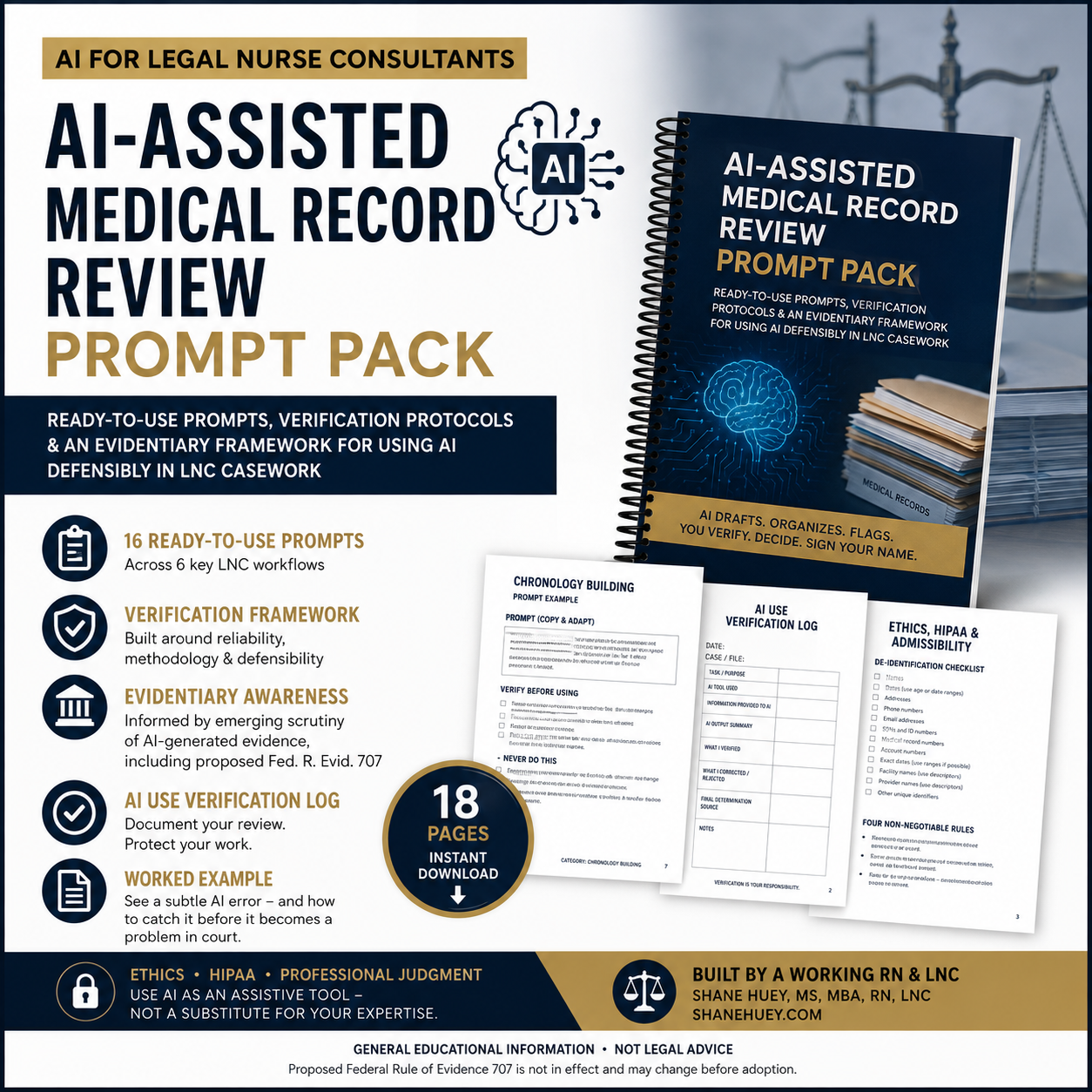
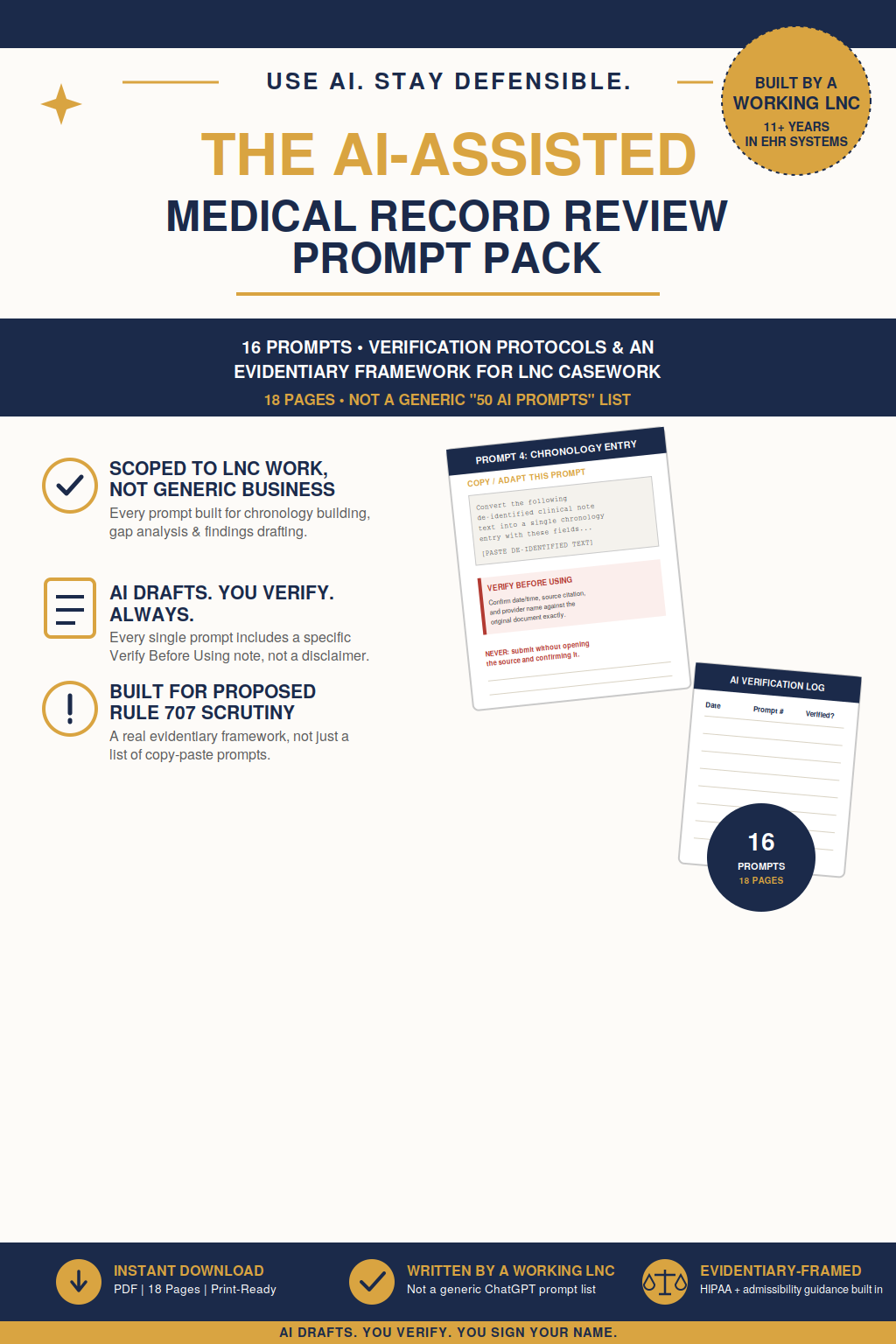
THE AI-ASSISTED MEDICAL RECORD REVIEW PROMPT PACK
Ready-to-Use Prompts, Verification Protocols & an Evidentiary Framework for Using AI Defensibly in LNC Casework
Most AI prompt packs are generic — the same 50 prompts sold to marketers, students, and small business owners with a new cover slapped on. This one isn't. Every prompt in this pack is scoped specifically to legal nurse consulting work, built around a real evidentiary framework, and written by a working legal and forensic nurse consultant — not adapted from a general-purpose template.
This guide exists because of something most LNCs using AI right now haven't thought through. A proposed new Federal Rule of Evidence — Rule 707 — would specifically require AI-generated evidence offered without an expert witness to meet the same reliability standards as expert testimony. It isn't in effect yet, and won't be before December 1, 2027 at the earliest — but the federal judiciary is actively working through exactly the questions this guide is built around: reliability, methodology, and verification for AI-generated evidence. Whether or not this specific rule is ultimately adopted, that scrutiny isn't going away. This pack teaches you to use AI genuinely well, inside a framework that stays defensible either way.
WHAT'S INSIDE (18 PAGES):
Why This Guide Exists
The real evidentiary context behind why AI discipline matters now — including a real federal case, decided under existing evidentiary standards (not the proposed Rule 707), that shows exactly the kind of scrutiny this new rule would formalize into a specific, named requirement.
Ethics, HIPAA & Admissibility — Read This Before Prompt 1
A genuine de-identification checklist, four non-negotiable rules governing every prompt in this pack, and the same Daubert-standard framework I hold every input to in my own practice — not a boilerplate disclaimer.
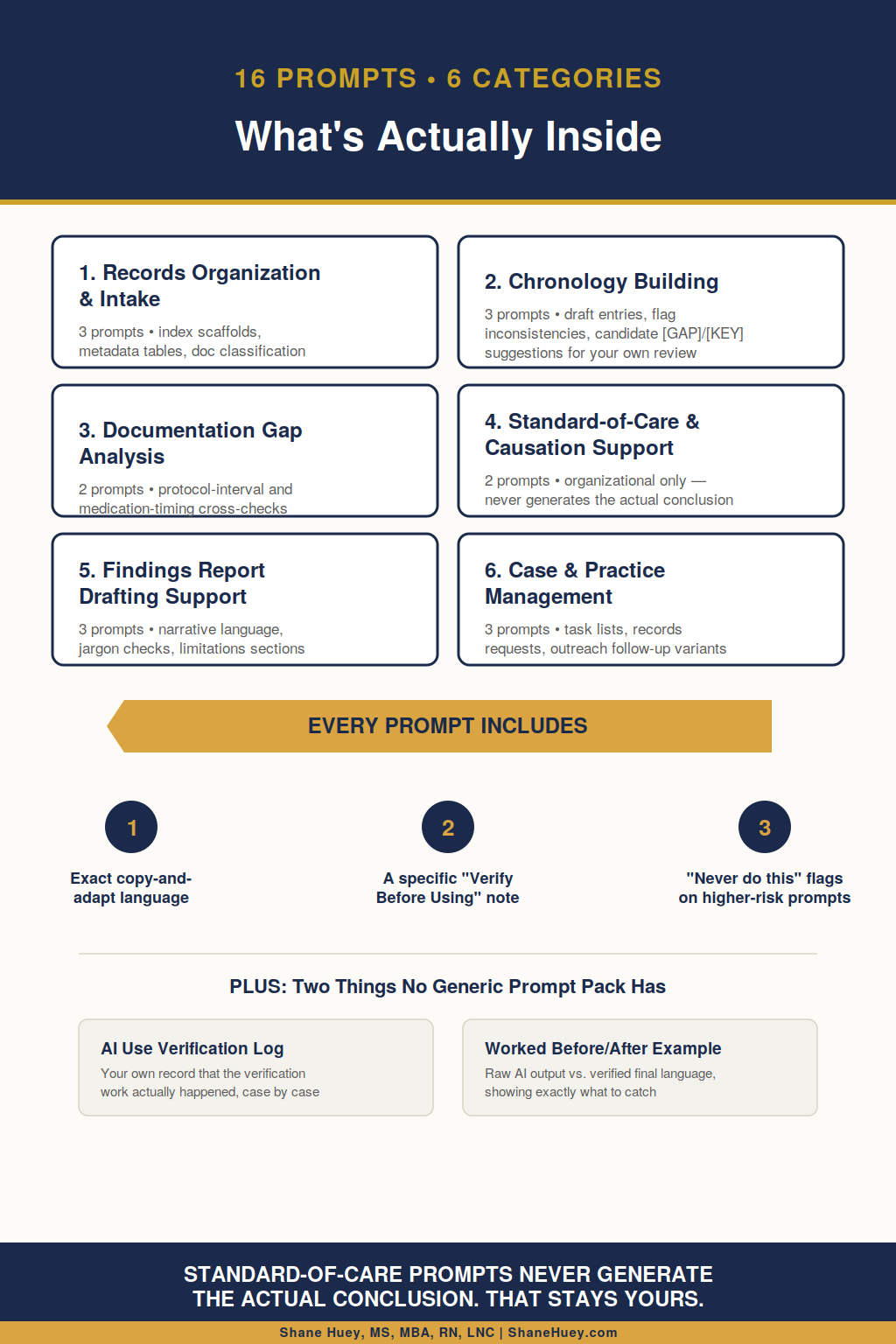
16 Ready-to-Use Prompts Across 6 Categories:
Records Organization & Intake
Chronology Building
Documentation Gap Analysis
Standard-of-Care & Causation Support (organizational support only — never asks AI to generate the actual clinical or legal conclusion)
Findings Report Drafting Support
Case & Practice Management
Every single prompt includes:
The exact copy-and-adapt language
A "Verify Before Using" note specific to that prompt's actual risk points — not a generic warning
"Never do this" callouts on the higher-risk prompts
Plus:
An AI Use Verification Log — your own record that the verification work actually happened
A worked before/after example showing the exact kind of subtle, confident AI error that gets expert reports excluded from court
WHY THIS IS DIFFERENT
This isn't a course teaching you to let AI think for you. Every prompt is built around one rule: AI drafts, organizes, and flags. You verify, decide, and sign your name. The standard-of-care prompts in particular are scoped so AI can never generate the actual clinical determination — that stays yours, always, by design.
WHAT YOU GET
The complete 18-page guide as an instant-download PDF
16 fully-developed prompts, ready to copy and adapt
Print-ready formatting
LICENSE
For personal, non-commercial use. Please don't share or redistribute — if a colleague wants a copy, send them to the listing.
A NOTE ON SCOPE
This guide offers general educational information about using AI tools in LNC work. It is not legal advice and does not constitute a HIPAA compliance determination. Verify current requirements in your own jurisdiction.
WRITTEN BY
Shane Huey, MS, MBA, RN, LNC — ShaneHuey.com
Instant digital download. No physical item will be shipped.
No results found
No results match your search. Try removing a few filters.