 Image 1 of 1
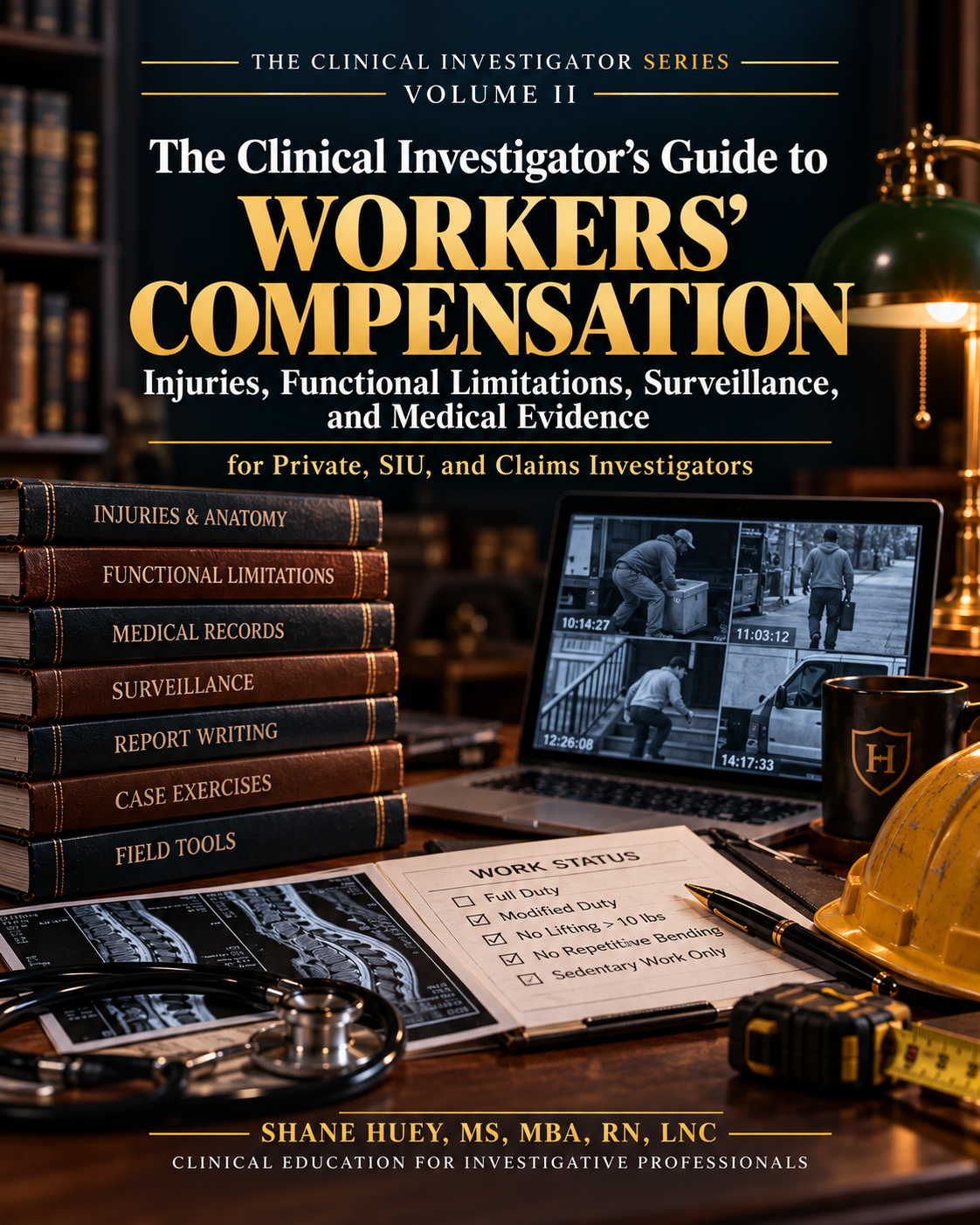
The Clinical Investigator’s Guide to Workers’ Compensation
The Clinical Investigator’s Guide to Workers’ Compensation
Injuries, Functional Limitations, Surveillance, and Medical Evidence for Private, SIU, and Claims Investigators
A 100-page professional field guide for investigators who need to understand the medical evidence behind a workers’ compensation claim — and document observations that can actually be used by attorneys, claims professionals, and medical experts.
You’ve been assigned surveillance on an injured worker.
The file says lumbar radiculopathy, 10-pound lifting restriction, no repetitive bending, and modified duty.
What should you actually be looking for?
And, just as importantly, what can you legitimately conclude from what you observe?
The Clinical Investigator’s Guide to Workers’ Compensation bridges the gap between the medical record and the field investigation.
This is not a guide to “catching fakers.”
It is a guide to producing better evidence.
Understand the Injury Before You Investigate the Activity
Workers’ compensation surveillance can generate hours of video and still fail to answer the question that matters.
Why?
Because surveillance without a question produces footage. Surveillance with a question produces evidence.
An investigator who understands the medical context knows that:
Lifting an object does not prove an injury has healed.
Driving does not automatically establish an ability to tolerate prolonged sitting.
Walking without a cane on one occasion does not establish that an assistive device is medically unnecessary.
Performing an activity once does not establish the ability to perform it repeatedly throughout a workday.
This guide teaches you to approach surveillance with a defined clinical question rather than simply waiting for something interesting to happen.
Learn What Matters in the Medical File
A workers’ compensation file can contain diagnoses, restrictions, therapy notes, imaging findings, work-status forms, functional assessments, impairment ratings, and disability determinations.
They do not all mean the same thing.
Learn to distinguish among:
Diagnosis · Symptoms · Restrictions · Function · Work capacity · Recovery · Maximum medical improvement · Impairment · Disability
The guide shows you how to extract the information most relevant to an investigation and translate it into useful investigative questions.
A restriction such as “no lifting over 10 pounds” is not simply a yes-or-no test.
A useful investigation considers:
What object was handled?
How was it handled?
Which extremity was used?
How far was it carried?
How often was the activity repeated?
How reliably can the object's weight be established?
That is the difference between recording activity and developing evidence.
A Practical Guide to Common Workplace Injuries
Dedicated chapters examine injuries investigators commonly encounter, including:
Low back injuries · Cervical spine injuries · Shoulder injuries · Knee injuries · Hip and lower-extremity injuries · Hand, wrist, elbow, and upper-extremity injuries · Head injury and concussion · Repetitive stress and cumulative trauma · Crush injuries, fractures, burns, and serious trauma · Psychological and psychiatric claims
Each injury chapter follows the same practical framework:
Anatomy → Mechanism → Symptoms → Evaluation → Treatment → Restrictions → Functional Effects → Activities to Observe → What the Observation May Establish → What It Cannot Establish → Questions for Expert Review
You don't need to become a clinician.
You need enough clinical understanding to recognize what may matter and what you should not assume.
Turn Surveillance Into Better Evidence
The guide examines how to document functional activity involving:
Lifting and carrying · Walking and gait · Bending and reaching · Driving and sitting · Stairs and climbing · Assistive devices · Repetitive activity · Recreational and employment activity
It also addresses one of the most common weaknesses in investigative reports:
interpretive language disguised as observation.
Instead of:
“Subject demonstrated normal gait.”
Document what actually occurred.
Instead of:
“Subject lifted the object without difficulty.”
Document the object, movement, duration, distance, repetition, pauses, and body mechanics you could actually observe.
Instead of:
“Claimant appeared pain free.”
Describe the observable behavior and leave the medical interpretation to the appropriate expert.
Words such as normal, pain free, full range of motion, strong, disabled, malingering, effortlessly, obviously, and inconsistent with injury can imply conclusions the investigator may not be qualified to make.
This guide teaches you how to replace them with objective, defensible observations.
Apparent Inconsistency Is Not Automatically Fraud
An observation may appear inconsistent with something in the medical record.
That can be important.
But it does not automatically establish fraud, malingering, exaggeration, or absence of injury.
There may be differences in:
Duration · Repetition · Medication · Recovery stage · Environmental conditions · Symptom variability · The precise restriction in effect · What happened before or after the observed activity
The investigator's job is to identify and preserve a potentially relevant inconsistency.
The appropriate expert determines its medical significance.
That distinction makes your investigative work more credible, not less.
Connect the Medical Record to the Surveillance
One of the central methods in the guide is the Medical Record–Surveillance Correlation Matrix.
It organizes:
Medical evidence → Documented limitation → Observed activity → What the observation establishes → What requires expert interpretation
The final column contains questions, not answers.
That structure helps transform surveillance from isolated footage into evidence that can be meaningfully reviewed by attorneys, physicians, nurses, therapists, vocational experts, claims professionals, and other specialists.
Write Reports Experts Can Actually Use
The strongest surveillance report does more than describe where someone went.
It preserves functional evidence.
Learn to document:
Time · Duration · Distance · Frequency · Repetition · Object handled · Body part used · Assistive devices · Pauses · Changes in activity · Environmental context
The objective is not to write the medical expert's conclusion.
It is to give the expert better evidence from which to reach one.
Practice With 10 Case Exercises
The guide includes ten practical exercises involving:
Shoulder restrictions · Lumbar injury and yard work · Knee injury and stairs · Carpal tunnel and tool use · Ankle injury and walking · Concussion and social activity · Cervical injury and driving · Cane use · Repetitive-use restrictions · Lifting restrictions
Each case challenges you to separate:
What you know.
What you observed.
What you can reasonably document.
What still requires expert interpretation.
Includes 8 Professional Field Tools
The guide also includes reusable tools for actual investigative work:
Clinical Surveillance Preparation Sheet
Functional Observation Worksheet
Medical Record–Surveillance Correlation Matrix
Expert Review Referral Sheet
Injury → Function → Observation Matrix
Objective Language Checklist
Words Investigators Should Avoid
Workers’ Compensation Medical Abbreviation Sheet
These turn the guide from something you simply read into a working investigative reference.
Who This Guide Is For
Designed primarily for private investigators conducting workers’ compensation and insurance investigations, with practical value for:
SIU investigators · insurance investigators · claims investigators · fraud investigators · surveillance investigators · litigation investigators · claims professionals · legal investigators · attorneys and paralegals
It is particularly useful for investigators who regularly receive medical records or work-status documentation but have little or no formal clinical training.
Five Distinctions Every Investigator Should Remember
The record is not the event.
Observation is not interpretation.
Diagnosis is not disability.
Activity is not work capacity.
Apparent inconsistency is not fraud.
Those distinctions form the evidence discipline behind the entire guide.
The Clinical Investigator Series · Volume II
100-page digital field guide · PDF format · Immediate access
Pairs with Volume I: Medical Terminology for Private Investigators, which provides the medical vocabulary, anatomy, record terminology, imaging concepts, and clinical foundation behind this guide.
Volume I asks: What does the medical evidence mean?
Volume II asks: What should I look for, how should I document it, and what can I legitimately conclude?
Observe function. Document behavior. Preserve context. Let the appropriate expert interpret the medical significance.
For professional education and investigative reference. This guide does not provide medical or legal advice. Workers’ compensation laws, investigative licensing requirements, surveillance rules, and privacy requirements vary by jurisdiction.
The Clinical Investigator’s Guide to Workers’ Compensation
Injuries, Functional Limitations, Surveillance, and Medical Evidence for Private, SIU, and Claims Investigators
A 100-page professional field guide for investigators who need to understand the medical evidence behind a workers’ compensation claim — and document observations that can actually be used by attorneys, claims professionals, and medical experts.
You’ve been assigned surveillance on an injured worker.
The file says lumbar radiculopathy, 10-pound lifting restriction, no repetitive bending, and modified duty.
What should you actually be looking for?
And, just as importantly, what can you legitimately conclude from what you observe?
The Clinical Investigator’s Guide to Workers’ Compensation bridges the gap between the medical record and the field investigation.
This is not a guide to “catching fakers.”
It is a guide to producing better evidence.
Understand the Injury Before You Investigate the Activity
Workers’ compensation surveillance can generate hours of video and still fail to answer the question that matters.
Why?
Because surveillance without a question produces footage. Surveillance with a question produces evidence.
An investigator who understands the medical context knows that:
Lifting an object does not prove an injury has healed.
Driving does not automatically establish an ability to tolerate prolonged sitting.
Walking without a cane on one occasion does not establish that an assistive device is medically unnecessary.
Performing an activity once does not establish the ability to perform it repeatedly throughout a workday.
This guide teaches you to approach surveillance with a defined clinical question rather than simply waiting for something interesting to happen.
Learn What Matters in the Medical File
A workers’ compensation file can contain diagnoses, restrictions, therapy notes, imaging findings, work-status forms, functional assessments, impairment ratings, and disability determinations.
They do not all mean the same thing.
Learn to distinguish among:
Diagnosis · Symptoms · Restrictions · Function · Work capacity · Recovery · Maximum medical improvement · Impairment · Disability
The guide shows you how to extract the information most relevant to an investigation and translate it into useful investigative questions.
A restriction such as “no lifting over 10 pounds” is not simply a yes-or-no test.
A useful investigation considers:
What object was handled?
How was it handled?
Which extremity was used?
How far was it carried?
How often was the activity repeated?
How reliably can the object's weight be established?
That is the difference between recording activity and developing evidence.
A Practical Guide to Common Workplace Injuries
Dedicated chapters examine injuries investigators commonly encounter, including:
Low back injuries · Cervical spine injuries · Shoulder injuries · Knee injuries · Hip and lower-extremity injuries · Hand, wrist, elbow, and upper-extremity injuries · Head injury and concussion · Repetitive stress and cumulative trauma · Crush injuries, fractures, burns, and serious trauma · Psychological and psychiatric claims
Each injury chapter follows the same practical framework:
Anatomy → Mechanism → Symptoms → Evaluation → Treatment → Restrictions → Functional Effects → Activities to Observe → What the Observation May Establish → What It Cannot Establish → Questions for Expert Review
You don't need to become a clinician.
You need enough clinical understanding to recognize what may matter and what you should not assume.
Turn Surveillance Into Better Evidence
The guide examines how to document functional activity involving:
Lifting and carrying · Walking and gait · Bending and reaching · Driving and sitting · Stairs and climbing · Assistive devices · Repetitive activity · Recreational and employment activity
It also addresses one of the most common weaknesses in investigative reports:
interpretive language disguised as observation.
Instead of:
“Subject demonstrated normal gait.”
Document what actually occurred.
Instead of:
“Subject lifted the object without difficulty.”
Document the object, movement, duration, distance, repetition, pauses, and body mechanics you could actually observe.
Instead of:
“Claimant appeared pain free.”
Describe the observable behavior and leave the medical interpretation to the appropriate expert.
Words such as normal, pain free, full range of motion, strong, disabled, malingering, effortlessly, obviously, and inconsistent with injury can imply conclusions the investigator may not be qualified to make.
This guide teaches you how to replace them with objective, defensible observations.
Apparent Inconsistency Is Not Automatically Fraud
An observation may appear inconsistent with something in the medical record.
That can be important.
But it does not automatically establish fraud, malingering, exaggeration, or absence of injury.
There may be differences in:
Duration · Repetition · Medication · Recovery stage · Environmental conditions · Symptom variability · The precise restriction in effect · What happened before or after the observed activity
The investigator's job is to identify and preserve a potentially relevant inconsistency.
The appropriate expert determines its medical significance.
That distinction makes your investigative work more credible, not less.
Connect the Medical Record to the Surveillance
One of the central methods in the guide is the Medical Record–Surveillance Correlation Matrix.
It organizes:
Medical evidence → Documented limitation → Observed activity → What the observation establishes → What requires expert interpretation
The final column contains questions, not answers.
That structure helps transform surveillance from isolated footage into evidence that can be meaningfully reviewed by attorneys, physicians, nurses, therapists, vocational experts, claims professionals, and other specialists.
Write Reports Experts Can Actually Use
The strongest surveillance report does more than describe where someone went.
It preserves functional evidence.
Learn to document:
Time · Duration · Distance · Frequency · Repetition · Object handled · Body part used · Assistive devices · Pauses · Changes in activity · Environmental context
The objective is not to write the medical expert's conclusion.
It is to give the expert better evidence from which to reach one.
Practice With 10 Case Exercises
The guide includes ten practical exercises involving:
Shoulder restrictions · Lumbar injury and yard work · Knee injury and stairs · Carpal tunnel and tool use · Ankle injury and walking · Concussion and social activity · Cervical injury and driving · Cane use · Repetitive-use restrictions · Lifting restrictions
Each case challenges you to separate:
What you know.
What you observed.
What you can reasonably document.
What still requires expert interpretation.
Includes 8 Professional Field Tools
The guide also includes reusable tools for actual investigative work:
Clinical Surveillance Preparation Sheet
Functional Observation Worksheet
Medical Record–Surveillance Correlation Matrix
Expert Review Referral Sheet
Injury → Function → Observation Matrix
Objective Language Checklist
Words Investigators Should Avoid
Workers’ Compensation Medical Abbreviation Sheet
These turn the guide from something you simply read into a working investigative reference.
Who This Guide Is For
Designed primarily for private investigators conducting workers’ compensation and insurance investigations, with practical value for:
SIU investigators · insurance investigators · claims investigators · fraud investigators · surveillance investigators · litigation investigators · claims professionals · legal investigators · attorneys and paralegals
It is particularly useful for investigators who regularly receive medical records or work-status documentation but have little or no formal clinical training.
Five Distinctions Every Investigator Should Remember
The record is not the event.
Observation is not interpretation.
Diagnosis is not disability.
Activity is not work capacity.
Apparent inconsistency is not fraud.
Those distinctions form the evidence discipline behind the entire guide.
The Clinical Investigator Series · Volume II
100-page digital field guide · PDF format · Immediate access
Pairs with Volume I: Medical Terminology for Private Investigators, which provides the medical vocabulary, anatomy, record terminology, imaging concepts, and clinical foundation behind this guide.
Volume I asks: What does the medical evidence mean?
Volume II asks: What should I look for, how should I document it, and what can I legitimately conclude?
Observe function. Document behavior. Preserve context. Let the appropriate expert interpret the medical significance.
For professional education and investigative reference. This guide does not provide medical or legal advice. Workers’ compensation laws, investigative licensing requirements, surveillance rules, and privacy requirements vary by jurisdiction.