 Image 1 of 1
The Evidence Discipline Collection
The Evidence Discipline Collection
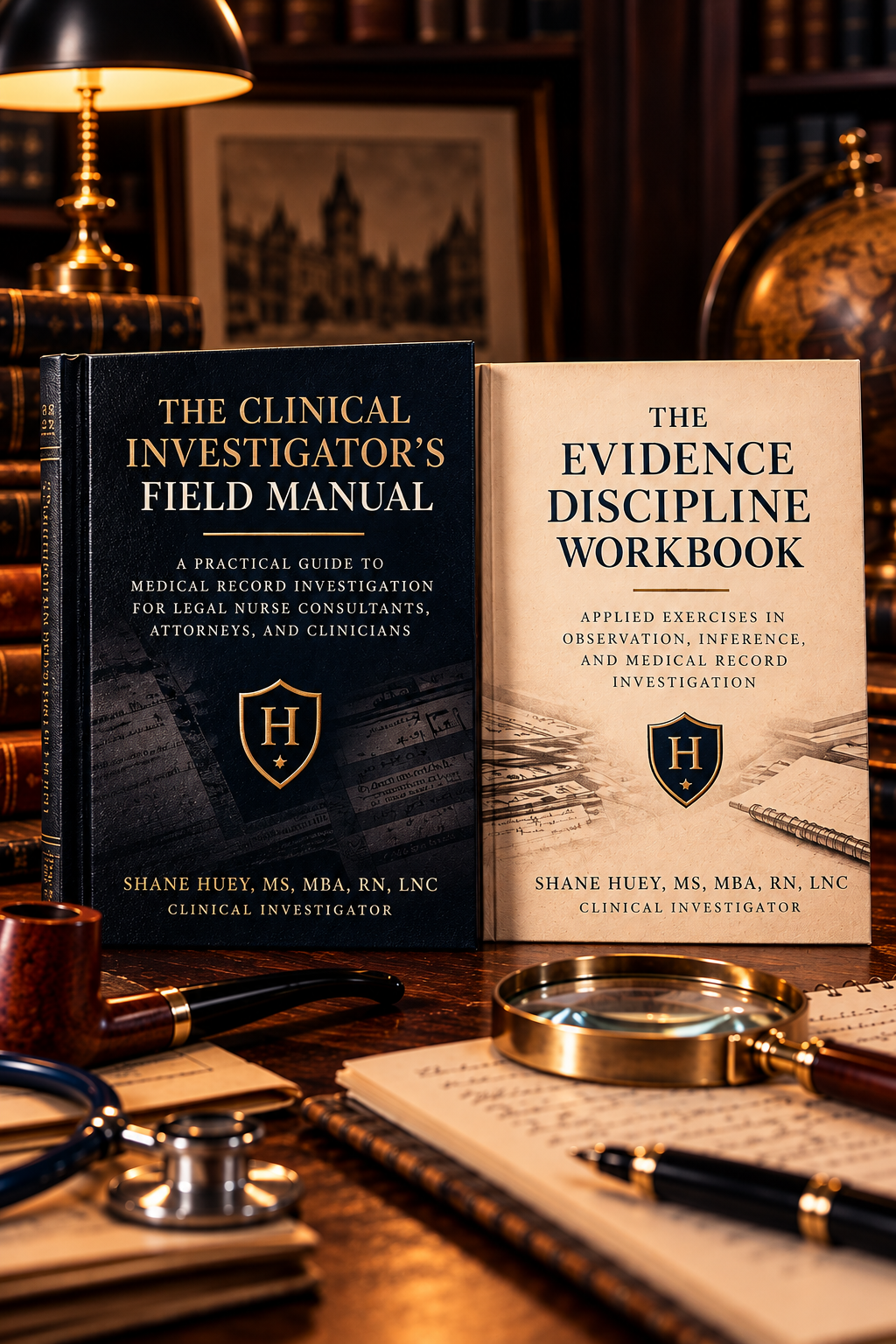
The Clinical Investigator’s Field Manual + The Evidence Discipline Workbook
Medical-record review is not simply finding information in a chart. It is determining what the record actually establishes, what can reasonably be inferred from it, what remains only a hypothesis, and what the available evidence does not permit you to conclude.
The Evidence Discipline Collection is a two-part professional training system designed for legal nurse consultants, clinical investigators, nurses, advanced practice clinicians, attorneys, and other professionals who analyze medical records in clinical, legal, and investigative settings.
Rather than teaching you simply what to look for, this collection focuses on how to think about what you find.
At its foundation is The Clinical Investigator’s Field Manual, a practical framework for disciplined medical-record investigation. It develops the reasoning skills necessary to move beyond passive chart review and approach the record as evidence — examining chronology, provenance, inconsistencies, missing information, documentation patterns, EHR behavior, competing explanations, and the limits of what the available record can support.
The Field Manual emphasizes a critical distinction that is easily lost during complex case review:
Observation is not inference. Inference is not hypothesis. Hypothesis is not conclusion.
Knowing where one ends and the next begins can profoundly affect the accuracy and defensibility of an analysis.
The companion Evidence Discipline Workbook turns those principles into deliberate practice. Through structured exercises and record-review problems, you will practice separating documented facts from interpretation, identifying unsupported assumptions, generating competing hypotheses, recognizing evidentiary gaps, testing conclusions, and communicating findings with appropriate precision.
Together, the two resources create a learn-and-apply system:
Learn the investigative method in the Field Manual. Practice the method in the Workbook. Carry the discipline into your own cases.
This collection is particularly useful for professionals who work with records involving questions of standard of care, chronology, causation, documentation discrepancies, medication administration, clinical decision-making, EHR workflows, metadata and audit trails, or other situations in which what appears in the chart may not tell the entire story.
The goal is not to teach reviewers to reach more dramatic conclusions.
It is to teach them to reach better-supported ones.
Because a strong clinical investigator must be able to tell counsel not only:
Here is what I found.
But also:
Here is what the record establishes.
Here is what it suggests.
Here is what it does not establish.
Here is what remains unknown.
And here is what I would investigate next.
Included in the Collection
The Clinical Investigator’s Field Manual
A practical reference for approaching medical records as investigative evidence, with an emphasis on observation, inference, hypothesis formation, verification, documentary inconsistencies, evidentiary limits, and disciplined clinical reasoning.
The Evidence Discipline Workbook
A companion practice resource designed to move those concepts off the page and into actual reasoning through structured exercises that challenge you to observe carefully, question assumptions, distinguish fact from interpretation, and defend only what the available evidence supports.
Who It’s For
Legal nurse consultants • Registered nurses • Nurse practitioners and physician assistants • Physicians • Attorneys • Medical-record reviewers • Clinical and forensic investigators
Two resources. One investigative discipline.
Don’t just review the record. Learn to interrogate it.
The Evidence Discipline Collection
The Clinical Investigator’s Field Manual + The Evidence Discipline Workbook
Medical-record review is not simply finding information in a chart. It is determining what the record actually establishes, what can reasonably be inferred from it, what remains only a hypothesis, and what the available evidence does not permit you to conclude.
The Evidence Discipline Collection is a two-part professional training system designed for legal nurse consultants, clinical investigators, nurses, advanced practice clinicians, attorneys, and other professionals who analyze medical records in clinical, legal, and investigative settings.
Rather than teaching you simply what to look for, this collection focuses on how to think about what you find.
At its foundation is The Clinical Investigator’s Field Manual, a practical framework for disciplined medical-record investigation. It develops the reasoning skills necessary to move beyond passive chart review and approach the record as evidence — examining chronology, provenance, inconsistencies, missing information, documentation patterns, EHR behavior, competing explanations, and the limits of what the available record can support.
The Field Manual emphasizes a critical distinction that is easily lost during complex case review:
Observation is not inference. Inference is not hypothesis. Hypothesis is not conclusion.
Knowing where one ends and the next begins can profoundly affect the accuracy and defensibility of an analysis.
The companion Evidence Discipline Workbook turns those principles into deliberate practice. Through structured exercises and record-review problems, you will practice separating documented facts from interpretation, identifying unsupported assumptions, generating competing hypotheses, recognizing evidentiary gaps, testing conclusions, and communicating findings with appropriate precision.
Together, the two resources create a learn-and-apply system:
Learn the investigative method in the Field Manual. Practice the method in the Workbook. Carry the discipline into your own cases.
This collection is particularly useful for professionals who work with records involving questions of standard of care, chronology, causation, documentation discrepancies, medication administration, clinical decision-making, EHR workflows, metadata and audit trails, or other situations in which what appears in the chart may not tell the entire story.
The goal is not to teach reviewers to reach more dramatic conclusions.
It is to teach them to reach better-supported ones.
Because a strong clinical investigator must be able to tell counsel not only:
Here is what I found.
But also:
Here is what the record establishes.
Here is what it suggests.
Here is what it does not establish.
Here is what remains unknown.
And here is what I would investigate next.
Included in the Collection
The Clinical Investigator’s Field Manual
A practical reference for approaching medical records as investigative evidence, with an emphasis on observation, inference, hypothesis formation, verification, documentary inconsistencies, evidentiary limits, and disciplined clinical reasoning.
The Evidence Discipline Workbook
A companion practice resource designed to move those concepts off the page and into actual reasoning through structured exercises that challenge you to observe carefully, question assumptions, distinguish fact from interpretation, and defend only what the available evidence supports.
Who It’s For
Legal nurse consultants • Registered nurses • Nurse practitioners and physician assistants • Physicians • Attorneys • Medical-record reviewers • Clinical and forensic investigators
Two resources. One investigative discipline.
Don’t just review the record. Learn to interrogate it.