 Image 1 of 1
The Chart Files: Case 001 — The 14:06 Administration | LNC Medical Record Investigation
Think you know how to read a medical record? Prove it.
The Chart Files is a series of realistic, case-based medical-record investigations created specifically for Legal Nurse Consultants.
If you've ever worked through Hunt A Killer, Unsolved Case Files, Deadbolt Mystery Society, or another investigative mystery experience, you'll recognize the basic idea:
You're given the evidence. You work the case. You decide what the evidence supports.
The Chart Files brings that concept into the world of Legal Nurse Consulting — without turning medical-record review into a game.
Instead of fictional police reports and crime-scene clues, you'll work with the evidence LNCs actually encounter: medication administration records, physician orders, nursing documentation, flowsheets, audit trails, laboratory results, device data, and more.
There are no hidden ciphers. No contrived riddles. No cheesy “gotcha” clues.
The medical record is the puzzle.
The documents, patients, clinicians, and facilities are fictional, but the problems you'll encounter are rooted in the realities of healthcare, EHR documentation, medical-legal investigation, and the kinds of evidentiary questions that arise in actual case review.
For experienced LNCs, The Chart Files is an opportunity to put your investigative skills to the test.
For new and aspiring LNCs, it's something even harder to find:
A case to work before someone pays you to work theirs.
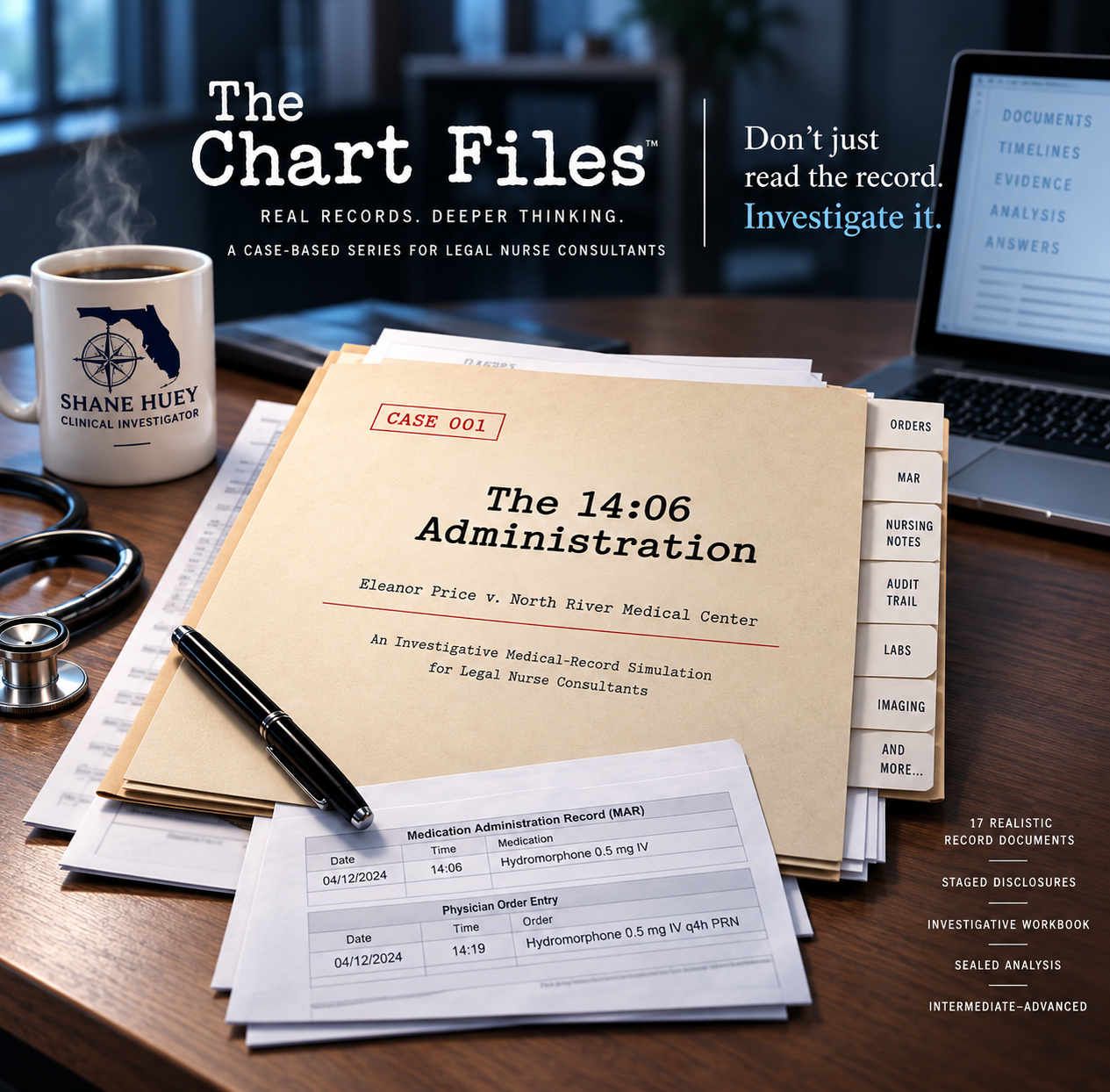
CASE 001: THE 14:06 ADMINISTRATION
A 67-year-old postoperative patient experiences a serious opioid-related respiratory event.
The Medication Administration Record shows hydromorphone 0.5 mg IV administered at 14:06.
There's a problem.
The physician order appears to have been entered at 14:19.
Plaintiff counsel wants answers:
Was hydromorphone administered before it was ordered?
Did that medication contribute to the patient's subsequent respiratory deterioration?
At first glance, the medical record appears to tell a straightforward story.
Don't be so sure.
YOUR ASSIGNMENT
You've been retained to conduct a preliminary medical-record review.
You'll receive a 37-page investigative case file containing an Investigator Workbook, 17 realistic medical-record documents, staged supplemental evidence, and a sealed Investigator's Analysis.
But you don't get everything at once.
The investigation unfolds in stages. You'll review the evidence available to you, reconstruct what happened, answer specific investigative questions, and commit to your conclusions before opening the next disclosure.
New evidence may confirm what you thought.
It may require you to revise your conclusions.
Or it may reveal that something you thought you knew was never actually established at all.
HOW THE INVESTIGATION WORKS
Stage 1 — Accept the Assignment
Receive the engagement letter from plaintiff counsel and determine exactly what you've been asked to investigate.
Stage 2 — Review the Initial Production
Work through the certified medical record as originally produced, including anesthesia documentation, postoperative orders, nursing flowsheets, the MAR, order history, nursing notes, Rapid Response documentation, laboratory results, imaging, physician documentation, and discharge records.
Stage 3 — Checkpoint One
Reconstruct the timeline. Identify the important evidence. Commit to your preliminary findings.
Stage 4 — Supplemental Disclosure
Counsel obtains additional electronic evidence. Review the newly produced EHR audit data and determine whether it changes the meaning of anything you've already seen.
Stage 5 — Checkpoint Two
Interrogate your original conclusions. Defend them, modify them, or abandon them based on the evidence now available.
Stage 6 — Biomedical Evidence
A final source of clinical data becomes available.
Stage 7 — The Final Challenge
Counsel calls.
You have 60 seconds to explain what the evidence actually supports.
Stage 8 — Break the Seal
Only after completing the investigation do you open the Investigator's Analysis and compare your reasoning with the case analysis.
THIS ISN'T A “SPOT THE ERROR” WORKSHEET.
The central discipline of The Chart Files is learning to separate four very different things:
DOCUMENTED FACT
What does the available evidence directly establish?
INFERENCE
What can reasonably be concluded from one or more observations?
HYPOTHESIS
What explanation fits the evidence but still requires additional evidence?
UNKNOWN
What does the available record simply not permit you to determine?
Because a plausible explanation is not necessarily an established fact.
And something appearing in the medical record doesn't necessarily mean what you initially think it means.
Your job isn't to construct the most persuasive story. Your job is to determine what the evidence permits you to say.
SKILLS YOU'LL PUT TO WORK
Case 001 challenges you to apply and sharpen skills including:
Timeline reconstruction
Medication-administration analysis
EHR documentation and audit trails
Source provenance
Observation versus inference
Negative evidence
Competing hypotheses
Recognition of missing information
Corroboration and contradiction
Revision of conclusions as new evidence emerges
And throughout the investigation, you'll confront a deceptively simple question:
What does a timestamp actually prove?
FOR EXPERIENCED LNCs
You review medical records professionally.
But how often do you get to test your own investigative process when nothing is riding on the outcome?
Case 001 gives you that opportunity.
Can you distinguish the record from the event the record supposedly represents?
Can you recognize when multiple documents aren't actually independent corroboration?
Can you identify assumptions hiding inside apparently factual conclusions?
Can you resist premature closure when the evidence seems obvious?
And, perhaps most importantly:
Can you change your mind when the evidence changes?
Put your process under pressure and find out.
FOR NEW AND ASPIRING LNCs
One of the great problems facing a new Legal Nurse Consultant is simple:
How do you become good at reviewing cases before you have cases to review?
Courses can teach concepts. Books can explain methodology. Sample reports can show you the finished product.
But eventually, you have to sit down with a medical record and do the work yourself.
The Chart Files gives you that opportunity in a controlled environment.
No client is waiting.
No attorney is depending on your answer.
No real patient's case is at stake.
You can investigate, make mistakes, reconsider your assumptions, and compare your reasoning with the Investigator's Analysis afterward.
A case to work before someone pays you to work theirs.
CASE FILE SPECIFICATIONS
Case: 001 — The 14:06 Administration
Matter: Eleanor Price v. North River Medical Center
Difficulty: Intermediate–Advanced
Estimated Investigation Time: 60–90 minutes
Case File: 37 pages
Evidence: 17 medical-record documents
Format: Digital PDF
Includes: Investigator Workbook + Sealed Investigator's Analysis
Designed For: Legal Nurse Consultants and medical-record reviewers
All patients, clinicians, facilities, and events portrayed in the simulation are fictional.
THIS IS CASE 001.
The 14:06 Administration is the first investigation in The Chart Files.
Future cases will bring new medical records, new clinical scenarios, new documentation problems, and new evidentiary challenges — each designed to develop the investigative reasoning behind sophisticated medical-record review.
Not simply:
What does the chart say?
But:
What does the evidence establish?
What am I inferring?
What else could explain it?
What should be present if my hypothesis is correct?
What's missing?
That's the difference between simply reading the medical record and investigating it.
Don't just read the record. Investigate it.
Open Case 001.
The record is waiting.
Digital download. Instant access.
Think you know how to read a medical record? Prove it.
The Chart Files is a series of realistic, case-based medical-record investigations created specifically for Legal Nurse Consultants.
If you've ever worked through Hunt A Killer, Unsolved Case Files, Deadbolt Mystery Society, or another investigative mystery experience, you'll recognize the basic idea:
You're given the evidence. You work the case. You decide what the evidence supports.
The Chart Files brings that concept into the world of Legal Nurse Consulting — without turning medical-record review into a game.
Instead of fictional police reports and crime-scene clues, you'll work with the evidence LNCs actually encounter: medication administration records, physician orders, nursing documentation, flowsheets, audit trails, laboratory results, device data, and more.
There are no hidden ciphers. No contrived riddles. No cheesy “gotcha” clues.
The medical record is the puzzle.
The documents, patients, clinicians, and facilities are fictional, but the problems you'll encounter are rooted in the realities of healthcare, EHR documentation, medical-legal investigation, and the kinds of evidentiary questions that arise in actual case review.
For experienced LNCs, The Chart Files is an opportunity to put your investigative skills to the test.
For new and aspiring LNCs, it's something even harder to find:
A case to work before someone pays you to work theirs.
CASE 001: THE 14:06 ADMINISTRATION
A 67-year-old postoperative patient experiences a serious opioid-related respiratory event.
The Medication Administration Record shows hydromorphone 0.5 mg IV administered at 14:06.
There's a problem.
The physician order appears to have been entered at 14:19.
Plaintiff counsel wants answers:
Was hydromorphone administered before it was ordered?
Did that medication contribute to the patient's subsequent respiratory deterioration?
At first glance, the medical record appears to tell a straightforward story.
Don't be so sure.
YOUR ASSIGNMENT
You've been retained to conduct a preliminary medical-record review.
You'll receive a 37-page investigative case file containing an Investigator Workbook, 17 realistic medical-record documents, staged supplemental evidence, and a sealed Investigator's Analysis.
But you don't get everything at once.
The investigation unfolds in stages. You'll review the evidence available to you, reconstruct what happened, answer specific investigative questions, and commit to your conclusions before opening the next disclosure.
New evidence may confirm what you thought.
It may require you to revise your conclusions.
Or it may reveal that something you thought you knew was never actually established at all.
HOW THE INVESTIGATION WORKS
Stage 1 — Accept the Assignment
Receive the engagement letter from plaintiff counsel and determine exactly what you've been asked to investigate.
Stage 2 — Review the Initial Production
Work through the certified medical record as originally produced, including anesthesia documentation, postoperative orders, nursing flowsheets, the MAR, order history, nursing notes, Rapid Response documentation, laboratory results, imaging, physician documentation, and discharge records.
Stage 3 — Checkpoint One
Reconstruct the timeline. Identify the important evidence. Commit to your preliminary findings.
Stage 4 — Supplemental Disclosure
Counsel obtains additional electronic evidence. Review the newly produced EHR audit data and determine whether it changes the meaning of anything you've already seen.
Stage 5 — Checkpoint Two
Interrogate your original conclusions. Defend them, modify them, or abandon them based on the evidence now available.
Stage 6 — Biomedical Evidence
A final source of clinical data becomes available.
Stage 7 — The Final Challenge
Counsel calls.
You have 60 seconds to explain what the evidence actually supports.
Stage 8 — Break the Seal
Only after completing the investigation do you open the Investigator's Analysis and compare your reasoning with the case analysis.
THIS ISN'T A “SPOT THE ERROR” WORKSHEET.
The central discipline of The Chart Files is learning to separate four very different things:
DOCUMENTED FACT
What does the available evidence directly establish?
INFERENCE
What can reasonably be concluded from one or more observations?
HYPOTHESIS
What explanation fits the evidence but still requires additional evidence?
UNKNOWN
What does the available record simply not permit you to determine?
Because a plausible explanation is not necessarily an established fact.
And something appearing in the medical record doesn't necessarily mean what you initially think it means.
Your job isn't to construct the most persuasive story. Your job is to determine what the evidence permits you to say.
SKILLS YOU'LL PUT TO WORK
Case 001 challenges you to apply and sharpen skills including:
Timeline reconstruction
Medication-administration analysis
EHR documentation and audit trails
Source provenance
Observation versus inference
Negative evidence
Competing hypotheses
Recognition of missing information
Corroboration and contradiction
Revision of conclusions as new evidence emerges
And throughout the investigation, you'll confront a deceptively simple question:
What does a timestamp actually prove?
FOR EXPERIENCED LNCs
You review medical records professionally.
But how often do you get to test your own investigative process when nothing is riding on the outcome?
Case 001 gives you that opportunity.
Can you distinguish the record from the event the record supposedly represents?
Can you recognize when multiple documents aren't actually independent corroboration?
Can you identify assumptions hiding inside apparently factual conclusions?
Can you resist premature closure when the evidence seems obvious?
And, perhaps most importantly:
Can you change your mind when the evidence changes?
Put your process under pressure and find out.
FOR NEW AND ASPIRING LNCs
One of the great problems facing a new Legal Nurse Consultant is simple:
How do you become good at reviewing cases before you have cases to review?
Courses can teach concepts. Books can explain methodology. Sample reports can show you the finished product.
But eventually, you have to sit down with a medical record and do the work yourself.
The Chart Files gives you that opportunity in a controlled environment.
No client is waiting.
No attorney is depending on your answer.
No real patient's case is at stake.
You can investigate, make mistakes, reconsider your assumptions, and compare your reasoning with the Investigator's Analysis afterward.
A case to work before someone pays you to work theirs.
CASE FILE SPECIFICATIONS
Case: 001 — The 14:06 Administration
Matter: Eleanor Price v. North River Medical Center
Difficulty: Intermediate–Advanced
Estimated Investigation Time: 60–90 minutes
Case File: 37 pages
Evidence: 17 medical-record documents
Format: Digital PDF
Includes: Investigator Workbook + Sealed Investigator's Analysis
Designed For: Legal Nurse Consultants and medical-record reviewers
All patients, clinicians, facilities, and events portrayed in the simulation are fictional.
THIS IS CASE 001.
The 14:06 Administration is the first investigation in The Chart Files.
Future cases will bring new medical records, new clinical scenarios, new documentation problems, and new evidentiary challenges — each designed to develop the investigative reasoning behind sophisticated medical-record review.
Not simply:
What does the chart say?
But:
What does the evidence establish?
What am I inferring?
What else could explain it?
What should be present if my hypothesis is correct?
What's missing?
That's the difference between simply reading the medical record and investigating it.
Don't just read the record. Investigate it.
Open Case 001.
The record is waiting.
Digital download. Instant access.