 Image 1 of 1
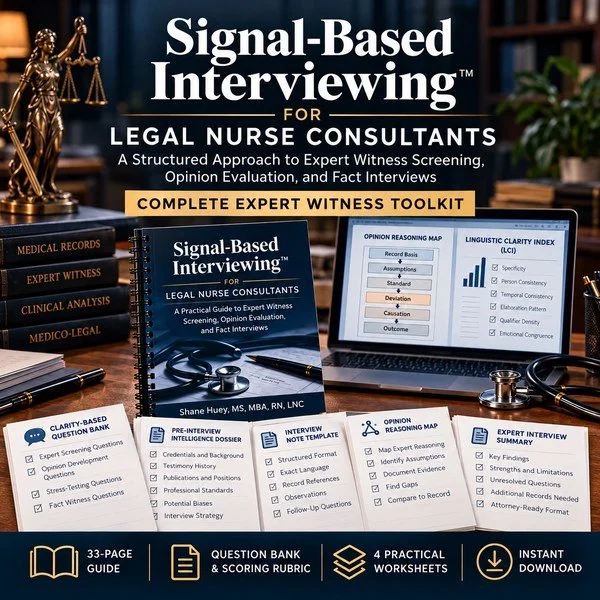
Signal-Based Interviewing™ for Legal Nurse Consultants | Complete Expert Witness Toolkit
Your Expert's Credentials Are Impressive. But Can Their Opinion Withstand Scrutiny?
You've reviewed the curriculum vitae. Verified the credentials. Examined the publications and testimony history.
The expert appears qualified.
But qualifications are only the beginning.
What happens when the expert's opinion is compared against the actual medical record?
Can the expert identify the documentation supporting each conclusion? Distinguish established facts from assumptions? Explain the clinical reasoning connecting a deviation from the standard of care to the alleged outcome?
And can you identify weaknesses in that reasoning before they become problems during deposition or litigation?
That's the problem Signal-Based Interviewing™ was designed to address.
Introducing Signal-Based Interviewing™ for Legal Nurse Consultants
A structured, evidence-focused approach to interviewing experts and witnesses in medico-legal investigations.
Developed by Shane Huey, MS, MBA, RN, LNC, Signal-Based Interviewing (SBI) provides legal nurse consultants with a repeatable framework for preparing, conducting, documenting, and analyzing investigative interviews.
Rather than relying on general impressions, SBI emphasizes observable language, documented reasoning, clinical records, and independent corroboration.
The methodology addresses three essential areas of legal nurse consulting:
1. Expert Witness Screening
Move beyond credentials and experience to explore how prospective experts approach clinical records, articulate professional standards, and develop opinions.
2. Expert Opinion Development and Evaluation
Examine the factual foundation, assumptions, clinical standards, alleged deviations, causation reasoning, and outcomes supporting an expert's conclusions.
3. Client, Patient, and Fact Witness Interviews
Use structured, non-leading questions to document accounts, identify areas requiring clarification, and compare material statements against the available clinical record.
The result is a more systematic investigative process — one that helps you ask better questions, identify evidentiary gaps, and communicate meaningful findings to the retaining attorney.
Two Complementary Tools. One Structured Method.
The Linguistic Clarity Index (LCI)
Evaluate how an account or opinion is expressed.
The LCI provides a structured observational framework for documenting six dimensions of interview language:
Specificity
Person Consistency
Temporal Consistency
Elaboration Pattern
Qualifier Density
Emotional Congruence
For expert interviews, these dimensions are adapted to examine record anchoring, opinion ownership, chronology, reasoning, certainty calibration, and advocacy.
The LCI helps organize observations and identify areas requiring further questioning.
Important: The LCI is an author-developed observational rubric, not a validated test of deception, credibility, clinical competence, or opinion reliability. Its numerical ratings and categories are provisional organizational tools.
The Opinion Reasoning Map
Evaluate what an expert's opinion actually rests on.
The Opinion Reasoning Map organizes expert analysis around six interconnected elements:
Record Basis → Assumptions → Standard → Deviation → Causation → Outcome
Use this framework to:
Identify unsupported or contradicted assumptions.
Examine whether conclusions are grounded in specific clinical records.
Distinguish professional standards from personal preferences.
Identify missing evidence and unresolved questions.
Examine competing explanations and limitations.
Document findings for attorney review.
The framework is informed by the reliability considerations associated with expert testimony, including Federal Rule of Evidence 702, while recognizing that admissibility decisions belong to the court and legal strategy belongs to the attorney.
The goal isn't to replace professional judgment. It's to make the investigative process more structured, transparent, and documented.
What's Included in the Complete SBI™ Expert Witness Toolkit?
Your digital download includes seven professional resources, plus a brief introductory README.
What You'll Receive
1. SBI™ for Legal Nurse Consultants — Complete Guide A 33-page guide covering the methodology, expert screening, opinion evaluation, fact interviews, documentation, professional boundaries, and a worked clinical example.
2. Clarity-Based Question Bank Structured interview questions for expert screening, retained opinion development, stress-testing, and fact witnesses, with explanations of how the questions are framed.
3. Linguistic Clarity Index Scoring Rubric Behaviorally anchored scoring criteria, expert and fact-witness examples, and printable scoring and profile sheets.
4. Worksheet A — Pre-Interview Intelligence Dossier A six-domain framework for investigating prospective experts, documenting sources, and developing interview questions.
5. Worksheet B — Interview Note Template A structured template for capturing responses, exact language, record references, and observations during interviews.
6. Worksheet C — Opinion Reasoning Map A practical tool for mapping opinion support, documenting assumptions, identifying reasoning gaps, and aligning witness accounts with records.
7. Worksheet D — Expert Interview Summary A structured format for presenting documented findings, unresolved questions, and additional records needed to the retaining attorney.
Bonus: A Read Me First document explains how the resources work together and recommends a workflow for each interview type.
All materials are provided as downloadable PDFs. Worksheets are designed for US Letter printing.
Who Is This Toolkit For?
The SBI™ Expert Witness Toolkit is designed for practicing legal nurse consultants who participate in expert witness screening, clinical case analysis, or investigative interviews.
It is particularly relevant for LNCs who:
Screen or evaluate prospective expert witnesses.
Assist attorneys with expert opinion development.
Review medical malpractice and professional negligence cases.
Interview clients, patients, family members, or fact witnesses.
Identify inconsistencies between statements and medical documentation.
Prepare structured investigative findings for attorney review.
Experience level: Intermediate to advanced.
Familiarity with medical records, professional negligence litigation, and expert witness practice is recommended.
Why Add SBI™ to Your Investigative Workflow?
Replace Impressions With Documented Observations
Move beyond statements such as “The expert seemed confident” or “The witness was vague.”
SBI emphasizes observable statements, supporting quotations, record references, and clearly documented analytical findings.
Identify Reasoning Gaps Before They Become Litigation Problems
A polished explanation can still contain unsupported assumptions, overlooked documentation, or incomplete clinical reasoning.
The Opinion Reasoning Map helps you identify where additional examination is warranted.
Ask Questions That Reveal More
Learn to structure questions that encourage detailed responses without unnecessarily signaling the desired answer.
Connect Witness Accounts to Clinical Evidence
Document what witnesses report, identify where their accounts align or conflict with the medical record, and determine what additional evidence may be needed.
Create a Repeatable Professional Workflow
Use a consistent approach to interview preparation, evidence capture, post-interview analysis, and attorney reporting.
Better questions. Clearer documentation. More disciplined clinical investigation.
Developed for the Realities of Medico-Legal Practice
Signal-Based Interviewing™ was developed by Shane Huey, MS, MBA, RN, LNC, a forensic nurse consultant, legal nurse consultant, and applied forensic linguist.
The methodology combines structured interviewing, clinical record analysis, linguistic observation, and documented evaluation of expert reasoning.
Unlike general interview guides, this edition focuses specifically on the challenges legal nurse consultants encounter when evaluating expert opinions and gathering factual information in healthcare litigation.
The guide includes a fictional clinical negligence case demonstrating how a qualified expert's initial opinion can contain assumptions that require further record review and clarification.
What's the Difference Between the Guide and the Complete Toolkit?
The guide explains the methodology. The complete toolkit helps you apply it.
The standalone guide provides the conceptual framework, instructions, and worked examples.
The complete bundle adds the question bank, detailed scoring rubric, and four structured worksheets needed to incorporate SBI into an investigative workflow.
If you want to implement SBI in your legal nurse consulting practice, the Complete Expert Witness Toolkit is the recommended option.
Digital Download Details
Format: PDF
Delivery: Digital download
Included: 8 PDF files (7 professional resources + README)
Printing: US Letter worksheets, suitable for black-and-white printing
Physical shipment: None required
Professional Use Notice: These materials are educational resources for qualified professionals. SBI does not determine deception, credibility, clinical competence, expert admissibility, or legal liability. The Linguistic Clarity Index has not undergone formal empirical validation. Users remain responsible for exercising independent professional judgment and working within applicable legal, ethical, and professional requirements.
Go Beyond the Expert's CV.
Develop a more structured approach to interviewing experts, evaluating opinions, and documenting the evidence behind clinical conclusions.
Get the complete Signal-Based Interviewing™ Expert Witness Toolkit and bring a consistent investigative framework to your next expert interview.
Download the Complete SBI™ Toolkit
Your Expert's Credentials Are Impressive. But Can Their Opinion Withstand Scrutiny?
You've reviewed the curriculum vitae. Verified the credentials. Examined the publications and testimony history.
The expert appears qualified.
But qualifications are only the beginning.
What happens when the expert's opinion is compared against the actual medical record?
Can the expert identify the documentation supporting each conclusion? Distinguish established facts from assumptions? Explain the clinical reasoning connecting a deviation from the standard of care to the alleged outcome?
And can you identify weaknesses in that reasoning before they become problems during deposition or litigation?
That's the problem Signal-Based Interviewing™ was designed to address.
Introducing Signal-Based Interviewing™ for Legal Nurse Consultants
A structured, evidence-focused approach to interviewing experts and witnesses in medico-legal investigations.
Developed by Shane Huey, MS, MBA, RN, LNC, Signal-Based Interviewing (SBI) provides legal nurse consultants with a repeatable framework for preparing, conducting, documenting, and analyzing investigative interviews.
Rather than relying on general impressions, SBI emphasizes observable language, documented reasoning, clinical records, and independent corroboration.
The methodology addresses three essential areas of legal nurse consulting:
1. Expert Witness Screening
Move beyond credentials and experience to explore how prospective experts approach clinical records, articulate professional standards, and develop opinions.
2. Expert Opinion Development and Evaluation
Examine the factual foundation, assumptions, clinical standards, alleged deviations, causation reasoning, and outcomes supporting an expert's conclusions.
3. Client, Patient, and Fact Witness Interviews
Use structured, non-leading questions to document accounts, identify areas requiring clarification, and compare material statements against the available clinical record.
The result is a more systematic investigative process — one that helps you ask better questions, identify evidentiary gaps, and communicate meaningful findings to the retaining attorney.
Two Complementary Tools. One Structured Method.
The Linguistic Clarity Index (LCI)
Evaluate how an account or opinion is expressed.
The LCI provides a structured observational framework for documenting six dimensions of interview language:
Specificity
Person Consistency
Temporal Consistency
Elaboration Pattern
Qualifier Density
Emotional Congruence
For expert interviews, these dimensions are adapted to examine record anchoring, opinion ownership, chronology, reasoning, certainty calibration, and advocacy.
The LCI helps organize observations and identify areas requiring further questioning.
Important: The LCI is an author-developed observational rubric, not a validated test of deception, credibility, clinical competence, or opinion reliability. Its numerical ratings and categories are provisional organizational tools.
The Opinion Reasoning Map
Evaluate what an expert's opinion actually rests on.
The Opinion Reasoning Map organizes expert analysis around six interconnected elements:
Record Basis → Assumptions → Standard → Deviation → Causation → Outcome
Use this framework to:
Identify unsupported or contradicted assumptions.
Examine whether conclusions are grounded in specific clinical records.
Distinguish professional standards from personal preferences.
Identify missing evidence and unresolved questions.
Examine competing explanations and limitations.
Document findings for attorney review.
The framework is informed by the reliability considerations associated with expert testimony, including Federal Rule of Evidence 702, while recognizing that admissibility decisions belong to the court and legal strategy belongs to the attorney.
The goal isn't to replace professional judgment. It's to make the investigative process more structured, transparent, and documented.
What's Included in the Complete SBI™ Expert Witness Toolkit?
Your digital download includes seven professional resources, plus a brief introductory README.
What You'll Receive
1. SBI™ for Legal Nurse Consultants — Complete Guide A 33-page guide covering the methodology, expert screening, opinion evaluation, fact interviews, documentation, professional boundaries, and a worked clinical example.
2. Clarity-Based Question Bank Structured interview questions for expert screening, retained opinion development, stress-testing, and fact witnesses, with explanations of how the questions are framed.
3. Linguistic Clarity Index Scoring Rubric Behaviorally anchored scoring criteria, expert and fact-witness examples, and printable scoring and profile sheets.
4. Worksheet A — Pre-Interview Intelligence Dossier A six-domain framework for investigating prospective experts, documenting sources, and developing interview questions.
5. Worksheet B — Interview Note Template A structured template for capturing responses, exact language, record references, and observations during interviews.
6. Worksheet C — Opinion Reasoning Map A practical tool for mapping opinion support, documenting assumptions, identifying reasoning gaps, and aligning witness accounts with records.
7. Worksheet D — Expert Interview Summary A structured format for presenting documented findings, unresolved questions, and additional records needed to the retaining attorney.
Bonus: A Read Me First document explains how the resources work together and recommends a workflow for each interview type.
All materials are provided as downloadable PDFs. Worksheets are designed for US Letter printing.
Who Is This Toolkit For?
The SBI™ Expert Witness Toolkit is designed for practicing legal nurse consultants who participate in expert witness screening, clinical case analysis, or investigative interviews.
It is particularly relevant for LNCs who:
Screen or evaluate prospective expert witnesses.
Assist attorneys with expert opinion development.
Review medical malpractice and professional negligence cases.
Interview clients, patients, family members, or fact witnesses.
Identify inconsistencies between statements and medical documentation.
Prepare structured investigative findings for attorney review.
Experience level: Intermediate to advanced.
Familiarity with medical records, professional negligence litigation, and expert witness practice is recommended.
Why Add SBI™ to Your Investigative Workflow?
Replace Impressions With Documented Observations
Move beyond statements such as “The expert seemed confident” or “The witness was vague.”
SBI emphasizes observable statements, supporting quotations, record references, and clearly documented analytical findings.
Identify Reasoning Gaps Before They Become Litigation Problems
A polished explanation can still contain unsupported assumptions, overlooked documentation, or incomplete clinical reasoning.
The Opinion Reasoning Map helps you identify where additional examination is warranted.
Ask Questions That Reveal More
Learn to structure questions that encourage detailed responses without unnecessarily signaling the desired answer.
Connect Witness Accounts to Clinical Evidence
Document what witnesses report, identify where their accounts align or conflict with the medical record, and determine what additional evidence may be needed.
Create a Repeatable Professional Workflow
Use a consistent approach to interview preparation, evidence capture, post-interview analysis, and attorney reporting.
Better questions. Clearer documentation. More disciplined clinical investigation.
Developed for the Realities of Medico-Legal Practice
Signal-Based Interviewing™ was developed by Shane Huey, MS, MBA, RN, LNC, a forensic nurse consultant, legal nurse consultant, and applied forensic linguist.
The methodology combines structured interviewing, clinical record analysis, linguistic observation, and documented evaluation of expert reasoning.
Unlike general interview guides, this edition focuses specifically on the challenges legal nurse consultants encounter when evaluating expert opinions and gathering factual information in healthcare litigation.
The guide includes a fictional clinical negligence case demonstrating how a qualified expert's initial opinion can contain assumptions that require further record review and clarification.
What's the Difference Between the Guide and the Complete Toolkit?
The guide explains the methodology. The complete toolkit helps you apply it.
The standalone guide provides the conceptual framework, instructions, and worked examples.
The complete bundle adds the question bank, detailed scoring rubric, and four structured worksheets needed to incorporate SBI into an investigative workflow.
If you want to implement SBI in your legal nurse consulting practice, the Complete Expert Witness Toolkit is the recommended option.
Digital Download Details
Format: PDF
Delivery: Digital download
Included: 8 PDF files (7 professional resources + README)
Printing: US Letter worksheets, suitable for black-and-white printing
Physical shipment: None required
Professional Use Notice: These materials are educational resources for qualified professionals. SBI does not determine deception, credibility, clinical competence, expert admissibility, or legal liability. The Linguistic Clarity Index has not undergone formal empirical validation. Users remain responsible for exercising independent professional judgment and working within applicable legal, ethical, and professional requirements.
Go Beyond the Expert's CV.
Develop a more structured approach to interviewing experts, evaluating opinions, and documenting the evidence behind clinical conclusions.
Get the complete Signal-Based Interviewing™ Expert Witness Toolkit and bring a consistent investigative framework to your next expert interview.
Download the Complete SBI™ Toolkit