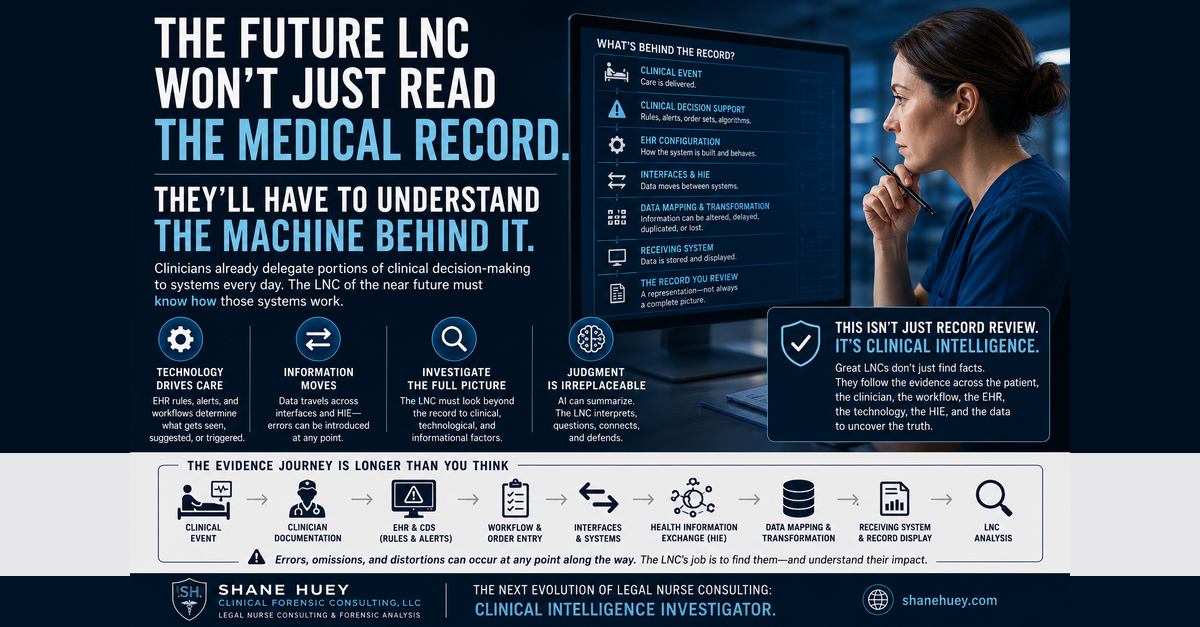
The Future LNC Won’t Just Read the Medical Record. They’ll Have to Understand the Machine Behind It.
I've been thinking about where legal nurse consulting is headed.
And I don't think the biggest change is going to be AI.
I think AI is only one part of a much larger shift.
The medical record is no longer simply a record of what clinicians did.
Increasingly, it is the product of people, workflows, algorithms, decision-support rules, EHR configuration, interfaces, health information exchange, alerts, automation, and clinical judgment.
And here's the part I think the LNC profession needs to pay much more attention to:
Clinicians are already delegating portions of clinical decision-making to these systems.
Not because clinicians are incapable of making decisions.
Because modern healthcare is too complex to function without technology helping determine what information gets surfaced, what gets flagged, what orders get suggested, what protocols get activated, and what actions get placed into a clinician's workflow.
That changes what it means to investigate a medical record.
And I think the LNC of the near future is going to need to understand the technology behind the record almost as well as they understand the clinical events documented within it.

The Interview Gap in Legal Nurse Consulting: What most LNCs were never trained to do — and why it shows up earliest at case viability
Legal nurse consultants are trained to read a medical record with more rigor than almost anyone else in the legal process. We know how to spot a gap in nursing documentation, reconcile a medication administration record against a physician's order, and reconstruct a timeline from scattered chart entries. That training is real, and it's the core of what makes an LNC valuable.
What most of us were never trained to do is evaluate the language of the people involved in a case — the client describing what happened, the witness recounting an event, the patient explaining a symptom history. We're taught to read charts. We're rarely taught to read interviews.
That gap doesn't show up in the parts of the job that look like nursing. It shows up earliest and most consequentially in the parts that look like law: the initial case viability review, and every interview that follows it.