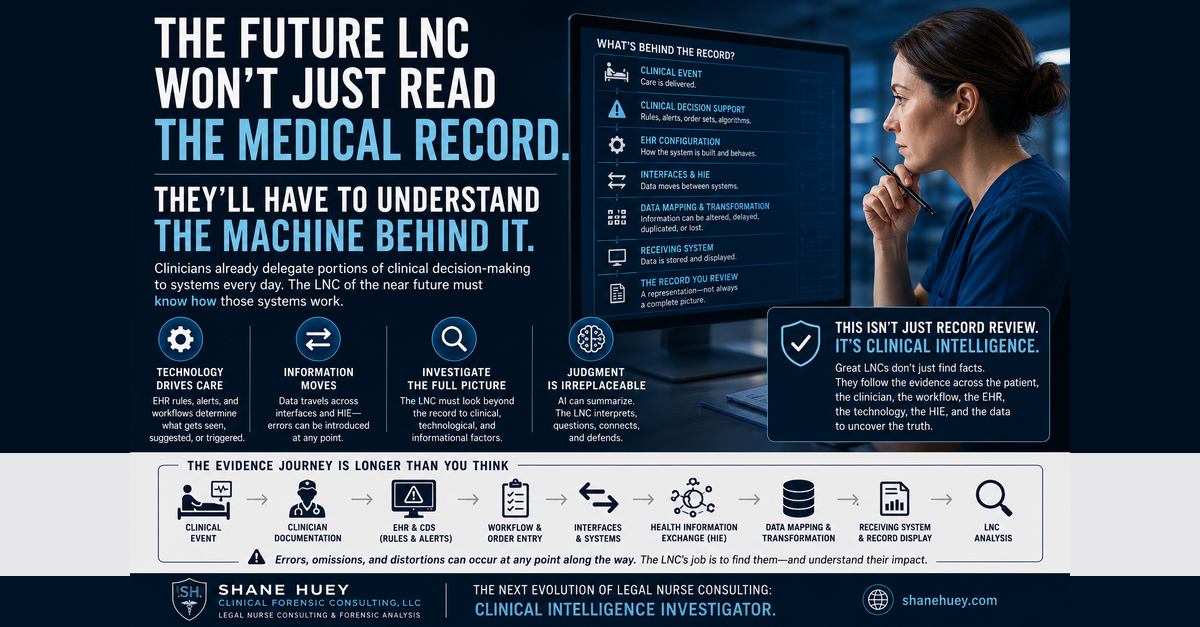
The Future LNC Won’t Just Read the Medical Record. They’ll Have to Understand the Machine Behind It.
I've been thinking about where legal nurse consulting is headed.
And I don't think the biggest change is going to be AI.
I think AI is only one part of a much larger shift.
The medical record is no longer simply a record of what clinicians did.
Increasingly, it is the product of people, workflows, algorithms, decision-support rules, EHR configuration, interfaces, health information exchange, alerts, automation, and clinical judgment.
And here's the part I think the LNC profession needs to pay much more attention to:
Clinicians are already delegating portions of clinical decision-making to these systems.
Not because clinicians are incapable of making decisions.
Because modern healthcare is too complex to function without technology helping determine what information gets surfaced, what gets flagged, what orders get suggested, what protocols get activated, and what actions get placed into a clinician's workflow.
That changes what it means to investigate a medical record.
And I think the LNC of the near future is going to need to understand the technology behind the record almost as well as they understand the clinical events documented within it.
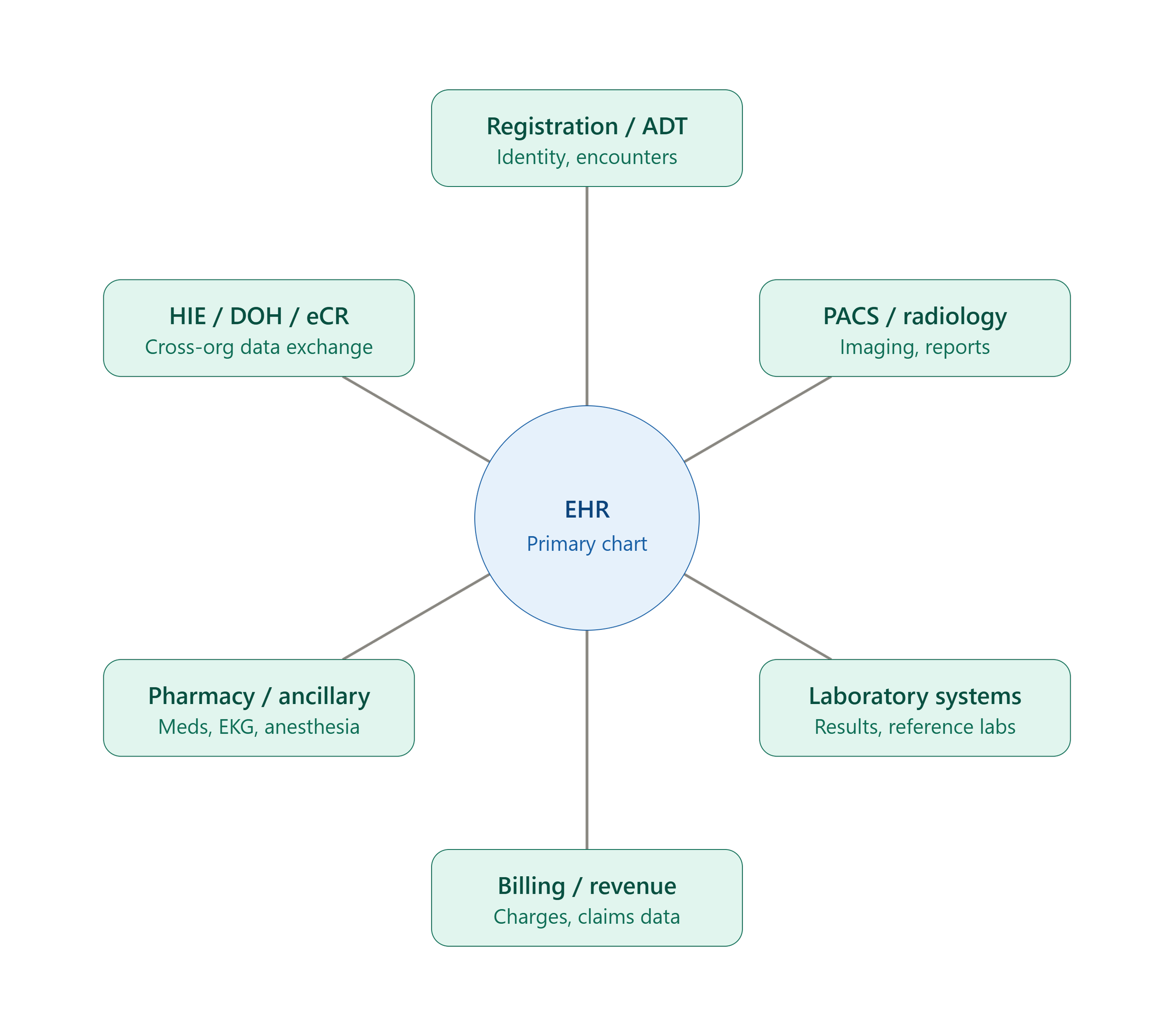
There Is No Such Thing as "The EHR": Why Attorneys and LNCs Need to Understand Clinical Systems Architecture
Ask most attorneys what a hospital's medical record looks like, and the mental picture is simple: one system, one login, one complete chart. Request the records, get the printout or the CD, done.
That picture is wrong — and in a case involving a serious injury, a missed diagnosis, or a documentation dispute, that wrong picture can cost you.
Yes, most healthcare organizations run a single primary electronic health record (EHR) platform — an Epic, an Oracle Health (Cerner), a MEDITECH. But the EHR is the hub, not the whole wheel. Around it sits a constellation of separate, specialized systems — some fully integrated, some only loosely connected, some barely connected at all. Understanding that architecture, at a conceptual level, is one of the most underused skills in medical-legal record review.