SIGNAL BASED INTERVIEWING — INTRODUCTORY COURSE
Stop guessing.
Start reading the signal.
Most behavioral interview frameworks were built to make candidates feel comfortable. This course teaches you to analyze what candidates actually say — and what that language reveals about how they think, communicate, and perform under pressure.
Instant access · Self-paced · Certificate of completion
THE PROBLEM
Behavioral interviews are broken.
Candidates rehearse STAR answers until they're indistinguishable from strong performers
Generic competency questions reward confident delivery, not actual capability
Gut-feel hiring decisions expose organizations to legal and operational risk
Post-hire surprises — underperformance, ethics violations — trace back to interview blind spots
The issue isn't the candidate. It's the framework. You were trained to listen for content, not structure — and language structure is where the signal lives.
THE COST OF GETTING IT WRONG
One bad hire costs more than this course by a factor of 100.
The research is consistent across industries: mis-hires are expensive, slow to surface, and almost always traceable to the interview process.
30%
of annual salary lost per mis-hire, on average
U.S. Dept. of Labor estimate
$17K
average cost of a single bad hire across all roles
SHRM / CareerBuilder research
74%
of employers say they've made a bad hire due to interview failure
CareerBuilder survey
6–9 mo
salary equivalent to replace a mid-level employee
SHRM turnover data
For a role paying $60,000, a single mis-hire conservatively costs $18,000–$54,000 in recruiting, onboarding, lost productivity, and separation. The SBI Intro Course is $297.
ILLUSTRATIVE ROI — ONE PREVENTED MIS-HIRE PER YEAR
Conservative mis-hire cost (mid-level role) − -$18,000
Course investment − -$297
Net return on one prevented hire +$17,703
Figures based on published SHRM and U.S. Department of Labor research. Individual results vary by role, industry, and organization size. The LCI methodology is a structured analytical tool — not a guarantee of hiring outcomes.
THE METHODOLOGY
The Linguistic Clarity Index (LCI)
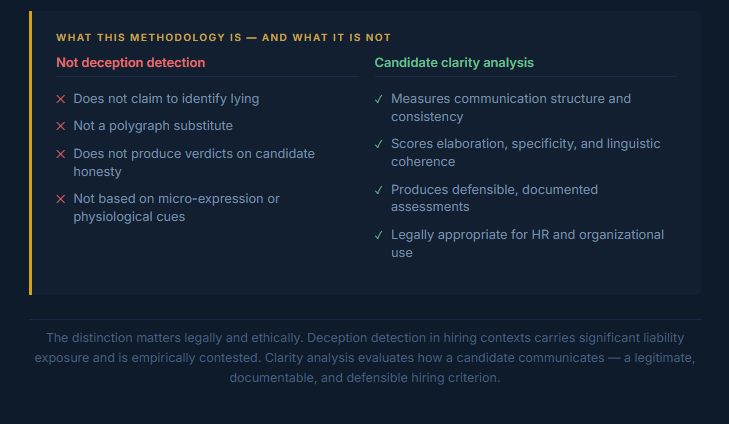
A structured scoring rubric built on forensic linguistics and statement analysis — six dimensions, each scored 1–4, applied to candidate responses in real time or from transcript.
Dimension 1
Specificity
Are details concrete and verifiable, or vague and interchangeable?
Dimension 4
Elaboration Pattern
Where does a candidate expand — and where do they compress?
Forensic linguistics
The systematic study of language as evidence — analyzing word choice, pronoun use, narrative structure, and omission patterns to understand how people communicate under cognitive load.
Dimension 5
Qualifier Density
Does hedging language cluster around specific themes or events?
Statement analysis
A discipline developed and refined by practitioners including Mark McClish and Peter Hyatt — focused on the structural integrity of verbal accounts rather than behavioral cues or physiological signals.
Investigative interviewing — PEACE model
A non-coercive framework developed for law enforcement that prioritizes information gathering over confession-seeking. The LCI borrows its structured, open-ended approach to eliciting natural language — without any of the interrogation context.
PEACE: Preparation, Engage & Explain, Account, Closure, Evaluate
Dimension 2
Person Consistency
Does pronoun use shift in ways that signal diffusion of accountability?
Dimension 3
Temporal Consistency
Does the narrative timeline hold under sequencing pressure?
Dimension 6
Emotional Congruence
Does the emotional register match the narrative content?
ABOUT THE METHODOLOGY
Built from forensic practice.
Designed for the hiring room.
Shane Huey, MS, MBA, RN
Forensic & Legal Nurse Consultant | Investigative Journalist | Private Investigator
The LCI emerged from years of applied work in forensic nursing and investigative journalism — disciplines where language is evidence and what someone omits is as significant as what they say. Trained in statement analysis methodology and forensic linguistics, the framework draws on established investigative traditions and adapts their analytical rigor for a context where the stakes are organizational rather than criminal: who you hire, and why you can defend that decision.
Behavioral analysis — Reid awareness
The Reid Technique's behavioral premise — that response patterns carry signal — informs what the LCI looks for. Its interrogation mechanics do not. The methodology draws on the observational insight while deliberately rejecting the coercive elements that make Reid inappropriate outside law enforcement.